

Maddy summaryS 3627, the Pregnant Students’ Rights Act, requires colleges and universities participating in federal student aid programs to provide clear information about pregnancy-related resources and accommodations to all enrolled students. The bill mandates annual email notifications, inclusion in student handbooks and orientations, and availability at health centers and websites, detailing campus/community resources, available accommodations, and how to file Title IX complaints. It specifically covers students planning to or currently pregnant who wish to carry a baby to term. The law focuses solely on disseminating existing information and does not create new rights or accommodations. (Bill text amended under Section 485 of the Higher Education Act.)
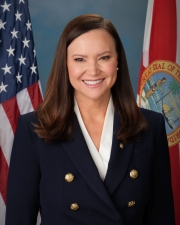
Sen. Ashley Moody
Sponsored bills
Maddy summaryS 3674, the Stop Citizenship Abuse and Misrepresentation Act (SCAM Act), expands grounds for revoking U.S. citizenship (denaturalization) for naturalized citizens who commit specific offenses within 10 years of becoming citizens. It targets individuals convicted of fraud against government programs (over $10,000), affiliation with foreign terrorist organizations, or certain aggravated felonies/espionage offenses, treating these as proof they lacked required moral character, loyalty to the Constitution, and commitment to U.S. order at the time of naturalization. If enacted, convictions would automatically trigger revocation of citizenship, treating the naturalization as void from the original date and making the person subject to deportation. The bill directly affects naturalized citizens who commit these offenses within the 10-year window, with no requirement for new evidence of pre-naturalization misconduct.
Maddy summarySRES 585 is a commemorative resolution honoring Ben Nighthorse Campbell, a former U.S. Senator from Colorado and the first Native American to chair the Senate Committee on Indian Affairs. It recognizes his military service, Olympic judo career, legislative work (including authoring the National Museum of the American Indian Act), and advocacy for tribal communities. The resolution has no policy impact - it formally expresses the Senate’s respect for his legacy, requests transmission to his family, and directs a moment of silence. It directly affects Campbell’s legacy and family, not any current policy or population. (Note: This is a procedural resolution, not a bill with legislative provisions.)
Maddy summaryThis bill requires Members of Congress and their spouses or dependent children to divest certain investments - including stocks, commodities, and futures - within 90 to 180 days of enactment or when becoming covered. It excludes common investments like U.S. Treasury bonds, diversified mutual funds, small business interests, and home-related real estate from the restrictions. Covered individuals cannot purchase new covered investments, with limited exceptions for trades tied to a spouse’s or child’s primary occupation. Violations trigger a 10% fee on the investment’s value, profit disgorgement, and public disclosure of fines.
Maddy summaryS 3650, the Child Interstate Abortion Notification Act, requires physicians performing abortions on minors traveling across state lines to provide 24 hours of "actual notice" (in person or in writing) to a parent before the procedure, or "constructive notice" (via certified mail) if actual notice isn't possible. The bill directly affects minors under 18 (not emancipated), their parents, and physicians in states where the minor resides but the abortion is performed. Key exceptions include life-threatening medical emergencies, court waivers for parental notification, documented child abuse, or when a parent accompanies the minor. Violations could lead to fines or imprisonment for those transporting minors to bypass parental involvement laws or physicians failing to comply with notification rules.
Maddy summaryThis bill would bar certain foreign nationals from entering the U.S. by making them inadmissible if they committed severe religious freedom violations while serving as foreign government officials or directly participated in such violations abroad. It specifically targets individuals who, outside the U.S., directed, supported, or carried out "particularly severe violations of religious freedom" as defined by existing law. The bill requires the State Department to publicly list the names of inadmissible individuals and the locations of violations, with limited exceptions for national security reasons where the State Department must report exclusions to Congress. This affects visa applicants and immigrants who have been involved in religious persecution, not U.S. citizens or residents.
Maddy summaryThe Stop Fraud by SOMALIA Act (S 3644) targets fraud in federal child care funding programs by creating clear standards for identifying and addressing fraudulent activity by child care providers. It defines "final determination of fraud" to include knowingly submitting false information, misrepresenting services, operating without required licensing, or improperly using funds, and mandates permanent debarment from federal child care programs for providers found to have committed fraud. The bill requires states to reimburse funds obtained through fraud and establishes immigration consequences including inadmissibility, deportability, and ineligibility for asylum for foreign child care providers convicted of fraud. It also creates expedited removal procedures for affected individuals without requiring additional hearings or inquiries.
Maddy summaryThis bill requires U.S. investors to divest from securities of Chinese military companies identified under existing defense laws. It mandates the Treasury Department to add these companies to the Non-SDN Chinese Military-Industrial Complex Companies List (NS-CMIC List) within 90 days of Defense Department identification. U.S. persons must sell such securities within one year of a company's listing on the NS-CMIC List, with the divestment period starting on the listing date. The policy implements prior executive orders and defense procurement restrictions by extending them to securities markets, directly affecting U.S. investors holding shares in listed Chinese military-linked entities.
Maddy summaryThis bill modifies tax code to help businesses in disaster-affected areas use unused tax credits. It allows businesses operating in qualified disaster zones (federally declared after 2023 or state-recognized under specific criteria) to treat certain carried-over tax credits as transferrable credits for eligible expenses. Eligible expenses include costs for business operations in these areas within two years of the disaster declaration. The change applies to tax years ending after the bill's enactment, making it easier for affected businesses to access credit benefits they previously couldn't utilize.
Maddy summaryThis bill changes U.S. immigration law to make certain fraud convictions deportable without requiring a minimum fraud loss amount. It targets immigrants (aliens) convicted of fraud against any private individual, fund, corporation, or government entity, removing the previous threshold for deportation. It also adds provisions to revoke citizenship for naturalized citizens convicted of such fraud crimes, requiring courts to cancel their naturalization certificates. The changes apply to fraud committed on or after September 30, 1996, if not previously charged before the bill's enactment.