Renewable Energy Certainty Act This bill authorizes long-term contracts for federal purchases of renewable energy and establishes related requirements. Specifically, the bill authorizes federal agencies to enter into contracts for the acquisition of energy generated from renewable energy sources or from cogeneration facilities for a period of up to 30 years. In addition, the bill requires the Federal Energy Management Program to publish a standardized energy purchase agreement that an agency may use for such an acquisition.
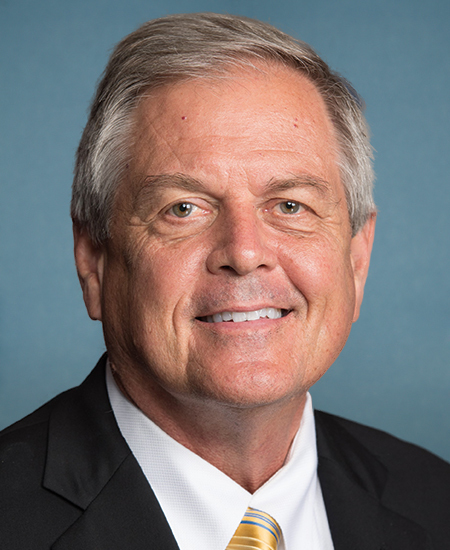
Rep. Ralph Norman
Sponsored bills
This joint resolution nullifies the action of the District of Columbia Council in approving the Minor Consent for Vaccinations Amendment Act of 2020, enacted by the council on December 23, 2020, and transmitted on February 1, 2021, to Congress pursuant to the District of Columbia Home Rule Act. The act authorizes a minor, 11 years of age or older, to consent to receive a vaccine if the minor is capable of meeting the informed consent standard and the vaccine is recommended by the United States Advisory Committee on Immunization Practices and will be provided in accordance with its recommended immunization schedule.
This resolution acknowledges the importance of the U.S.-Egypt partnership and Egypt's role in the fight against terrorism and violent extremism. It also urges the Egyptian government to (1) enact serious and legitimate reforms to ensure that Coptic Christians have the same rights and opportunities as other Egyptian citizens, (2) complete the process of church certification, and (3) take steps to end the culture of impunity for attacks on Christians.
Lessening Regulatory Costs and Establishing a Federal Regulatory Budget Act of 2021 This bill establishes procedures and provides statutory authority to reduce the number of federal regulations. Specifically, it requires each agency to establish a regulatory reform task force chaired by a designated regulatory reform officer. Each task force must, among other duties (1) review each existing agency regulation; (2) estimate the potential cost savings of repealing or modifying each regulation; and (3) identify regulations that are appropriate for repeal, replacement, or modification based on cost, effectiveness, and impact on employment. The bill further provides statutory authority for the executive order prohibiting agencies from issuing a new regulation with an economic impact of at least $100 million without identifying two regulations for repeal that will offset the cost of the proposed new regulation. Agencies also must submit a list of all planned regulatory actions for inclusion in the semiannual Unified Agenda of Federal Regulatory and Deregulatory Actions, including (1) the estimated economic effect of each action, and (2) proposed deregulatory actions to offset the cost of each proposed new regulation. Additionally, the Office of Management and Budget must establish an annual regulatory budget for each federal agency that specifies the net allowable increase in regulatory costs for each agency during the next fiscal year.
No taxpayer funding for United Nations Human Rights Council Act This bill prohibits the Department of State from making contributions to the United Nations Human Rights Council, either as a percentage of the U.S. contribution to the regular budget of the United Nations or as a voluntary contribution to the council.
No Social Security for Illegal Aliens Act of 2021 This bill prohibits an individual from collecting Social Security benefits based on wages and income earned for services illegally performed in the United States while the individual was an alien.
No Tax Breaks for Sanctuary Cities Act This bill denies a tax exclusion for the interest on bonds issued by sanctuary jurisdictions. A sanctuary jurisdiction is a governmental entity that has a statute in effect that restricts cooperation with the federal government regarding the citizenship or immigration status of any individual or that prohibits compliance with a request by the Department of Homeland Security with a detainer for, or notification about the release of, an individual.
This bill terminates the Department of Education on December 31, 2022.
Education Freedom Scholarships and Opportunity Act This bill allows individual and corporate taxpayers a tax credit for cash contributions to tax-exempt scholarship-granting organizations for elementary and secondary education expenses. It imposes a cap of $5 billion on the amount of contributions that qualify for a tax credit. The bill directs the Department of Education, in coordination with the Department of the Treasury, to establish, host, and maintain a web portal that (1) lists all eligible scholarship-granting organizations; (2) enables contributions to such organizations; (3) provides information about the benefits of this bill; and (4) enables a state to submit and update information about its programs and scholarship-granting organizations, including information on student eligibility and allowable educational expenses.
This resolution supports the designation of Career and Technical Education Month to celebrate career and technical education across the United States.