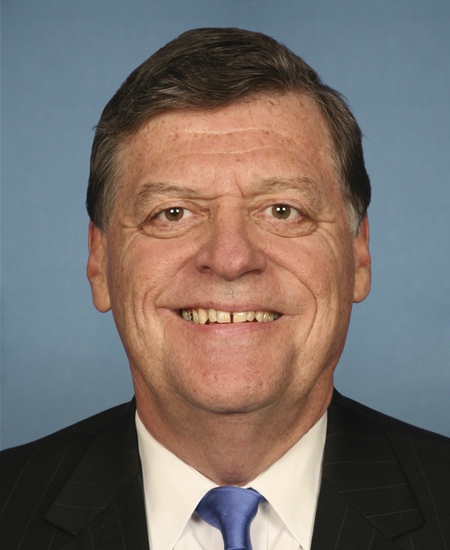
Photo of Tom Cole
R United States House · District 4 · Oklahoma On the 2026 ballot

Rep. Tom Cole

Compare
Total votes
2,837
all sessions
Attendance
98%
50 missed
Near the chamber average
With party
91%
of cast votes
Near the chamber average
Bipartisan score
5%
crosses aisle rarely
Near the chamber average
Sponsored
675
bills & resolutions
Lower than 94% of chamber peers
Committees
1
assignment
675 bills and resolutions

Sponsored bills

Total
675
Primary
61
Co-sponsor
614
This page
675
matching current filters
Co-sponsor HR 4382
In committee · Utah House · Co-sponsor
America’s Olympic and Paralympic Games Commemorative Coins Act

Maddy summaryHR 4382 authorizes the U.S. Mint to produce commemorative coins for the 2028 Los Angeles Olympics/Paralympics and 2034 Salt Lake City Winter Olympics/Paralympics. It specifies gold, silver, and half-dollar coin designs with defined mintage limits (e.g., up to 100,000 $5 gold coins for each event), all bearing inscriptions like "2028" or "2034" and standard coin features. A surcharge ($5-$50 per coin) is added to sales, with all funds directed to the respective Olympic committees to support event hosting and legacy programs like youth sports. The bill ensures no net cost to the government by requiring surcharge revenues to cover all design, production, and marketing expenses before funds are disbursed.

In committee Jul 14, 2025 1 co-sponsor
Co-sponsor HR 4147
In committee · Utah House · Co-sponsor
Poarch Band of Creek Indians Parity Act

Maddy summaryThis bill retroactively applies the Indian Reorganization Act (IRA) to the Poarch Band of Creek Indians as of June 18, 1934, clarifying their federal jurisdiction status under existing law. It directly affects the Poarch Band by confirming all lands previously taken into trust by the U.S. for their benefit as valid trust lands. The key provision reaffirms the Secretary of the Interior's past actions in placing these lands into trust under the IRA, making those decisions legally final. This provides legal clarity for the tribe's land holdings and governance under federal law.

In committee Jun 25, 2025 1 co-sponsor
Co-sponsor HR 4032
In committee · Utah House · Co-sponsor
Lowering Broadband Costs for Consumers Act of 2025

Maddy summaryThis bill requires major internet companies (including social media, streaming services, and app stores) and broadband providers to contribute to the Universal Service Fund, which subsidizes affordable broadband in rural and high-cost areas. It exempts smaller companies that transmit less than 3% of U.S. broadband data or earn under $5 billion annually. The Federal Communications Commission must create a new support mechanism to help rural broadband providers cover costs, while ensuring contributions remain fair and predictable. The bill explicitly states it does not grant the FCC new authority over these companies.

In committee Jun 17, 2025 1 co-sponsor
Co-sponsor HJRES 101
In committee · Utah House · Co-sponsor
Proposing an amendment to the Constitution of the United States giving Congress power to prohibit the physical desecration of the flag of the United States.

Maddy summaryThis bill proposes a constitutional amendment that would grant Congress the power to pass laws banning the physical desecration of the U.S. flag (such as burning, trampling, or defacing it). If ratified, it would directly affect individuals who engage in such acts by making them subject to federal criminal penalties under new laws Congress could create. The amendment would add a specific clause to the Constitution stating: "Congress shall have power to prohibit the physical desecration of the flag of the United States." Ratification would require approval by 3/4 of state legislatures within seven years of submission.

In committee Jun 13, 2025 1 co-sponsor
Co-sponsor HR 3956
In committee · Utah House · Co-sponsor
Food Distribution Program on Indian Reservations (FDPIR) Act of 2025

Maddy summaryThis bill amends the Food and Nutrition Act to allow federally recognized tribes and tribal organizations to directly manage the Food Distribution Program on Indian Reservations (FDPIR) through self-determination contracts or self-governance agreements. It requires tribes to purchase domestically produced food that maintains similar nutritional value and package size to current FDPIR offerings, while respecting foods of Tribal significance. The Secretary must consult tribes on participation processes and submit annual reports to Congress on program activities. The bill also terminates a prior demonstration program and ensures tribal agreements follow the Indian Self-Determination Act’s rules, with interpretations favoring tribal interests. This directly affects tribal communities managing their own food distribution systems on reservations.

In committee Jun 12, 2025 1 co-sponsor
Co-sponsor HR 3773
In committee · Utah House · Co-sponsor
PROTECT Act of 2025

Maddy summaryHR 3773 (PROTECT Act of 2025) amends federal law to recognize tribal courts as having authority equivalent to state courts for certain electronic evidence cases. It requires that warrants for electronic communications stored 180 days or less must follow procedures from the Indian Civil Rights Act (25 U.S.C. 1302(a)(2)) when issued by tribal courts. The bill also expands tribal jurisdiction over controlled substance offenses (like drug trafficking or possession) and firearms offenses (such as possession by domestic violence offenders) by defining these terms for tribal courts. This directly affects tribal courts and tribal law enforcement by standardizing legal procedures for evidence handling and broadening their authority under federal law. The changes align tribal court processes with federal and state standards for digital evidence and criminal jurisdiction.

In committee Jun 5, 2025 1 co-sponsor
Co-sponsor HR 3485
In committee · Utah House · Co-sponsor
To amend the Small Business Act to eliminate certain requirements relating to the award of construction subcontracts within the county or State of performance.

Maddy summaryHR 3485 repeals a specific requirement in the Small Business Act (section 8(a)(11)) that previously mandated small businesses receiving federal construction contracts through the 8(a) program must award subcontracts within the same county or state where the main project is performed. This change eliminates the geographic restriction on subcontracting for these federal construction contracts. The bill directly affects small businesses participating in the 8(a) program that secure federal construction work, allowing them more flexibility in selecting subcontractors nationwide. The key mechanism is the removal of this specific statutory provision from the Small Business Act.

In committee May 19, 2025 1 co-sponsor
Co-sponsor HR 3378
In committee · Utah House · Co-sponsor
Racehorse Health and Safety Act of 2025

Maddy summaryThe Racehorse Health and Safety Act of 2025 replaces the 2020 Horseracing Integrity and Safety Act with a new framework for horse racing safety and medication control. The bill establishes a Racehorse Health and Safety Organization (RHSO) to coordinate safety rules across states, with breed-specific committees for Thoroughbreds, Standardbreds, and Quarter Horses to develop medication control and safety protocols. It creates new rules prohibiting certain medications, mandates track safety standards, and establishes procedures for handling violations, including administrative sanctions and disciplinary processes. The law requires states to join an interstate compact to participate in the new system, with states that don't join prohibited from allowing interstate wagering on races. This legislation directly affects all entities involved in horse racing, including owners, trainers, veterinarians, racetracks, and breed associations across the country.

In committee May 14, 2025 1 co-sponsor
Co-sponsor HRES 381
In committee · Utah House · Co-sponsor
Expressing support for the designation of May 5, 2025, as the "National Day of Awareness for Missing and Murdered Indigenous Women and Girls".

Maddy summaryHRES 381 designates May 5, 2025, as the "National Day of Awareness for Missing and Murdered Indigenous Women and Girls," calling for public commemoration of victims and solidarity with their families. The resolution urges the public and groups to honor both documented and undocumented cases while recommending the Department of Justice commission a new study on the crisis, citing that the last major study was published in 2016. It does not create new laws or funding but aims to raise awareness about ongoing issues, referencing recent data showing 5,614 Indigenous women and girls reported missing in 2024. This symbolic resolution directly affects Indigenous communities, families, and the public, aligning with prior federal efforts like Savanna’s Act and the Not Invisible Act.

In committee May 5, 2025 1 co-sponsor
Co-sponsor HR 2814
In committee · Utah House · Co-sponsor
Transportation Freedom Act

Transportation Freedom Act This bill reduces taxes on auto companies and repeals specified environmental regulations on cars and trucks. The bill establishes a new tax deduction equal to 200% of eligible wages paid or incurred by domestic producers of automobiles or automobile components, subject to limitations. It also allows an entity to reduce (and adjust) its financial statement income (for purposes of calculating liability for the alternative minimum tax) by the amount of eligible wages it elects to deduct. The bill nullifies the 2024 rules of the Environmental Protection Agency (EPA) regarding (1) the finalization of specified greenhouse gas (GHG) programs and the reduction of emissions from certain light-duty and medium-duty vehicles (e.g., cars and trucks that are under a certain weight) starting with model year 2027, and (2) phase three of GHG emission standards for heavy-duty vehicles (e.g., school buses and tractor-trailer trucks). It also repeals the 2024 rules of the National Highway Traffic Safety Administration (NHTSA) regarding corporate average fuel economy (CAFE) standards for certain cars, trucks, and vans.  Additionally, the bill eliminates (1) the option given to California to set standards for car emissions that are more stringent than those set under the Clean Air Act, and (2) the option for other states to adopt California's standards.  NHTSA and the EPA must establish new CAFE and GHG standards, respectively, for vehicles that are economically practicable and technologically feasible. The GHG standards may not require the production or sale of electric vehicles.

In committee Apr 10, 2025 1 co-sponsor
Showing 71 to 80 of 675 bills
Previous 1 … 7 8 9 … 68 Next