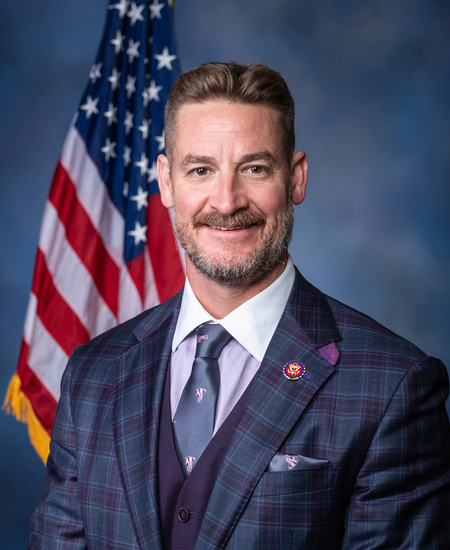
Photo of W. Gregory Steube
R United States House · District 17 · Florida On the 2026 ballot

Rep. W. Gregory Steube

Compare
Total votes
2,837
all sessions
Attendance
94%
175 missed
Near the chamber average
With party
87%
of cast votes
Lower than 94% of chamber peers
Bipartisan score
7%
crosses aisle rarely
Higher than 93% of chamber peers
Sponsored
1,510
bills & resolutions
Near the chamber average
Committees
7
assignments
1,510 bills and resolutions

Sponsored bills

Total
1,510
Primary
236
Co-sponsor
1,274
This page
1,510
matching current filters
Primary HR 7453
In committee · Utah House · Lead sponsor
CLEAN Act

Maddy summaryThis bill denies tax credits for health insurance under the Affordable Care Act and Medicaid medical assistance to individuals convicted of sex offenses (as defined by the Adam Walsh Act). Specifically, it amends tax law to block refundable health care credits for sex offenders and adds a Medicaid provision allowing states to exclude sex offenders from receiving government-funded medical coverage. The policy directly affects sex offenders who would otherwise qualify for these federal benefits. The changes apply to tax years and Medicaid enrollments starting after the bill's enactment.

In committee Feb 9, 2026 0 co-sponsors
Co-sponsor HR 7356
In committee · Utah House · Co-sponsor
To amend the Help America Vote Act of 2002 to prohibit the use of Federal funds for election administration in States that permit ballot harvesting.

Maddy summaryHR 7356, the "No Federal Funds for Ballot Harvesting Act," amends the Help America Vote Act to block federal funding for election administration in states that permit third parties (non-voters) to collect and transmit mailed ballots for federal elections. It requires states to prohibit such collection by non-authorized individuals, with exceptions for election officials, USPS employees, and family/caregivers living with or assisting the voter. States failing to adopt this prohibition would lose federal funds for administering federal elections. The bill cites concerns about ballot chain-of-custody vulnerabilities and references the Supreme Court’s Brnovich ruling upholding state restrictions on ballot harvesting.

In committee Feb 4, 2026 1 co-sponsor
Primary HR 7378
In committee · Utah House · Lead sponsor
Daylight Act of 2026

Maddy summaryThis bill permanently changes U.S. standard time zones by reducing the offset from UTC by 30 minutes across all regions. It amends the 1918 Calder Act to adjust time zone differences (e.g., changing "4 hours" to "3.5 hours" for the Eastern Time Zone) and repeals the 1966 Uniform Time Act, which currently governs daylight saving time rules. The change directly affects all U.S. time zones, shifting local times earlier by 30 minutes without altering daylight saving time schedules. The policy change takes effect 90 days after enactment, implementing a permanent adjustment to standard time.

In committee Feb 4, 2026 0 co-sponsors
Co-sponsor HR 7368
In committee · Utah House · Co-sponsor
Riley Gaines Act

Maddy summaryThe Riley Gaines Act allows female student athletes injured in women's sports competitions to sue schools or athletic associations that permitted biologically male athletes to compete in those events. It creates a legal pathway for victims to seek compensation for physical injuries, lost scholarships, or missed professional opportunities due to the inherent physiological advantages of male athletes. If a female athlete wins a lawsuit under this law, the court must also award them reasonable attorney fees. The bill directly affects institutions of higher education and athletic associations that oversee women's sports competitions.

In committee Feb 4, 2026 1 co-sponsor
Co-sponsor HR 3699
In committee · Utah House · Co-sponsor
Energy Choice Act

Maddy summaryThis bill prevents state or local governments from banning or restricting energy connections (like installation, modification, or access) based on the type or source of energy, such as electricity, natural gas, or renewable fuels. It directly affects consumers choosing energy providers and energy companies seeking to offer services. The key provision prohibits local laws, regulations, or policies that limit energy services sold in interstate commerce, covering all energy types listed in the bill’s definitions. It does not create new programs but limits regulatory authority at the state or local level. The law aims to ensure open access to diverse energy sources without source-based restrictions.

In committee Feb 4, 2026 1 co-sponsor
Primary HR 6675
In committee · Utah House · Lead sponsor
DISPOSAL Act

Maddy summaryHR 6675, the DISPOSAL Act, requires the General Services Administration (GSA) to sell or lease six specific federal buildings in Washington, D.C. (including the Frances Perkins, Forrestal, and Humphrey buildings) at fair market value or for up to 99 years. The bill mandates relocating federal agencies currently occupying these buildings to other locations, prohibits foreign ownership of the properties, and exempts the disposal from certain environmental and historic preservation requirements. Proceeds from sales must first cover relocation costs and GSA implementation expenses before any remaining funds go to deficit reduction. The law expires on December 31, 2028, and does not allow judicial review of GSA actions under this bill.

In committee Feb 2, 2026 0 co-sponsors
Primary HR 6342
In committee · Utah House · Lead sponsor
Clean Up DEBRIS Act

Maddy summaryThis bill amends the federal disaster relief law to streamline debris removal in specific housing types after major disasters. It requires the President to issue rules allowing federal debris removal from residential common interest communities (like condos, housing co-ops, and manufactured home parks) when state or local officials determine debris poses a threat to life, health, safety, or economic recovery. The rules must respect existing state or local definitions of these housing arrangements. This change applies to disasters declared after the bill's enactment, making federal debris removal more accessible for these communities without creating new funding.

In committee Feb 2, 2026 0 co-sponsors
Co-sponsor HR 4242
In committee · Utah House · Co-sponsor
Innovate Less Lethal to De-Escalate Tax Modernization Act

Maddy summaryThis bill exempts certain less-than-lethal projectile devices from federal sales taxes and National Firearms Act restrictions. It directly affects manufacturers, importers, and producers of these devices, which are defined as non-lethal tools (like rubber bullets or beanbag rounds) designed not to cause serious injury and unable to be easily converted to use standard firearm ammunition. Key mechanisms include a 90-day classification process for manufacturers seeking exemption, an annual public list of approved devices, and annual congressional reports on devices excluded from the exemption. The policy change applies to devices meeting specific safety criteria, such as projectile velocity limits and design features preventing misuse as conventional weapons.

In committee Feb 2, 2026 1 co-sponsor
Co-sponsor HR 7296
In committee · Utah House · Co-sponsor
SAVE America Act

Safeguard American Voter Eligibility Act or the SAVE America Act This bill requires individuals to provide documentary proof of U.S. citizenship when registering to vote, and requires photo identification to vote, in federal elections. Specifically, the bill prohibits states from accepting and processing an application to register to vote in a federal election unless the applicant presents documentary proof of U.S. citizenship. The bill specifies what documents are considered acceptable proof of U.S. citizenship, such as identification that complies with the REAL ID Act of 2005 that indicates U.S. citizenship. Further, the bill (1) prohibits states from registering an individual to vote in a federal election unless, at the time the individual applies to register to vote, the individual provides documentary proof of U.S. citizenship; and (2) requires states to establish an alternative process to demonstrate U.S. citizenship. Each state must take affirmative steps on an ongoing basis to ensure that only U.S. citizens are registered to vote, which shall include establishing a program to identify individuals who are not U.S. citizens using information supplied by certain sources. Additionally, states must remove noncitizens from their official lists of eligible voters. The bill (1) provides for a private right of action for certain violations, and (2) establishes criminal penalties for certain offenses. Individuals voting in federal elections must present an eligible photo identification document. An individual who votes by absentee ballot must submit a copy of their identification document with both the request for, and the submission of, the absentee ballot.

In committee Jan 30, 2026 1 co-sponsor
Co-sponsor HR 7286
In committee · Utah House · Co-sponsor
To amend the Internal Revenue Code of 1986 to revoke the tax-exempt status of organizations that provide, or provide funding for, abortion.

Maddy summaryThis bill would revoke the tax-exempt status of nonprofit organizations (like charities or health groups) that provide or fund abortions, except in specific cases. It directly affects organizations currently classified under Section 501(c)(3) of the tax code, such as some healthcare providers or advocacy groups. Key provisions define "abortion" as intentionally terminating a pregnancy (excluding cases where the mother’s life is at risk, or the pregnancy resulted from rape or incest), and deny tax exemption to groups meeting this definition. The change would take effect for tax years starting after the bill’s enactment date.

In committee Jan 30, 2026 1 co-sponsor
Showing 121 to 130 of 1,510 bills
Previous 1 … 12 13 14 … 151 Next