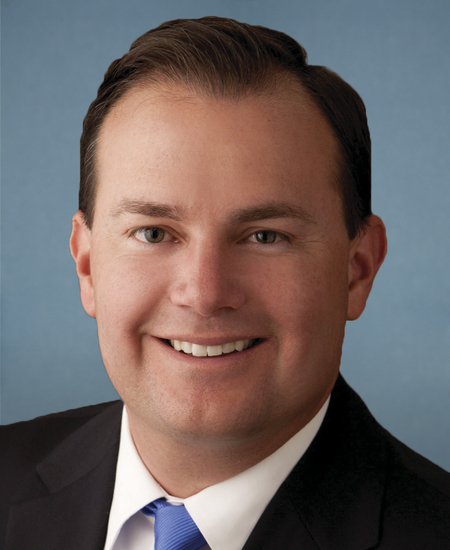
Photo of Mike Lee
R United States Senate · Utah

Sen. Mike Lee

Compare
Total votes
1,044
all sessions
Attendance
98%
23 missed
Near the chamber average
With party
85%
of cast votes
Lower than 87% of chamber peers
Bipartisan score
8%
crosses aisle rarely
Higher than 85% of chamber peers
Sponsored
1,070
bills & resolutions
Near the chamber average
Committees
15
assignments
1,070 bills and resolutions

Sponsored bills

Total
1,070
Primary
404
Co-sponsor
666
This page
1,070
matching current filters
Co-sponsor S 3857
In committee · Texas Senate · Co-sponsor
One Nation, One Visa Policy Act

Maddy summaryThe One Nation, One Visa Policy Act (S 3857) requires all nationals of the People's Republic of China - including those from Hong Kong and Macau - to hold a valid U.S. visa for entry, eliminating visa-free access. It prohibits using Department of Homeland Security funds to allow Chinese nationals to participate in programs like the Guam and Northern Mariana Islands Visa Waiver Program. The bill enforces existing visa requirements by banning federal funding for visa-free admission under current agreements. This directly affects Chinese citizens seeking to travel to the U.S. without a visa through existing waiver programs.

In committee Feb 12, 2026 1 co-sponsor
Co-sponsor S 3862
In committee · Texas Senate · Co-sponsor
Payment Integrity Act

Maddy summaryThe Payment Integrity Act (S 3862) requires state agencies managing child care funds to pay providers based on verified child attendance - not just enrollment - using attendance records or similar methods. It directly affects child care providers and state lead agencies administering federal child care grants. The bill adds a new requirement that payments must be tied to actual service delivery, prohibiting pre-payment before care is provided. These changes aim to ensure taxpayer funds are only used for verified child care services. The legislation amends existing child care funding rules without altering eligibility or funding levels.

In committee Feb 12, 2026 1 co-sponsor
Primary S 2968
In committee · Texas Senate · Lead sponsor
Outdoor Americans with Disabilities Act

Maddy summaryThis bill requires U.S. Forest Service and Bureau of Land Management to update travel plans for public lands, ensuring areas meet a new standard: at least 2.5 miles of accessible road per square mile for people with disabilities using motorized or off-road vehicles. It directly affects public land users, particularly those with mobility disabilities who rely on accessible routes for recreation. Key provisions include preventing road closures that would drop accessibility below the 2.5-mile threshold (unless for emergencies or safety), mandating public notice and hearings before closures, and requiring new roads to replace closed ones within a year. The law prioritizes maintaining access to activities like hiking, fishing, and wildlife viewing while balancing safety and environmental needs.

In committee Feb 12, 2026 0 co-sponsors
Co-sponsor S 2417
In committee · Texas Senate · Co-sponsor
Star-Spangled Summit Act of 2025

Maddy summaryThe Star-Spangled Summit Act of 2025 grants a 10-year special use permit to maintain a U.S. flag at Kyhv Peak Lookout Point in Utah's Uinta National Forest. It prioritizes Robert S. Collins of Provo, Utah, or a qualified Utah County resident/nonprofit with flagpole maintenance experience for the permit, which exempts the holder from land use fees. The permit may be renewed for additional 10-year terms if the holder complies with maintenance conditions, and the bill exempts the permit from standard environmental review requirements.

In committee Feb 12, 2026 1 co-sponsor
Co-sponsor S 3836
In committee · Texas Senate · Co-sponsor
FENCES Act

Maddy summaryThis bill amends the Clean Air Act to address air quality challenges caused by emissions originating outside U.S. borders. It prevents states from being penalized (e.g., with sanctions or fees) for failing to meet air quality standards if the deficiency is due to emissions from outside the U.S. (regardless of whether those emissions are human-caused), or from exceptional events like wildfires. States must demonstrate this cause to avoid penalties and renew the demonstration every five years. The bill does not change air quality standards themselves but modifies how states are held accountable for meeting them. It directly affects states struggling with cross-border pollution, particularly for ozone and particulate matter.

In committee Feb 11, 2026 1 co-sponsor
Co-sponsor S 3853
In committee · Texas Senate · Co-sponsor
End the Vaccine Carveout Act

Maddy summaryThe End the Vaccine Carveout Act would amend the National Vaccine Injury Compensation Program to allow individuals to directly file civil lawsuits against vaccine manufacturers or administrators for vaccine-related injuries or deaths, removing the previous requirement to first pursue compensation through the federal program. It repeals provisions that forced people to choose between the compensation program and a lawsuit, and specifically excludes COVID-19 vaccines from the definition of "covered countermeasure" under emergency use authorities. This change would directly affect vaccine manufacturers and individuals harmed by vaccines, as it eliminates a legal barrier to holding manufacturers accountable in court. The bill does not alter the compensation program's operation for non-COVID-19 vaccines but ends the special liability protection for COVID-19 vaccines under emergency use designations.

In committee Feb 11, 2026 1 co-sponsor
Primary S 1453
In committee · Texas Senate · Lead sponsor
University of Utah Research Park Act

University of Utah Research Park Act This bill confirms the use by the University of Utah of approximately 593 acres of specified nonfederal land in Salt Lake City, Utah, as a university research park and for related university purposes (including development of student housing and a transit hub) as a valid public purpose.

In committee Feb 11, 2026 0 co-sponsors
Primary S 714
In committee · Texas Senate · Lead sponsor
Critical Mineral Consistency Act of 2025

Critical Mineral Consistency Act of 2025 This bill modifies the Energy Act of 2020 to expand the definition of  critical minerals used by the U.S. Geological Survey (USGS) to include  critical materials designated by the Department of Energy (DOE). It also directs USGS to update its list within 45 days of DOE adding a  mineral, element, substance, or material to its critical materials list. Thus, the bill requires the lists to be treated consistently and makes critical materials eligible for the same benefits (e.g., financing support or clean energy tax credits) provided to critical minerals. By way of background, DOE's critical materials list contains certain materials that are essential for energy, including those on the critical minerals list of the USGS. The USGS's list, which contains certain minerals that are essential to the nation's economic or national security, is currently not required to include the materials on DOE's list.

In committee Feb 11, 2026 0 co-sponsors
Co-sponsor S 1809
In committee · Texas Senate · Co-sponsor
Drone Espionage Act

Maddy summaryThe Drone Espionage Act (S 1809) amends existing law to explicitly include video recordings alongside photographs in the prohibition against taking or transmitting defense information. This technical update to Title 18, U.S. Code, Section 793 clarifies that video footage of defense-related information - such as from drones or other devices - falls under espionage laws, just like photographic images. The bill directly affects individuals or entities recording defense information via video, expanding the scope of prohibited activities under current espionage statutes. It does not create new penalties but ensures modern recording methods are covered by existing legal protections.

In committee Feb 9, 2026 1 co-sponsor
Primary S 3786
In committee · Texas Senate · Lead sponsor
Balance the Highway Trust Fund Act

Maddy summaryS 3786, the Balance the Highway Trust Fund Act, sets a strict annual spending limit for federal highway construction programs equal to the most recent Treasury estimate of highway tax receipts. It requires the Transportation Secretary to cap obligations at this level and redistribute unused funds to states with large unobligated balances, prioritizing those with significant leftover funds from previous years. The bill also applies similar spending limits to mass transit programs funded through the Highway Trust Fund’s Mass Transit Account. It directly affects state transportation departments and federal highway programs by changing how funds are allocated and redistributed. The law takes effect October 1, 2027.

In committee Feb 5, 2026 0 co-sponsors
Showing 101 to 110 of 1,070 bills
Previous 1 … 10 11 12 … 107 Next