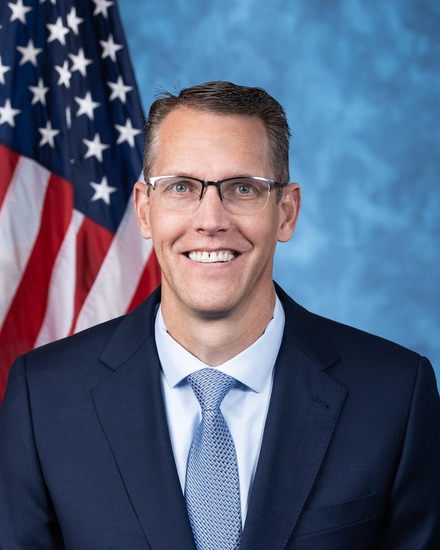
Photo of Randy Feenstra
R United States House · District 4 · Iowa

Rep. Randy Feenstra

Compare
Total votes
2,837
all sessions
Attendance
99%
18 missed
Near the chamber average
With party
97%
of cast votes
Near the chamber average
Bipartisan score
2%
crosses aisle rarely
Near the chamber average
Sponsored
926
bills & resolutions
Near the chamber average
Committees
7
assignments
926 bills and resolutions

Sponsored bills

Total
926
Primary
101
Co-sponsor
825
This page
926
matching current filters
Co-sponsor HR 8295
In committee · Texas House · Co-sponsor
Protecting Families from Fertility Fraud Act of 2026

Maddy summaryHR 8295, the Protecting Families from Fertility Fraud Act of 2026, creates a new federal crime for knowingly misrepresenting the nature or source of DNA used in assisted reproductive technology or assisted insemination. This directly affects fertility clinics, practitioners, and patients undergoing such procedures. Individuals found guilty could face up to 10 years in prison, a fine, or both. The bill defines federal jurisdiction for these offenses, primarily involving interstate commerce, and extends the statute of limitations to 10 years after identification through DNA testing. It also adds this new crime to the list of "racketeering activities" under federal law.

In committee Apr 15, 2026 1 co-sponsor
Co-sponsor HR 8101
In committee · Texas House · Co-sponsor
Ensuring Better Interest Treatment and Deductibility Act (EBITDA)

Maddy summaryThis bill, titled the Ensuring Better Interest Treatment and Deductibility Act, would change how businesses calculate the limit on interest expenses they can deduct on their taxes. It directly affects corporations and other businesses that pay interest on loans by modifying the rules for determining adjusted taxable income. The key provision removes a specific clause from the tax code that currently limits how much interest can be deducted based on a company's earnings, effectively allowing more interest to be treated as a deductible business expense. These changes would apply to tax years starting after December 31, 2025, meaning businesses would need to adjust their financial planning for future tax filings.

In committee Mar 26, 2026 1 co-sponsor
Co-sponsor HR 8104
In committee · Texas House · Co-sponsor
Fertilizer Transparency Act of 2026

Maddy summaryThis bill requires fertilizer manufacturers and wholesalers to report weekly prices and quantities of nitrogen, phosphorus, potassium, and fertilizer products to the U.S. Department of Agriculture. The reporting must distinguish between domestic and foreign sources while exempting agricultural cooperatives and non-manufacturer retailers from mandatory requirements, though they may voluntarily provide data. The Secretary of Agriculture will make this information publicly available on a weekly basis through a dashboard that aggregates data to protect confidential business details. A separate retail survey program will supplement manufacturer reports with regional price estimates, and the Secretary must review reporting requirements every two years to ensure they remain accurate. The legislation explicitly states that these reporting requirements do not override existing antitrust laws.

In committee Mar 26, 2026 1 co-sponsor
Co-sponsor HRES 1132
In committee · Texas House · Co-sponsor
Expressing support for the designation of March 24, 2026, as "National Agriculture Day" and celebrating the importance of agriculture as one of the most impactful industries in the United States.

Maddy summaryThis resolution expresses support for designating March 24, 2026, as National Agriculture Day to honor the agricultural industry. It does not create new laws or change existing policies but serves as a symbolic gesture to recognize agriculture's economic importance in the United States. The measure is a non-binding expression of appreciation rather than a legislative action with enforceable provisions.

In committee Mar 24, 2026 1 co-sponsor
Co-sponsor HR 7142
In committee · Texas House · Co-sponsor
ACE Agriculture Act

Maddy summaryThe ACE Agriculture Act reauthorizes and expands the Agricultural Research, Extension, and Teaching Policy Act's AGARDA program, directly affecting USDA agricultural research initiatives and the scientists managing them. It increases annual funding from $50 million to $100 million for fiscal years 2027-2032 and broadens research priorities to include water conservation, greenhouse gas reduction, pest resilience, and export competitiveness. The bill removes "pilot" references throughout, clarifies reporting structures (requiring the AGARDA Director to report to the Chief Scientist), and allows flexible use of existing USDA personnel authorities. This creates a more permanent, well-funded framework for advancing agricultural technology research within the Department of Agriculture.

In committee Mar 20, 2026 1 co-sponsor
Co-sponsor HR 1958
Passed · Texas House · Co-sponsor
Deporting Fraudsters Act of 2026

Deporting Fraudsters Act of 2026 This bill makes certain acts related to public benefits fraud grounds for (1) barring a non-U.S. national ( alien under federal law) from admission into the United States, or (2) deporting the individual. The bill also makes such an individual ineligible for immigration enforcement relief, including relief for an individual in danger of subjection to torture. Specifically, this bill applies to individuals who have been convicted of, admit to having committed, or admit to acts which constitute certain offenses. Offenses covered by this bill include (1) fraud involving Supplemental Nutrition Assistance Program (SNAP) benefits, (2) fraud involving Social Security benefits, (3) fraud involving programs that receive federal funds, and (4) the production of fraudulent identification documents.

Passed Mar 19, 2026 1 co-sponsor
Co-sponsor HR 1422
Passed · Texas House · Co-sponsor
Enhanced Iran Sanctions Act of 2025

Enhanced Iran Sanctions Act of 2025 This bill imposes sanctions on certain foreign persons (individuals and entities) that are involved in Iran's petroleum sector as well as certain associated persons. The bill also requires or authorizes actions to facilitate the enforcement of sanctions on Iran. Specifically, the bill requires the President to impose visa- and property-blocking sanctions on any foreign person that, after the bill's enactment, knowingly engages in any transaction related to the processing, export, or sale of oil, condensates, gas, liquefied natural gas, or other petrochemical products in whole or in part from Iran. The President must also impose sanctions on certain foreign persons associated with a sanctioned individual or entity. For example, the President must sanction the subsidiaries and corporate officers of a sanctioned business. The bill provides certain exceptions to these sanctions, including specifying that sanctions do not apply to the importation of goods or to conducting or facilitating transactions for humanitarian assistance. The Department of State must establish an interagency working group that shall seek to establish a multilateral contact group to coordinate international efforts to enforce sanctions on Iran. The bill expands the State Department rewards program to authorize a reward payment to any individual who furnishes information leading to the identification of a person (1) subject to sanctions under this bill, or (2) that has attempted or is attempting to evade sanctions under this bill.

Passed Mar 17, 2026 1 co-sponsor
Co-sponsor HR 7747
In committee · Texas House · Co-sponsor
State Veterans Homes Inspection Simplification Act

Maddy summaryThis bill, known as the State Veterans Homes Inspection Simplification Act, would allow certain State Veterans Homes that are already certified by the Department of Veterans Affairs to be automatically considered compliant with Medicare and Medicaid nursing home standards. Under this proposal, facilities meeting specific VA inspection and certification requirements would not need to undergo separate reviews by the Centers for Medicare & Medicaid Services, reducing duplication of effort. The legislation maintains oversight by requiring the VA to submit its inspection standards for review every two years, allowing CMS to conduct targeted surveys or complaints investigations, and mandating public reporting of inspection data on the Nursing Home Care Compare website. A Government Accountability Office report would be required three years after enactment to evaluate the bill's impact on survey efficiency, enforcement outcomes, and resident care quality.

In committee Mar 16, 2026 1 co-sponsor
Co-sponsor HR 7847
In committee · Texas House · Co-sponsor
Stop Unemployment Fraud Act

Maddy summaryThis bill, titled the Stop Unemployment Fraud Act, requires states to verify the identity of unemployment compensation claimants using government-issued IDs and supporting documents like utility bills or lease agreements. It mandates that states use data-matching systems to cross-check claimant information against employment records, new hire directories, and databases of incarcerated or deceased individuals to detect and prevent fraud. The legislation also prohibits relying solely on a claimant's self-attestation to prove eligibility and strengthens work search requirements by mandating that claimants maintain and submit weekly records of job search activities. Additionally, the bill allows states to use up to 5% of recovered overpayments or collected contributions to fund fraud prevention efforts, technology modernization, and proper employment classification programs.

In committee Mar 5, 2026 1 co-sponsor
Primary HR 7749
In committee · Texas House · Lead sponsor
Quantum in Practice Act

Maddy summaryThis bill, known as the Quantum in Practice Act, amends the National Quantum Initiative Act to formally include quantum modeling and simulation as a core area of research. It directly affects federal agencies and researchers involved in quantum information science by updating the legal definition and adding specific funding priorities for quantum molecular modeling. The legislation aims to support scientific work that could lead to breakthroughs in areas like fertilizer production, drug development, battery technology, and new materials. By making these changes, the bill ensures that federal quantum research programs explicitly cover the development and study of quantum simulations for practical applications.

In committee Mar 2, 2026 0 co-sponsors
Showing 41 to 50 of 926 bills
Previous 1 … 4 5 6 … 93 Next