This resolution expresses the sense of the House of Representatives that Congress should ensure that the U.S. Postal Service is not privatized and remains an independent establishment of the federal government.
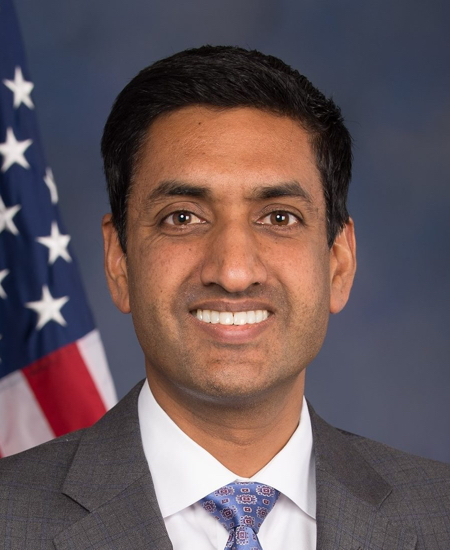
Rep. Ro Khanna
Sponsored bills
Equal COLA Act This bill revises the formula used to calculate the cost-of-living adjustment for annuities paid under the Federal Employees Retirement System.
SAFE Workers Act or the Secure And Fair Elections for Workers Act This bill requires the National Labor Relations Board (NLRB) to provide employees with the ability to vote remotely by telephone or the internet in union representation elections during the COVID-19 (i.e., coronavirus disease 2019) public health emergency. The bill further permits the NLRB's use of appropriations to issue directives or regulations providing for electronic voting methods.
This resolution calls upon Vice President Michael R. Pence (1) to immediately use his powers under section 4 of the Twenty-fifth Amendment to convene and mobilize the principal officers of the executive departments to declare that the President is unable to successfully discharge the duties and powers of his office, and (2) to transmit to the President pro tempore of the Senate and the Speaker of the House notice that he will be immediately assuming the powers and duties of the office as Acting President.
This resolution supports teaching climate change in schools and programs to increase public knowledge on the impacts that humans have on the climate.
Repeal of the Authorization for Use of Military Force This bill repeals the Authorization for Use of Military Force signed into law September 18, 2001.
Congressional Budget Justification Transparency Act of 2021 This bill requires federal agencies to post budget justification materials on certain public websites, including a single searchable website (e.g., USAspending.gov) and each agency's website. The materials most be posted in an open format that enables users to download individual reports, all reports in bulk, and the results of a search. In addition, the materials must be posted no later than two weeks after they are first submitted to Congress. The bill also requires the Office of Management and Budget to maintain a public website that includes details regarding the materials, including a list of the agencies that submit budget justification materials to Congress, the dates that the materials were submitted to Congress and posted online, and links to the materials.
Guam Supplemental Security Income Equality Act This bill extends the Supplemental Security Income (SSI) program to Guam. This is a federal program designed to help aged, blind, and disabled individuals with limited income and resources meet basic needs. When Congress created the SSI program in 1972, it excluded Puerto Rico, the Virgin Islands, and Guam. The Social Security Administration may waive or modify statutory requirements relating to the provision of benefits as necessary to adapt the program to Guam.
Reenergized Economic Sustainability for Community and Urban Entities Act for Black and Community Banks or the RESCUE Act for Black and Community Banks This bill establishes programs and requirements related to minority banks, Black banks, community banks, women's banks, and low-income credit unions. The bill establishes the Office of Black and Community Banks in the Office of the Comptroller of the Currency (OCC) to oversee Black and community banks. The OCC and the Securities and Exchange Commission must exempt these banks from specified securities and federal banking regulations in certain circumstances. The bill also establishes the Minority Bank Deposit Program. The Department of the Treasury must certify a depository institution or credit union upon successful application as a minority bank, a women's bank, or a low-income credit union. Every federal department and agency is directed to implement standards and procedures to ensure the use of such institutions to serve the financial needs of the department or agency. The Government Accountability Office must study the use of the new markets tax credit, lower-value home mortgages, and blockchain investments.