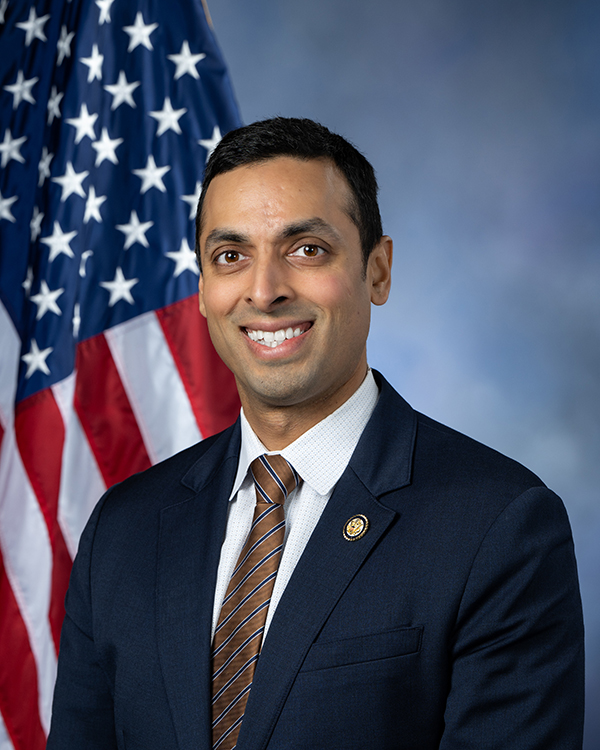
Photo of Suhas Subramanyam
D United States House · District 10 · Virginia On the 2026 ballot

Rep. Suhas Subramanyam

Compare
Total votes
669
all sessions
Attendance
100%
2 missed
Higher than 89% of chamber peers
With party
96%
of cast votes
Near the chamber average
Bipartisan score
2%
crosses aisle rarely
Near the chamber average
Sponsored
442
bills & resolutions
Higher than 75% of chamber peers
Committees
8
assignments
442 bills and resolutions

Sponsored bills

Total
442
Primary
44
Co-sponsor
398
This page
442
matching current filters
Co-sponsor HR 10004
In committee · Oklahoma House · Co-sponsor
Defending Our Energy and Water Act

Maddy summaryThe Defending Our Energy and Water Act directs the Administrator of the Office of Electronic Government to update minimum requirements for new federal data centers, mandating the use of the most water-efficient cooling systems. This update must be completed within 180 days of the bill's enactment. Additionally, the legislation extends a previous deadline for reviewing data center standards from 2026 to 2031 and requires the Department of Defense to identify and integrate water efficiency technologies to protect water resources. These changes apply specifically to federal data centers and aim to minimize their operational impact on water supplies.

In committee Jul 30, 2026 1 co-sponsor
Co-sponsor HR 9917
In committee · Oklahoma House · Co-sponsor
AI Kill Switch Act

Maddy summaryThis bill, known as the AI Kill Switch Act, requires companies developing high-cost artificial intelligence systems to build the technical ability to immediately stop or shut down their technology if it poses a serious risk. It defines "covered technology" as AI systems trained using more than $100 million in computing power and applies these rules to businesses that earn at least $500 million annually from such systems, while exempting non-commercial or academic users. Under the law, companies must report incidents causing significant harm or loss of control and could face emergency orders from the Department of Homeland Security to throttle, disable, or fully shut down their AI if a dangerous event occurs. The legislation also establishes a graduated framework for corrections, allowing for proportional responses like limiting user access or compute resources before resorting to a complete shutdown, and includes provisions for civil penalties and judicial review.

In committee Jul 24, 2026 1 co-sponsor
Co-sponsor HR 9925
In committee · Oklahoma House · Co-sponsor
FRONTIER Act

Maddy summaryThe FRONTIER Act establishes a regulatory framework for the largest artificial intelligence developers to manage and disclose risks associated with their most powerful models, known as "frontier models." It requires companies meeting specific revenue and spending thresholds to create public safety frameworks, undergo independent third-party audits, and report incidents or potential harms to the Department of Commerce. The bill also creates a system where the Secretary of Commerce can issue emergency orders to suspend or restrict model development if an imminent catastrophic risk is identified. Additionally, the legislation preempts state laws that impose new obligations on AI developers regarding risk transparency, auditing, and incident reporting to ensure a uniform national approach.

In committee Jul 23, 2026 1 co-sponsor
Co-sponsor HR 9901
In committee · Oklahoma House · Co-sponsor
To provide that the final rule of the United States Fish and Wildlife Service and National Oceanic and Atmospheric Administration titled "Rescinding the Definition of 'Harm' Under the Endangered Species Act" shall have no force or effect.

Maddy summaryThis bill would invalidate a final rule issued by the U.S. Fish and Wildlife Service and the National Oceanic and Atmospheric Administration that rescinded the definition of "harm" under the Endangered Species Act. By declaring that the 2026 rule has no force or effect, the legislation aims to restore the previous legal interpretation of how actions can harm protected species. This change directly affects entities subject to the Endangered Species Act by reinstating the broader regulatory framework for protecting endangered and threatened wildlife.

In committee Jul 23, 2026 1 co-sponsor
Co-sponsor HR 9875
In committee · Oklahoma House · Co-sponsor
Protecting Childcare from Private Equity Act

Maddy summaryThe Protecting Childcare from Private Equity Act requires the Securities and Exchange Commission to collect and report data on private funds that own or control childcare providers. It restricts these large private funds from selling their interests in childcare entities or taking dividends for four years after they first gain control. Additionally, the bill mandates a study by the Comptroller General to examine how private equity ownership affects childcare quality, availability, costs, and employee wages. These measures specifically target private funds with over $150 million in assets that operate childcare at more than 25 locations.

In committee Jul 22, 2026 1 co-sponsor
Co-sponsor HR 9860
In committee · Oklahoma House · Co-sponsor
Pardon Transparency and Accountability Act of 2026

Maddy summaryThe Pardon Transparency and Accountability Act of 2026 requires the President to publicly explain the reasons for any pardon, commutation, reprieve, or fine remission in the Federal Register and on the official White House website. It also mandates that the Pardon Attorney prepare a Justice Impact Statement within 30 days, which must include victim statements and input from law enforcement officials regarding the potential impact on ongoing investigations. Additionally, the bill expands lobbying disclosure rules to require immediate registration and reporting for any lobbying efforts related to seeking executive clemency, regardless of the amount of money involved. Finally, the Pardon Attorney will conduct annual studies on how well the government follows these new transparency requirements and report the findings to Congress.

In committee Jul 22, 2026 1 co-sponsor
Co-sponsor HR 9835
In committee · Oklahoma House · Co-sponsor
Congressional Oversight and Agency Access Act

Maddy summaryThis bill, titled the Congressional Oversight and Agency Access Act, grants Members of Congress and their full-time staff guaranteed entry to all federal public buildings during regular business hours. It requires these individuals to present official congressional identification and mandates that staff members be accompanied by their employing Member of Congress. The legislation also ensures access outside of normal hours within 24 hours of a request, allows immediate entry during public meetings, and permits access to secure areas if the Member belongs to a relevant committee or obtains consent from the committee's leadership. Additionally, the bill prohibits temporary modifications to buildings that would obstruct a Member's ability to observe the facility.

In committee Jul 22, 2026 1 co-sponsor
Co-sponsor HR 6610
In committee · Oklahoma House · Co-sponsor
Pharmacists Fight Back [in Federal Employee Health Benefit Plans Act]

Maddy summaryThis bill requires pharmacy benefits managers (PBMs) administering prescription drug benefits for federal employee health plans to reimburse pharmacies at specific rates, including the national average drug cost plus a small percentage or $50, whichever is lower. It prohibits PBMs from favoring their own pharmacies, restricting patient choice, or reducing pharmacy payments after claims are processed. The bill establishes $10,000 civil penalties for violations, with debarment from federal health plans after 10 penalties in 10 years. This directly affects PBMs, in-network pharmacies, and federal health benefit plans covering millions of federal employees and their families. The law aims to ensure fair reimbursement practices and maintain pharmacy choice under the Federal Employees Health Benefits Program.

In committee Jul 22, 2026 1 co-sponsor
Co-sponsor HR 9807
In committee · Oklahoma House · Co-sponsor
Americans vs. Poisonous Pesticides Act

Maddy summaryThe Americans vs. Poisonous Pesticides Act amends federal pesticide laws to allow state courts to hear lawsuits alleging that pesticide labels fail to warn about health or environmental risks. It clarifies that a pesticide's federal registration and label approval do not automatically block these state claims, though they serve as initial evidence of compliance. The bill also permits companies to update their product labels to address new safety information without waiting for prior government approval, subject to potential review by the agency. These changes apply to both new lawsuits and cases already in progress, ensuring that federal rules do not limit existing state legal remedies for damages or injunctive relief.

In committee Jul 21, 2026 1 co-sponsor
Co-sponsor HR 4348
Passed · Oklahoma House · Co-sponsor
To reauthorize the Kay Hagan Tick Act, and for other purposes.

Maddy summaryThis bill reauthorizes federal programs focused on preventing and responding to tick-borne diseases through 2026-2030, extending existing efforts beyond their previous expiration. It updates the National Strategy for Vector-Borne Diseases to emphasize identifying, reporting, preventing, and responding to these illnesses. The bill modifies two sections of the Public Health Service Act to continue funding for health departments working on vector-borne disease control. It directly affects public health programs and state/local health departments managing tick-borne disease prevention and response.

Passed Jul 21, 2026 1 co-sponsor
Showing 31 to 40 of 442 bills
Previous 1 … 3 4 5 … 45 Next