Taiwan Fellowship Act This bill directs the Department of State to establish a program to provide fellowships in Taiwan to qualifying U.S. government employees. Each program fellow shall work in (1) a Taiwanese government agency; or (2) a nongovernmental organization, such as the American Institute in Taiwan, whose interests are associated with the interests of the fellow's employing U.S. government agency. (In 1979, the United States established diplomatic relations with China and ended formal diplomatic ties with Taiwan. The American Institute in Taiwan is a private organization that has a contract with the State Department to represent U.S. interests in Taiwan and provide consular services.)
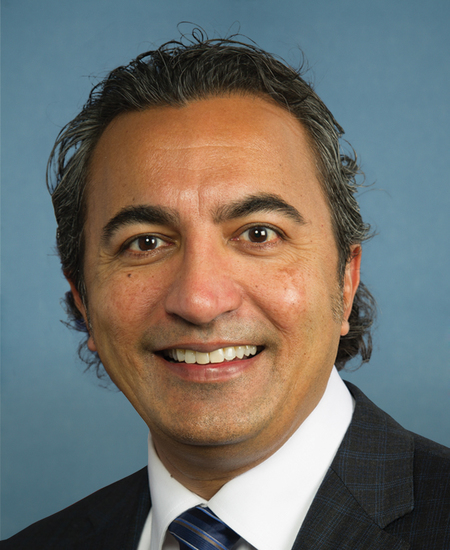
Rep. Ami Bera
Sponsored bills
John Lewis Every Child Deserves a Family Act This bill prohibits discrimination on the basis of sexual orientation, gender identity, marital status, or religion in the provision of child welfare programs and services by entities receiving federal funding. The Department of Health and Human Services (HHS) must provide technical assistance to help states follow this requirement, including (1) guidance for bringing state laws into compliance, (2) developing training to increase cultural competency related to social identity, and (3) training for judges and attorneys involved in child welfare cases, among other supports. Additionally, HHS must establish the National Resource Center on Safety, Well-Being, Placement Stability, and Permanency for LGBTQ Children and Youth Involved with Child Welfare Services to provide training, technical assistance, and guidance to applicable state and local agencies and service providers. Further, the Religious Freedom Restoration Act may not be the basis for challenging the application or enforcement of this bill. The Government Accountability Office must study and report on states' compliance with the requirements of the bill no later than three years after enactment.
This resolution acknowledges the safety and efficacy of COVID-19 (i.e., coronavirus disease 2019) vaccines and encourages all eligible individuals to receive a vaccination.
Arctic Diplomacy Act of 2021 This bill establishes the position of Ambassador at Large for Arctic Affairs within the Department of State. The ambassador shall facilitate the development and coordination of U.S. foreign policy and activities related to the Arctic region, including policies and activities to (1) meet U.S. national security needs, (2) protect the environment, (3) increase cooperation among Arctic countries, (4) involve Arctic Indigenous people in relevant decisions, and (5) enhance scientific research and monitoring. Furthermore, the ambassador must establish an Arctic Region Security Policy. The policy must assess and implement plans and actions to (1) bolster U.S. diplomatic presence in Arctic countries, (2) enhance the resilience of Arctic countries to environmental change and increased civilian and military activity in the region, and (3) advance principles of good governance in the region.
This resolution welcomes President Moon Jae-in of South Korea to the United States. It also reaffirms the importance of the U.S.-South Korea relationship to peace, security, and prosperity on the Korean Peninsula and in the Indo-Pacific region.
This resolution states that the United Nations Security Council should immediately impose an arms embargo against the military of Burma (Myanmar) and hold it accountable for its ongoing violations of human rights.
This resolution condemns the acts of gun violence that led to the tragic loss of eight lives in Georgia on March 16, 2021.
This resolution expresses support for the designation of DIPG Awareness Day. DIPG is diffuse intrinsic pontine glioma, a terminal childhood brain cancer.
COVID - 19 Hate Crimes Act This bill requires a designated officer or employee of the Department of Justice (DOJ) to facilitate the expedited review of COVID-19 (i.e., coronavirus disease 2019) hate crimes and reports of COVID-19 hate crimes. It defines COVID-19 hate crime as a violent crime that is motivated by two things: (1) the actual or perceived characteristic (e.g., race or ethnicity) of any person, and (2) the actual or perceived relationship to the spread of COVID-19 of any person because of that characteristic. The bill requires DOJ to issue guidance for state and local law enforcement agencies on (1) the establishment of online hate crime reporting processes and the availability of online reporting in multiple languages, and (2) the expansion of culturally competent education campaigns. Additionally, DOJ and the Department of Health and Human Services must issue guidance on best practices for mitigating racially discriminatory language in describing the COVID-19 pandemic.
Uyghur Human Rights Protection Act This bill designates certain residents of the Xinjiang region in China as prioritized refugees of special humanitarian concern and addresses other related issues. This priority designation shall apply to individuals (and the spouses, children, and parents of such individuals) who (1) reside in or fled Xinjiang and who suffered persecution on account of their peaceful political, religious, or cultural activities or associations, or have a well-founded fear of such persecution; or (2) have been formally charged, detained, or convicted for certain peaceful actions related to Xinjiang. Such an individual may not be denied admission into the United States based primarily on an arrest or other adverse government action due to that individual's participation in protests. The bill also waives certain immigration-related requirements for such individuals. Furthermore, a Chinese national seeking refugee status shall be considered to have been persecuted on account of political opinion if the Chinese government revoked that individual's residency in any region of China because the individual submitted a nonfrivolous application for a U.S. immigration benefit. Similarly, if the Chinese government revoked a Chinese national's citizenship, nationality, or residency because that individual filed for a U.S. immigration benefit, that revocation shall constitute a changed circumstance. (Among other things, a changed circumstance may allow an individual who has been rejected for asylum to apply again.)