Due Process Continuity of Care Act This bill allows an otherwise eligible individual who is in custody pending disposition of charges (i.e., pretrial detainees) to receive Medicaid benefits at the option of the state. The bill also provides for state planning grants to support the provision of such benefits.
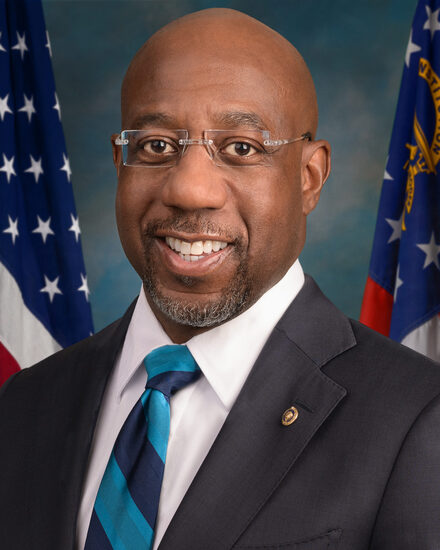
Sen. Raphael G. Warnock
Sponsored bills
Maddy summarySRES 210 is a ceremonial Senate resolution honoring the Blinded Veterans Association (BVA) for its 80th anniversary. It commends BVA’s founding in 1945 by WWII veterans who lost sight and its ongoing advocacy for blind and low-vision veterans, including efforts to improve VA rehabilitation services, guide dog access, and disability benefits. The resolution urges the VA to ensure safe guide dog access at facilities and maintain on-site "Service Dog Champions," but contains no new funding or policy changes. It directly recognizes BVA’s work without altering laws or affecting veterans’ benefits. This is purely a symbolic gesture of appreciation from the Senate.
Maddy summaryThe HUD-USDA-VA Interagency Coordination Act requires the Secretaries of Housing and Urban Development (HUD), Agriculture (USDA), and Veterans Affairs (VA) to establish a formal agreement for sharing housing-related research and market data. Within 180 days of enactment, these agencies must jointly submit a report to Congress detailing opportunities for improved collaboration to enhance efficiency in housing programs, and publish the report for 30 days of public comment beforehand. This bill directly affects HUD, USDA, and VA by mandating new coordination procedures but does not change existing housing laws or funding. The focus is on streamlining data sharing and collaborative planning between the three agencies to support evidence-based policymaking.
Maddy summaryS 1668 prohibits senior U.S. government officials - including the President, Vice President, Members of Congress, and Senate-confirmed appointees - from issuing, sponsoring, or endorsing cryptocurrencies, tokens, or stablecoins for profit. It also bans acquiring similar financial interests through derivatives or investment funds, while allowing normal public market trading. Violations face civil penalties of up to 10% of the financial interest's value or profits gained, and criminal charges if losses exceed $1 million or personal financial gain occurs. The law applies during official service and for one year after leaving office.
Maddy summaryThis bill creates a dedicated single point of contact within the Social Security Administration for individuals affected by identity theft involving their Social Security number. It directly affects victims whose SSN was misused to fraudulently claim benefits (under Titles II, VIII, or XVI of the Social Security Act) or whose physical card was lost during delivery. The key provision requires the SSA to assign a specially trained team to coordinate all aspects of the victim's case, track it to resolution, and maintain continuity even if team members change. The team must be accountable for the case until fully resolved, with procedures ensuring case history continuity and victim notification during transitions. The requirement takes effect 180 days after the bill becomes law.
Maddy summaryS 1649, the Sporting Goods Excise Tax Modernization Act, requires certain online marketplace platforms (like Amazon or eBay) to collect and pay the federal excise tax on sporting goods sold through their platforms, rather than individual sellers. It specifically targets platforms that host third-party listings, handle payments, and facilitate the import of goods from outside the U.S. (e.g., a platform selling a foreign-made golf club). The bill treats these platforms as the "importer and seller" for tax purposes, shifting responsibility to them for collecting the tax under Section 4161 of the tax code. This change applies to sales occurring 60 days after the bill's enactment, with exceptions if tax would otherwise apply to another party. The law aims to modernize tax collection for goods sold via digital marketplaces.
Maddy summaryS 1618, the Precision Agriculture Loan Act of 2025, amends existing farm loan programs to specifically include funding for precision agriculture. It expands loan eligibility for farmers to adopt precision agriculture practices (like GPS-guided equipment) and acquire related technologies (such as soil sensors). The bill adds new provisions allowing these loans to also support participation in environmental incentive programs under the Food Security Act of 1985. It streamlines administration by enabling the Farm Service Agency's Deputy Administrator to handle these loans and simplifying approvals with conservation agencies. This directly affects farmers seeking to modernize operations with technology, with the program now authorized through 2029.
Maddy summarySRES 201 is a non-binding Senate resolution designating the week of May 4-10, 2025, as "National Small Business Week." It honors small businesses and entrepreneurs across all U.S. communities for their economic contributions, citing that small businesses support over 59 million jobs. The resolution recognizes their resilience and celebrates their role in strengthening local economies. This symbolic gesture, consistent with annual presidential proclamations since 1963, does not create new laws or affect any specific group through policy changes.
Maddy summaryThis bill expands the use of 529 college savings plans to cover tuition and related costs for specific aviation training. It allows students to use 529 funds for qualified aviation maintenance courses at FAA-approved Part 147 schools and qualified commercial pilot courses at FAA-approved flight schools (Part 61 or Part 141). The change directly affects students pursuing careers as aircraft maintenance technicians or commercial pilots by making these training costs eligible for tax-advantaged savings. The provision amends the Internal Revenue Code to include these specific aviation programs under existing 529 plan rules, effective after the bill's enactment.
Maddy summaryThis bill requires colleges and universities to improve their net price calculators - tools that help prospective students estimate actual college costs after aid. It mandates clearer website placement, detailed cost breakdowns (including tuition, room/board, books, and available aid), and data updated within two academic years. Calculators must also prominently display privacy protections, stating no personal information is sold or stored. These changes directly affect all institutions of higher education that operate such calculators, aiming to make cost estimates more transparent and user-friendly for students and families.