

Maddy summaryThe Counter Drone State and Local Defender Act (HR 7525) authorizes state, local, tribal, and territorial law enforcement agencies to use approved counter-drone technology to detect, track, and mitigate drone threats at "covered facilities or assets" identified as high-risk by jurisdiction leaders. The bill establishes two pilot programs: a general 3-year program for law enforcement agencies and a special program for security around the 2026 FIFA World Cup, requiring FAA approval of equipment and training. It mandates privacy protections for communications, requires written policies and reporting to Congress about drone mitigation activities, and creates a permanent authorization framework after the pilot programs conclude. The law aims to strengthen security against drone threats while incorporating oversight mechanisms and privacy safeguards for law enforcement operations.
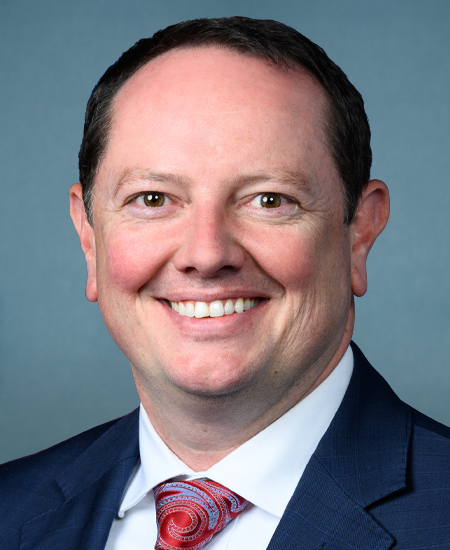
Rep. Eric Burlison
Sponsored bills
Maddy summaryThe No Tax Dollars for Terrorists Act requires the U.S. State Department to identify foreign countries and organizations receiving U.S. foreign aid that have provided financial or material support to the Taliban, including the amounts of aid they receive and the support they give to the Taliban. It mandates a strategy to use U.S. aid to discourage such support, with initial and follow-up reports to Congress on the strategy and its implementation. The bill also demands detailed reports on U.S. cash assistance programs in Afghanistan and the Afghan Fund, explaining how funds are transferred (including traditional money transfer systems) and how safeguards prevent Taliban access.
Maddy summaryThis bill modifies federal budget rules for unspent agency funds. It requires federal agencies to allocate 49% of unused funds to the next fiscal year, 49% toward paying the national debt, and 2% for retention bonuses (capped at 10% of an employee's base pay). Agencies must also limit future budget requests to the previous year's amount adjusted for inflation. The bill directly affects all executive branch agencies (excluding the Red Cross), altering how they manage leftover budget authority. It does not create new savings programs for individuals but changes government fiscal management procedures.
Maddy summaryThis bill prevents state or local governments from banning or restricting energy connections (like installation, modification, or access) based on the type or source of energy, such as electricity, natural gas, or renewable fuels. It directly affects consumers choosing energy providers and energy companies seeking to offer services. The key provision prohibits local laws, regulations, or policies that limit energy services sold in interstate commerce, covering all energy types listed in the bill’s definitions. It does not create new programs but limits regulatory authority at the state or local level. The law aims to ensure open access to diverse energy sources without source-based restrictions.
Maddy summaryThe Make Elections Great Again Act (HR 7300) would require voters to present photo identification to cast ballots in person or by mail for federal elections, with limited exceptions for religious objections or military voters. It would establish new requirements for proving U.S. citizenship during voter registration, including documentary proof of citizenship and proof of state residency. The bill would change mail-in ballot procedures by requiring voters to request mail-in ballots (rather than universal mail-in voting), implementing barcode tracking for mail-in ballots, and setting strict deadlines for ballot receipt. These provisions would apply to all states for federal elections held in 2027 or later, affecting how voters register, vote in person, and submit mail-in ballots for federal office elections.
Maddy summaryThis resolution is a symbolic gesture supporting the designation of January 25-31, 2026, as "National School Choice Week." It does not create new laws or affect specific groups, but formally expresses the House's backing for raising public awareness about parental education options. The resolution encourages parents to learn about K-12 education choices (including public schools, charters, private schools, and homeschooling) and urges communities to host events during that week. It has no binding effect and focuses solely on recognition and awareness, not policy change.
Maddy summaryHR 1295, the Reorganizing Government Act of 2025, amends federal law to streamline executive branch operations. It requires all executive departments (like the Departments of Defense or Education) to eliminate unnecessary programs, reduce federal employee numbers, and cut burdensome regulations that increase compliance costs. The bill updates deadlines for reorganization plans from 1984 to 2026 and explicitly mandates that all government operations must serve the public interest. These changes apply broadly across the federal government, focusing on efficiency and cost reduction.
Maddy summaryHR 3492, the Protect Children’s Innocence Act, makes it a federal crime to perform genital or bodily mutilation or chemical castration on minors under 18, except for specific medical reasons. The bill broadly defines prohibited procedures to include gender transition-related surgeries (like hysterectomies or mastectomies) and medical treatments such as puberty blockers or cross-sex hormones administered to minors. It criminalizes these acts when they occur across state lines, involve payments, or use interstate commerce, while explicitly banning religious tradition as a defense. Exceptions include medically necessary procedures for health emergencies, childbirth, or conditions certified by a physician.
Maddy summaryHR 6734, the Auto Data Privacy and Autonomy Act, gives car, truck, and farm/construction vehicle owners direct control over data generated by their vehicles. It prohibits manufacturers from accessing or sharing vehicle data (including location and personal information) without the owner’s explicit, written consent, and bans selling such data to specific foreign governments like China, Russia, or North Korea. Owners gain free, real-time access to all vehicle data through standard interfaces (like the car’s port or wireless), with no fees for decryption or third-party access, and can delete data or adjust settings via an open application interface. The law requires manufacturers to provide this access without restricting how owners use the data or forcing them to pay for it.
Miracle on Ice Congressional Gold Medal Act This act provides for the award of Congressional Gold Medals to the members of the 1980 U.S. Olympic men's ice hockey team in recognition of the team's achievement at the 1980 Winter Olympic Games.