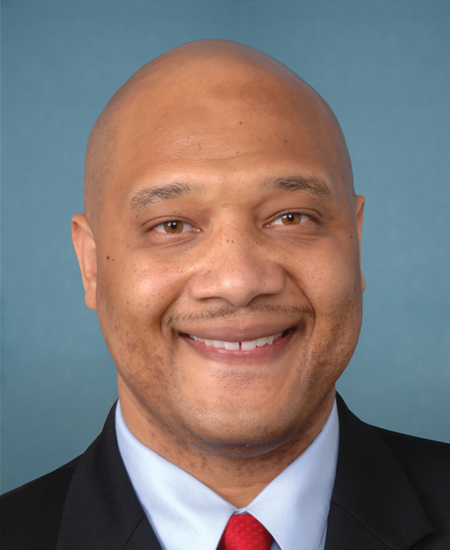
This resolution condemns the bigotry that fueled those who stormed the U.S. Capitol, the elected officials who stoked that bigotry, including former President Trump, and the Members of Congress who have continued to support those individuals. It reaffirms that harmful rhetoric and violent behavior against individuals based on factors including religion, race, immigration status, and sex will not be tolerated.
Rep. André Carson
Sponsored bills
Agriculture Resilience Act This bill establishes, expands, and revises multiple programs and activities of the Department of Agriculture (USDA) primarily to reduce carbon emissions from the agriculture sector. Specifically, USDA must finalize and implement a plan to achieve net-zero emissions from the sector by 2040. USDA must periodically review and revise the plan, as necessary, and annually report on its implementation. Additionally, the bill expands the scope of various USDA research, extension, and education programs; conservation programs; and livestock programs to incorporate climate change adaption and mitigation. Expanded activities include efforts to improve soil health and preserve farmland and grassland. Further, the bill changes programs that support renewable energy in rural areas to address carbon emissions in the agriculture sector. Among these changes, the bill provides statutory authority for a program for reducing methane emissions from livestock waste that is carried out by the Environmental Protection Agency and transitions the program to USDA. The bill also addresses food waste, for example, by (1) standardizing the voluntary labels used by food producers to indicate the date by which food should be used or discarded, and (2) making composting activities eligible for support through USDA conservation programs. Moreover, the bill establishes grants to reduce and prevent food waste in landfills and in schools.
Build America, Buy America Act This bill requires federal infrastructure programs to provide for the use of materials produced in the United States. Each federal agency must submit to the Office of Management and Budget and to Congress a report that identifies each federal financial assistance program for infrastructure administered by the agency and (1) identify domestic content procurement preferences applicable to the assistance, (2) assess the applicability of such requirements, (3) provide details on any applicable domestic content procurement preference requirement, and (4) include a description of the type of infrastructure projects that receive funding under the program. Each agency shall ensure that none of the funds made available for such a program may be used for a project unless all of the iron, steel, and manufactured products used in the project are produced in the United States, subject to waivers where inconsistent with the public interest, where not produced in sufficient quantities or satisfactory quality, or where such inclusion will increase the cost of the project by more than 25%.
Justice is Not For Sale Act of 2021 This bill prohibits private for-profit entities from operating confinement facilities (e.g., prisons) or providing electronic monitoring of released persons at the federal, state, and local levels. The bill also establishes various requirements related to the standards of detention and availability of services at confinement facilities. The bill provides for the establishment of limits on the fees and charges for financial services (e.g., money transfer services), caps on the rates charged for communications services, detention standards and oversight requirements related to the detention of noncitizens, and community-based alternatives to the detention or separation of family units apprehended under immigration authorities.
Congress Commission Act This bill establishes the Congressional Commission to Strengthen Representative Democracy, which must examine and make recommendations relating to changing the membership size of the House of Representatives and the method of electing Representatives.
Hadiya Pendleton and Nyasia Pryear-Yard Gun Trafficking and Crime Prevention Act of 2021 This bill makes trafficking in firearms a stand-alone criminal offense. A person who commits or conspires to commit a gun trafficking offense is subject to criminal penalties—a prison term of up to 20 years (or up to 25 years, if the person also acted as an organizer), a fine, or both.
Gun Show Loophole Closing Act of 2021 This bill establishes new requirements regarding firearm transfers at gun shows. Specifically, the bill requires the following: a person who operates a gun show must meet certain requirements (e.g., minimum age and registration); and a firearm transfer between private parties at a gun show must be facilitated by a licensed gun dealer, importer, or manufacturer in compliance with certain background check and recordkeeping requirements.
Handgun Trigger Safety Act of 2021 This bill establishes a framework to regulate handguns as consumer products. The bill establishes two general requirements: (1) new domestically manufactured handguns must be personalized handguns, and (2) handguns distributed in commerce must be personalized handguns or retrofitted personalized handguns. A personalized handgun allows only an authorized user to fire the handgun. The bill directs the National Institute of Justice to make grants to develop technology for personalized handguns. It also requires gun manufacturers to retrofit, at an owner's request, a domestically manufactured handgun that is not a personalized handgun or retrofitted personalized handgun. The bill authorizes the Consumer Product Safety Commission (CPSC) to issue safety standards for personalized handguns. The CPSC and states may enforce violations, which are treated as violations under the Consumer Product Safety Act. The bill retains civil liability protections for gun manufacturers for harms resulting from the misuse of a handgun, but only if the handgun is a personalized handgun or retrofitted personalized handgun.
NICS Review Act of 2021 This bill revises the amount of time that the national instant criminal background check system retains certain information about an approved firearm transaction. Currently, identifying information about an approved firearm purchaser must be destroyed within 24 hours. This bill requires identifying information about an approved firearm purchaser to be retained for at least 90 days before it can be destroyed.
Firearm Risk Protection Act of 2021 This bill establishes requirements for gun purchasers and gun owners to be covered by a qualified liability insurance policy. A qualified liability insurance policy, with respect to a firearm purchaser, is a policy that covers losses resulting from use of the firearm while it is owned by the purchaser. A person who fails to comply with the requirements is subject to a criminal fine of up to $10,000.