This resolution honors Officers Brian Sicknick and Howard Liebengood of the U.S. Capitol Police, and it commends the bravery and service demonstrated by officers of the U.S. Capitol Police, the Metropolitan Police Department of the District of Columbia, and the other law enforcement agencies and protective entities that assisted in responding to the January 6, 2021, attack on the U.S. Capitol.
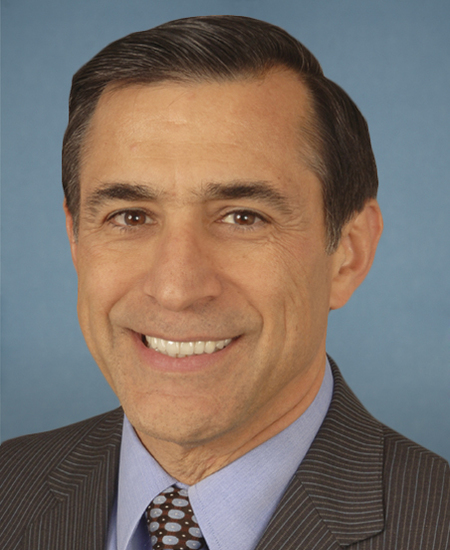
Rep. Darrell Issa
Sponsored bills
Stop the High-Speed Money Pit Act This bill prohibits the use of federal funds for a high-speed rail corridor development project in California that is the same or substantially similar to the project that is the subject of a cooperative agreement entered into on December 16, 2009, between the California High-Speed Rail Authority and the Federal Railroad Administration.
Hearing Protection Act This bill removes silencers from the definition of firearms for purposes of the National Firearms Act. It also treats persons acquiring or possessing a firearm silencer as meeting any registration and licensing requirements of such Act. The Department of Justice must destroy certain records relating to the registration, transfer, or making of a silencer. The bill also revises the definitions of firearm silencer and firearm muffler under the federal criminal code and includes such items in the 10% excise tax category.
Concealed Carry Reciprocity Act This bill establishes a federal statutory framework to regulate the carry or possession of concealed firearms across state lines. Specifically, an individual who is eligible to carry a concealed firearm in one state may carry or possess a concealed handgun (other than a machine gun or destructive device) in another state that allows its residents to carry concealed firearms. It sets forth requirements for the lawful concealed carry across state lines. The bill preempts most state and local laws related to concealed carry and establishes a private right of action for a person adversely affected by interference with a concealed-carry right established by this bill.
PPP Flexibility for Farmers and Ranchers Act This bill expands eligibility for agricultural producers under the Paycheck Protection Program, established to support small businesses in response to COVID-19 (i.e., coronavirus disease 2019), to include certain agricultural producers organized as partnerships. Currently, only certain agricultural producers that are sole proprietorships, independent contractors, or self-employed individuals may receive support under the program.
This resolution reaffirms the United States' commitment to supporting democracy and human rights both domestically and internationally. The resolution also calls on the U.S. government to uphold all relevant international human rights agreements ratified by the United States.
This resolution recognizes the roles that development and diplomacy play in advancing American interests and national security, and it expresses support for a substantial U.S. international affairs budget.
American Values and Security in International Athletics Act This bill requires the Department of State to distribute specified briefing materials to individuals representing the United States at international athletic competitions. These materials must contain information on human rights concerns and personal privacy and security risks posed by certain host countries (e.g., specified communist countries and countries that do not meet certain minimum standards with respect to human trafficking and are not making significant efforts to do so).
Keystone XL Pipeline Construction and Jobs Preservation Act This bill authorizes the TransCanada Keystone Pipeline to construct, connect, operate, and maintain the pipeline facilities in Phillips County, Montana, for the import of oil from Canada to the United States.
National Right-to-Work Act This bill repeals those provisions of the National Labor Relations Act and the Railway Labor Act that permit employers to make an agreement with a labor union to require employees to join such union as a condition of employment. Currently, at least 27 states have enacted laws prohibiting employers from compelling employees to become members of a union as a condition of employment.