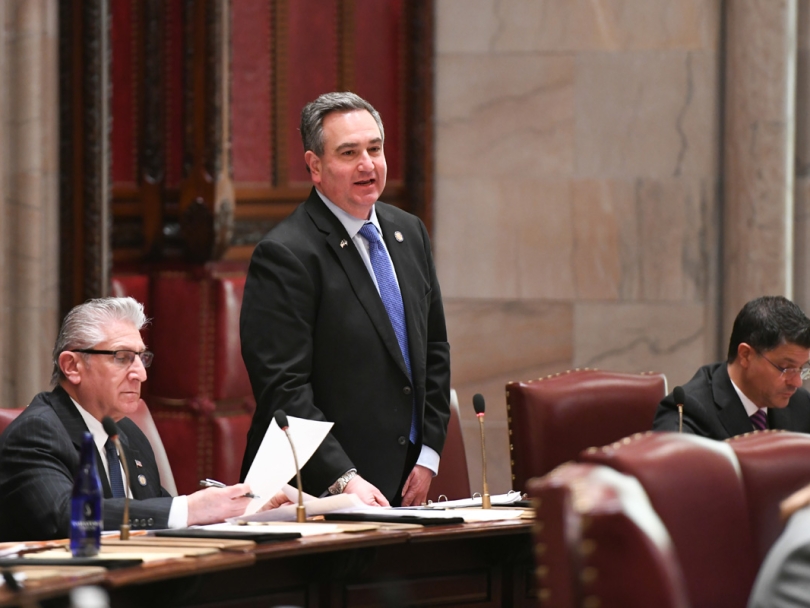
This bill (S 5418) allows New York cities, counties, towns, and fire/police districts to waive citizenship requirements for police and firefighter candidates who provide proof of an honorable military discharge from U.S. or New York military service (including National Guard or Naval Militia). It directly affects non-citizen applicants with military service history who would otherwise be ineligible due to citizenship rules. The key provision amends state law to permit local governing bodies to exempt these candidates from citizenship requirements if they submit verified military discharge documentation. This creates a pathway for qualified military veterans to serve in local emergency services roles without U.S. citizenship.
This bill establishes a Coordinator of Asylum Seeker Services to oversee and integrate support for asylum seekers in New York State. The Governor and the Mayor of New York City will jointly appoint this coordinator. The coordinator will be responsible for developing a systemic response to various needs, including housing, healthcare, education, language services, and transportation. This role involves integrating efforts across specific state agencies, as well as applicable local and federal agencies, to facilitate resettlement and access to federal programs.
Requires the court to advise a defendant that if such defendant is a noncitizen resident and is convicted of a crime, whether by plea or trial, such conviction may result in such defendant's deportation; allows a withdrawal of a plea of guilty by a noncitizen resident if such noncitizen resident is threatened with deportation and such noncitizen resident is not so advised of such threat of deportation.
Prohibits the permanent or temporary housing of migrant populations in schoolhouses or on school grounds in districts outside of a city with a population of one million or more.
S 103, the "New York Religious Freedom Act," prohibits state and local agencies and law enforcement from collecting, sharing, or using personally identifiable information about individuals' religious beliefs, practices, or affiliations for government databases related to law enforcement or immigration. It specifically bans using public funds or resources to create or enforce such databases and restricts sharing religious data with federal authorities, except in limited cases like targeted criminal investigations with a clear link to the crime or for providing religious accommodations. The law also terminates existing agreements that conflict with these restrictions and clarifies that agencies may still share citizenship or immigration status information as permitted under federal law. This directly affects all New York state and local government agencies handling personal data.
Provides that schools, child day cares, day care centers, or community based organizations which support activities for children under the age of eighteen can not serve as a shelter for migrants.
This bill proposes amending the state constitution to require that only U.S. citizens may vote in elections. It would replace the current voting eligibility language with a specific provision stating "Only citizens shall be entitled to vote," while maintaining existing requirements that voters must be at least 18 years old and residents of the state and their local area for 30 days prior to an election. The key change directly affects voting eligibility by restricting the right to vote to citizens, removing any existing non-citizen voting provisions. If passed, this would be a constitutional change, not a temporary law, requiring approval through the standard amendment process.
Requires the city university of New York and state university of New York have education programs for prospective teachers, administrators, and counselors for teaching immigrant-origin students that promotes diversity, equity and inclusion, and is multilingual.
Provides that employees of the state police shall not be directed by executive order or regulations to not assist with the enforcement of federal laws.
S 3602 prevents New York's Medicaid program from ending benefits for Temporary Protected Status (TPS) and DACA recipients if the federal government terminates these programs. It ensures current beneficiaries retain coverage and extends eligibility to former TPS/DACA recipients who meet all requirements except immigration status. The law takes effect immediately upon enactment. This applies solely to New York State's Medicaid program, not federal benefits.