Issue · Healthcare

Healthcare (Medicaid)

Every healthcare bill, vote, and legislator stance in New York, automatically classified by Maddy, our AI policy reader.

Total bills
188
2025 Regular Session
Top supporter
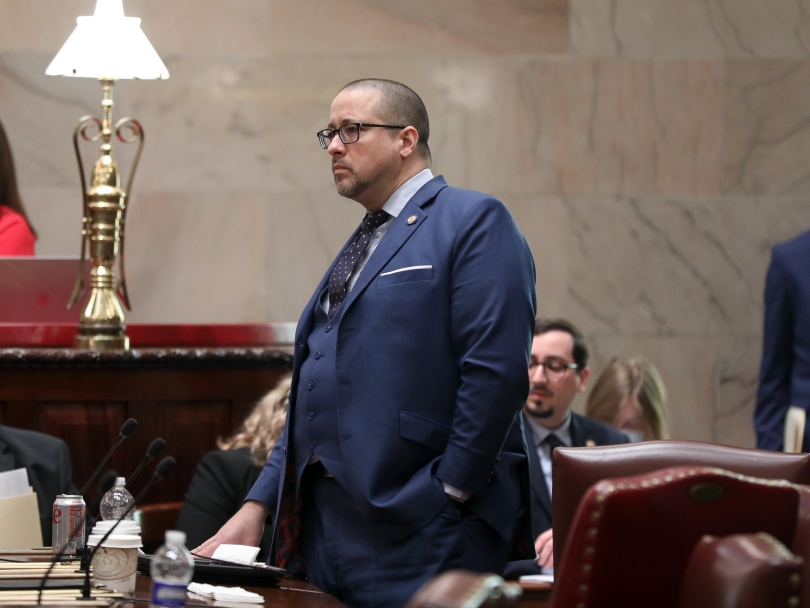
Gustavo Rivera
100% support rate
Top opponent
Andrew Lanza
0% support rate
Ranked legislators
10
5 support · 5 oppose
Key legislators

Who's moving medicaid in New York

Legislators moving medicaid in New York
Legislator Party Stance Support rate Decisive votes
Gustavo Rivera
Gustavo Rivera Senate · District 33
D
Strong +
100% 14
Robert Jackson
Robert Jackson Senate · District 31
D
Strong +
100% 12
Lea Webb
Lea Webb Senate · District 52
D
Strong +
100% 11
Kevin Parker
Kevin Parker Senate · District 21
D
Strong +
100% 10
Zellnor Myrie
Zellnor Myrie Senate · District 20
D
Strong +
100% 10
Andrew Lanza
Andrew Lanza Senate · District 24
R
Strong −
0% 6
Alexis Weik
Alexis Weik Senate · District 8
R
Strong −
14% 7
Patricia Canzoneri-Fitzpatrick
Patricia Canzoneri-Fitzpatrick Senate · District 9
R
Strong −
17% 6
George Borrello
George Borrello Senate · District 57
R
Oppose
25% 8
Dean Murray
Dean Murray Senate · District 3
R
Oppose
29% 7
Showing 171–180 of 188 bills

All healthcare bills

in committee · New York · Assembly Jan 7, 2026

A 2156: Relates to medical assistance for patients for infertility treatment

This bill would require New York's Medicaid program to cover ovulation-enhancing drugs and specific monitoring services for women seeking infertility treatment. It mandates coverage for the drugs themselves, office visits, hysterosalpingograms, pelvic ultrasounds, and blood tests necessary to monitor the treatment. If federal funding for these services falls below 90%, the state must use its own funds to create a grant program to maintain coverage. The bill directly affects Medicaid-eligible women undergoing infertility treatment by expanding their covered services to include these specific treatments and monitoring procedures.
Sub-Topics Medicaid
in committee · New York · Senate Jan 7, 2026

S 2449: Requires Medicare and Medicaid managed care providers to provide coverage for certain out-of-network health care

Requires Medicare and Medicaid managed care providers to provide coverage for certain out-of-network health care when the patient has a long term relationship with a medical professional who is not a recurring provider under the managed care provider's network.
Sub-Topics Medicaid Medicare
in committee · New York · Assembly Jan 7, 2026

A 4051: Relates to including accountable care organizations within the definition of a managed care provider

This bill amends New York's social services law to include accountable care organizations (ACOs) under the legal definition of "managed care provider." It directly affects ACOs established under Article 29-E of the Public Health Law, allowing them to operate under the same regulatory framework as traditional managed care plans for Medicaid programs. The key change adds specific language to the law stating that ACOs qualify as managed care providers, streamlining their eligibility for Medicaid contracts. The Health Commissioner must implement these changes through regulations, effective immediately upon the bill's enactment.
Sub-Topics Medicaid Public Health
in committee · New York · Senate Jan 7, 2026

S 6164: Relates to prescription drugs in Medicaid managed care programs; repealer

Requires Medicaid managed care, and Child Health Plus plans to adopt the procedural protections of the Preferred Drug Program, including "prescriber prevails", for all drugs.
in committee · New York · Assembly Jan 7, 2026

A 5199: Ensures that temporary protected status beneficiaries continue to receive Medicaid benefits

This bill (A 5199) ensures that New York residents with Temporary Protected Status (TPS) or Deferred Action for Childhood Arrivals (DACA) status maintain Medicaid benefits even if the federal government ends those programs. It directly affects TPS beneficiaries and DACA recipients in New York by preventing the state from canceling their Medicaid coverage due to changes in federal immigration designations. Key provisions require the state health department to: (1) keep Medicaid benefits active for TPS/DACA recipients if federal programs end, and (2) extend eligibility to former TPS/DACA recipients who meet all other Medicaid requirements except immigration status. The law takes effect immediately upon enactment.
in committee · New York · Senate Jan 7, 2026

S 586: Establishes a mandated window of five business days for both Medicaid and private insurers to respond to pre-authorization claims for testing and/or treatments made by physicians on behalf of oncology patients

Establishes a mandated window of five business days for both Medicaid and private insurers to respond to pre-authorization claims for testing and/or treatments made by physicians on behalf of oncology patients.
Sub-Topics Medicaid
in committee · New York · Senate Jan 7, 2026

S 5249: Relates to Medicaid eligibility for striking workers

This bill (S 5249) automatically grants Medicaid eligibility to workers participating in strikes or labor disputes, ensuring they maintain health coverage during the strike period. It directly affects striking employees who would otherwise lose Medicaid due to employment status, without requiring them to reapply. Key provisions include limiting coverage strictly to the duration of the strike, prohibiting the consideration of personal resources (like savings) when determining eligibility, and allowing temporary "presumptive eligibility" through health department processes. The bill requires the Health Commissioner to create implementing regulations for eligibility rules and covered services.
in committee · New York · Senate Jan 7, 2026

S 5361: Provides for a minimum reimbursement rate for ambulatory behavioral health services

This bill (S 5361) requires health insurers in New York to reimburse licensed behavioral health providers (under public health or mental hygiene laws) for ambulatory behavioral health services at a minimum rate equivalent to what the state's Medicaid program (Medical Assistance) pays for similar services. It applies to all health insurance policies covering medical, major medical, or comprehensive coverage, including group plans and health maintenance organizations. Insurers may negotiate higher rates with providers but cannot pay less than the Medicaid-equivalent rate established under the Ambulatory Patient Group (APG) methodology. The law takes effect September 1, 2025, for all new or renewed policies.
in committee · New York · Assembly Jan 7, 2026

A 1359: Relates to the establishment of rates of payment for medical assistance for needy persons

This bill requires New York's health commissioner to update medical assistance payment rates for hospitals and health services at least every four years, ensuring rates reflect current operational costs rather than outdated data. It directly affects hospitals, health service providers, and Medicaid programs by mandating that reimbursement rates align with recent cost information for efficient operations. Key provisions include prohibiting the use of base-year calculations older than four years and requiring annual public disclosure of reimbursement methodologies on the state health department's website. The changes aim to modernize payment structures for Medicaid and related programs without altering eligibility or benefit levels.
Sub-Topics Medicaid
in committee · New York · Assembly Jan 7, 2026

A 2170: Repeals the state Medicaid spending cap and related processes; repealer

This bill repeals a 2011 law that imposed a spending cap on the state's Medicaid program, specifically removing Sections 91 and 92 of Chapter 59. It directly affects how the state Department of Health manages Medicaid funding by eliminating the annual growth limit on state funds for Medicaid. The key mechanism is the complete removal of these specific legal provisions, allowing Medicaid spending to increase without the previous restriction. This change takes effect immediately upon enactment.
Showing 171 to 180 of 188 bills