Maddy summaryThis resolution prohibits U.S. Senators from using official funds for certain travel during government shutdowns. Specifically, it prevents Senators from using money from their Official Personnel and Office Expense Account. These funds cannot be used to pay for or reimburse a Senator for travel between Washington D.C. and their primary residence. This restriction applies only when there is a lapse in appropriations for one or more federal agencies.
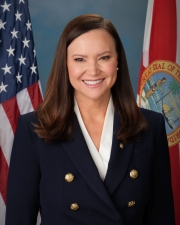
Sen. Ashley Moody
Sponsored bills
Maddy summaryThe FLEX Act amends the Elementary and Secondary Education Act to increase federal funding and flexibility for high-quality charter schools. It requires that at least 15 percent of Title IV funds go to charter schools, raising the previous requirement of 12.5 percent, and expands allowable uses of these funds to include new academic programs, personalized learning, and facility improvements. The bill also introduces advance payment options for grant recipients to help with planning and program design, while allowing states to use existing charter authorization applications to streamline the grant process. Additionally, the legislation directs the Secretary of Education to consult with charter school operators before issuing new rules and limits the number of non-essential regulations imposed on these schools.
Maddy summaryThe Breast Cancer Stamp Reauthorization Act extends the sale of a special postage stamp dedicated to breast cancer research until the year 2037. This change directly affects the United States Postal Service and the public by allowing the continued availability of this specific stamp for purchase. The bill achieves this by amending federal law to update the expiration date for the stamp's authorized sale period. No other policy changes or funding mechanisms are introduced by this legislation.
Maddy summaryThis resolution prohibits U.S. Senators from using their official office funds to pay for or be reimbursed for official travel expenses. Specifically, it prevents funds from a Senator's Official Personnel and Office Expense Account from being obligated or expended for travel. This restriction applies during any period when there is a lapse in appropriations for one or more federal agencies, commonly known as a government shutdown.
Maddy summarySRES 627 is a Senate resolution designating March 5, 2026, as "National Slam the Scam Day" to raise public awareness about government imposter scams. It specifically targets scams where fraudsters impersonate agencies like the IRS, Social Security, or Medicare to steal money or personal information, disproportionately affecting older adults. The resolution encourages education through community groups, law enforcement, and financial institutions to help people recognize and report these scams, without creating new laws or regulations.
Maddy summaryThe Combating Illicit Xylazine Act places xylazine - a veterinary sedative increasingly found in illicit drug mixtures - into Schedule III of the Controlled Substances Act, subjecting it to federal regulation as a controlled substance. It specifically allows veterinary use without requiring registration of the ultimate user (e.g., pet owners or veterinarians) if xylazine is dispensed by a registered veterinarian or pharmacy with a vet prescription and used for animals owned by the user, under their care, or in authorized animal programs. The bill provides a one-year delay for labeling and packaging requirements and a 60-day delay for registration and recordkeeping for veterinary use to ease implementation. Additionally, it adds xylazine to the Arcos tracking system for controlled substances and mandates two congressional reports on illicit use prevalence within 18 months and 4 years of enactment.
Maddy summaryThis bill designates a memorial and museum currently being constructed in Jacksonville, Florida, as the "National POW/MIA Memorial and Museum." The facility aims to honor and educate the public about members of the Armed Forces who were prisoners of war or are missing in action since World War II. To maintain this national designation, the museum's director must submit a report to Congress within 90 days outlining its budget, organizational structure, and accreditation. The designation can be withdrawn if the museum is not operational within five years or if this report is not submitted on time.
Maddy summaryThis resolution designates March 21, 2026, as "National Osceola Turkey Day" to recognize the cultural and economic significance of wild turkey hunting in the United States. The bill highlights the role of turkey hunting in conservation efforts, particularly in Florida, where revenue from hunting permits supports habitat management through the Wild Turkey Cost Share Program. It notes that the Osceola subspecies is unique to peninsular Florida and is one of five wild turkey subspecies in North America. The resolution encourages Americans to observe the day with ceremonies and activities celebrating turkey hunting traditions.
Safeguard American Voter Eligibility Act or the SAVE America Act This bill requires individuals to provide documentary proof of U.S. citizenship when registering to vote, and requires photo identification to vote, in federal elections. Specifically, the bill prohibits states from accepting and processing an application to register to vote in a federal election unless the applicant presents documentary proof of U.S. citizenship. The bill specifies what documents are considered acceptable proof of U.S. citizenship, such as identification that complies with the REAL ID Act of 2005 that indicates U.S. citizenship, a valid U.S. passport, or a valid government-issued photo identification card that shows the applicant's place of birth was in the United States. Further, the bill (1) requires states to accept and process a voter registration application in the event of a name discrepancy in the applicant's documentation, as long as the applicant provides additional documentation; and (2) requires states to establish an alternative process to demonstrate U.S. citizenship. Within 30 days of the bill's enactment, each state must take affirmative steps on an ongoing basis to ensure that only U.S. citizens are registered to vote, which shall include establishing a program to identify individuals who are not U.S. citizens using information supplied by certain sources. Further, each state must submit its complete official list of eligible voters to the Department of Homeland Security for comparison with the Systematic Alien Verification for Entitlements system, which is used to verify immigration status. Individuals who are identified as noncitizens must be given the opportunity to provide documentary proof of U.S. citizenship. Additionally, states must remove noncitizens from their official lists of eligible voters. The bill (1) provides for a private right of action for certain violations, and (2) establishes criminal penalties for certain offenses. The bill prohibits a state or local election official from providing a ballot for a federal election to an individual who does not present valid physical photo identification. An individual who does not present the required identification must be permitted to cast a provisional ballot. However, an election official may not determine that the individual is eligible under state law to vote in the election unless, not later than three days after casting the provisional ballot, the individual presents (1) the identification required, or (2) an affidavit attesting that the individual does not possess the identification because of a religious objection to being photographed. Further, an election official may not allow for voting methods other than in-person voting unless the individual submits the ballot with (1) a copy of their photo identification, or (2) the last four digits of their Social Security number with an affidavit attesting that the individual is unable to obtain a copy of a valid photo identification after making reasonable efforts to obtain a copy. This prohibition shall not apply to overseas military voters or individuals provided the right to vote other than in person under the Voting Accessibility for the Elderly and Handicapped Act. State and local government officials must provide, to the extent practicable, public access to a digital imaging device for the purpose of allowing individuals to use the device at no cost to make a copy of their valid photo identification.
Maddy summaryThe STOP FRAUD in Medicaid Act expands the scope of Medicaid fraud investigations by directing state Medicaid fraud control units to examine not just providers but also individuals who apply for or receive benefits. This change requires states to investigate and prosecute fraudulent activities involving both healthcare providers and beneficiaries seeking or receiving Medicaid coverage. The bill amends existing federal law to explicitly include individuals in the definition of entities subject to fraud control unit oversight. These provisions take effect 180 days after the law is enacted, giving states time to adjust their investigation procedures.