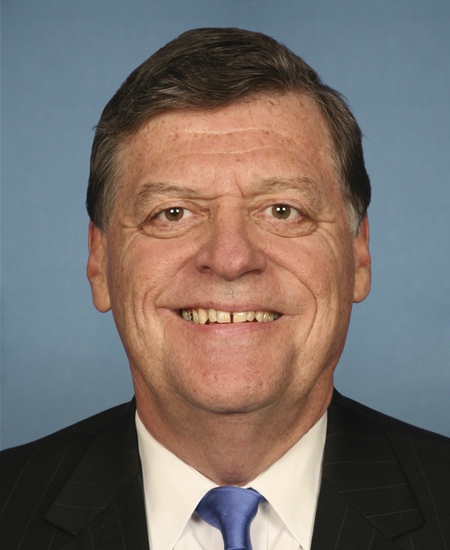
Photo of Tom Cole
R United States House · District 4 · Oklahoma On the 2026 ballot

Rep. Tom Cole

Compare
Total votes
2,837
all sessions
Attendance
98%
50 missed
Near the chamber average
With party
91%
of cast votes
Near the chamber average
Bipartisan score
5%
crosses aisle rarely
Near the chamber average
Sponsored
675
bills & resolutions
Lower than 94% of chamber peers
Committees
1
assignment
675 bills and resolutions

Sponsored bills

Total
675
Primary
61
Co-sponsor
614
This page
675
matching current filters
Primary HR 9187
In committee · Missouri House · Lead sponsor
Bipartisan Social Security Commission Act of 2026

Maddy summaryThis bill establishes a bipartisan Commission on Long-Term Social Security Solvency to study and propose solutions for ensuring the financial stability of Social Security for at least 75 years. The 13-member commission includes appointments from the President, congressional leaders, and committee chairs, with at least half of the congressional appointees required to be non-political experts. After holding public hearings and gathering data, the commission must submit a report with specific legislative recommendations, which Congress is then required to expedite and vote on without amendments. The commission is authorized up to $2 million in funding and will dissolve shortly after submitting its final report.

In committee Jun 8, 2026 0 co-sponsors
Primary HR 7147
Signed into law · Missouri House · Lead sponsor
Homeland Security and Further Additional Continuing Appropriations Act, 2026.

Further Additional Continuing Appropriations Act, 2026 This bill provides continuing FY2026 appropriations to the Department of Homeland Security (DHS) through May 22, 2026. It is known as a continuing resolution (CR) and ends the partial DHS shutdown that began on February 14, 2026, due to a lapse in appropriations for DHS. The CR generally funds most DHS agencies and programs at the FY2025 levels through the earlier of May 22, 2026, or the enactment of the FY2026 DHS appropriations act. The bill also authorizes back pay, in accordance with current law, for federal employees who were affected by the partial DHS shutdown. Finally, the bill ratifies and approves certain obligations that were incurred during the partial DHS shutdown, including obligations incurred to maintain the essential level of activity to protect life and property and bring about an orderly termination of government functions.

Signed into law Apr 30, 2026 0 co-sponsors
Co-sponsor HR 8092
In committee · Missouri House · Co-sponsor
Native American Housing Assistance and Self-Determination Modernization Act of 2026

Maddy summaryThis bill modernizes housing assistance programs for Native American tribes and Native Hawaiians by streamlining environmental reviews, extending funding authorization through 2032, and expanding loan guarantee options. Key provisions include consolidating environmental review requirements to reduce paperwork for tribes, allowing 99-year leasehold interests on trust lands for housing, and creating new rental assistance specifically for homeless or at-risk Native American veterans. The legislation also clarifies rent rules, waives certain housing counseling certifications for tribal entities, exempts tribal housing projects from some federal civil rights and Buy America requirements, and establishes a direct loan guarantee process for tribal housing projects.

In committee Apr 23, 2026 1 co-sponsor
Co-sponsor HR 151
In committee · Missouri House · Co-sponsor
Equal Representation Act of 2025

Equal Representation Act This bill requires that the statement sent by the President to Congress after the decennial census indicating the number of persons in each state exclude noncitizens. (This statement is the basis for reapportionment of U.S. Representatives.) The bill also requires any questionnaire used in the decennial census to include a checkbox or other similar option for respondents to indicate whether the respondent and each household member is (1) a U.S. citizen, (2) a U.S. national but not a citizen, (3) a non-U.S. national ( alien under federal law) lawfully residing in the United States, or (4) a non-U.S. national unlawfully residing in the United States. The Department of Commerce must make public the number of persons in each state, disaggregated by each of these four categories.

In committee Apr 21, 2026 1 co-sponsor
Co-sponsor HR 8380
In committee · Missouri House · Co-sponsor
To amend the Congressional Budget and Impoundment Control Act of 1974 to establish certain procedures for consideration of annual appropriation bills, and for other purposes.

Maddy summaryHR 8380 amends the Congressional Budget and Impoundment Control Act of 1974 to establish new procedures for how the Senate and House of Representatives consider annual appropriation (spending) bills. In the Senate, the bill applies existing rules for budget resolutions to these spending bills and limits debate on them to a maximum of 20 hours. For the House of Representatives, it prohibits adjourning for more than three calendar days during the month of July until all annual appropriation bills for the upcoming fiscal year have been approved by the House. These changes directly affect how members of Congress manage and approve federal spending legislation.

In committee Apr 20, 2026 1 co-sponsor
Co-sponsor HR 1422
Passed · Missouri House · Co-sponsor
Enhanced Iran Sanctions Act of 2025

Enhanced Iran Sanctions Act of 2025 This bill imposes sanctions on certain foreign persons (individuals and entities) that are involved in Iran's petroleum sector as well as certain associated persons. The bill also requires or authorizes actions to facilitate the enforcement of sanctions on Iran. Specifically, the bill requires the President to impose visa- and property-blocking sanctions on any foreign person that, after the bill's enactment, knowingly engages in any transaction related to the processing, export, or sale of oil, condensates, gas, liquefied natural gas, or other petrochemical products in whole or in part from Iran. The President must also impose sanctions on certain foreign persons associated with a sanctioned individual or entity. For example, the President must sanction the subsidiaries and corporate officers of a sanctioned business. The bill provides certain exceptions to these sanctions, including specifying that sanctions do not apply to the importation of goods or to conducting or facilitating transactions for humanitarian assistance. The Department of State must establish an interagency working group that shall seek to establish a multilateral contact group to coordinate international efforts to enforce sanctions on Iran. The bill expands the State Department rewards program to authorize a reward payment to any individual who furnishes information leading to the identification of a person (1) subject to sanctions under this bill, or (2) that has attempted or is attempting to evade sanctions under this bill.

Passed Mar 17, 2026 1 co-sponsor
Primary HR 7744
Passed · Missouri House · Lead sponsor
Department of Homeland Security Appropriations Act, 2026

Department of Homeland Security Appropriations Act, 2026 This bill provides appropriations to the Department of Homeland Security (DHS) for the remainder of FY2026. It also ends the partial DHS shutdown that began on February 14, 2026, because the continuing resolution (CR) that was funding DHS expired and a regular FY2026 DHS appropriations bill had not been enacted.  Specifically, the bill provides appropriations to DHS for Departmental Management, Intelligence, Situational Awareness, and Oversight, including the Office of the Secretary and Executive Management; the Management Directorate; Intelligence, Analysis, and Situational Awareness; and the Office of Inspector General. In addition, the bill provides appropriations for Security, Enforcement, and Investigations, including U.S. Customs and Border Protection, U.S. Immigration and Customs Enforcement, the Transportation Security Administration, the U.S. Coast Guard, and the U.S. Secret Service. The bill provides appropriations for Protection, Preparedness, Response, and Recovery, including the Cybersecurity and Infrastructure Security Agency, and the Federal Emergency Management Agency (FEMA). The bill provides appropriations for Research, Development, Training, and Services, including U.S. Citizenship and Immigration Services, the Federal Law Enforcement Training Centers, and the Science and Technology Directorate. The bill also authorizes back pay, in accordance with current law, for federal employees who were affected by the partial DHS shutdown. Finally, the bill ratifies and approves certain obligations that were incurred during the partial DHS shutdown, including obligations incurred to maintain the essential level of activity to protect life and property and bring about an orderly termination of government functions.
Passed Mar 9, 2026 0 co-sponsors
Co-sponsor HR 7698
In committee · Missouri House · Co-sponsor
Tribal Firearm Access Act

Maddy summaryThis bill, known as the Tribal Firearm Access Act, would allow members of federally recognized Tribes to use their Tribal government identification documents instead of state-issued IDs when purchasing firearms from federally licensed dealers. The legislation amends federal law to officially recognize Tribal government IDs as valid forms of identification for firearm transactions, while defining "Tribal government" to include the governing bodies of federally recognized Indian and Alaska Native Tribes. The changes would take effect 90 days after the bill is enacted, directly affecting Tribal members seeking to exercise their right to purchase firearms under current federal regulations.

In committee Feb 25, 2026 1 co-sponsor
Co-sponsor HR 7705
In committee · Missouri House · Co-sponsor
Tribal Tax and Investment Reform Act of 2026

Maddy summaryThis bill, the Tribal Tax and Investment Reform Act of 2026, treats federally recognized Indian tribes and Alaska Native entities as states for specific tax purposes, allowing them to issue tax-exempt bonds and maintain employee pension plans under the same rules as state governments. It creates a new $175 million annual tax credit allocation for investments in tribal areas, expands existing employment tax credits, and clarifies how tribal general welfare benefits and trust funds are treated for federal assistance programs. The legislation also establishes uniform fiduciary standards for tribal pension plans, provides technical assistance for tribal area investments, and ensures tribal areas qualify for certain affordable housing tax incentives.

In committee Feb 25, 2026 1 co-sponsor
Co-sponsor HR 2130
In committee · Missouri House · Co-sponsor
Tribal Trust Land Homeownership Act of 2025

Tribal Trust Land Homeownership Act of 2025 This bill sets forth requirements for the processing of a proposed residential leasehold mortgage, business leasehold mortgage, land mortgage, or right-of-way document by the Bureau of Indian Affairs (BIA). The BIA must notify lenders upon receipt of such documentation, perform a preliminary review of such documents not later than 10 days after receipt, and approve or disapprove of such documents within 20 or 30 days, depending on the type of application. Additionally, the bill sets forth requirements for the BIA regarding (1) response times for the completion of certified title status reports, (2) notification of delays in processing, and (3) the form of notices and delivery of certain reports. The bill also provides relevant federal agencies and Indian tribes with read-only access to the Trust Asset and Accounting Management System maintained by the BIA. The Government Accountability Office must report on digitizing documents for the purpose of streamlining and expediting the completion of mortgage packages for residential mortgages on Indian land. Finally, the bill establishes within the BIA's Division of Real Estate Services the position of Realty Ombudsman.

In committee Feb 23, 2026 1 co-sponsor
Showing 21 to 30 of 675 bills
Previous 1 … 2 3 4 … 68 Next