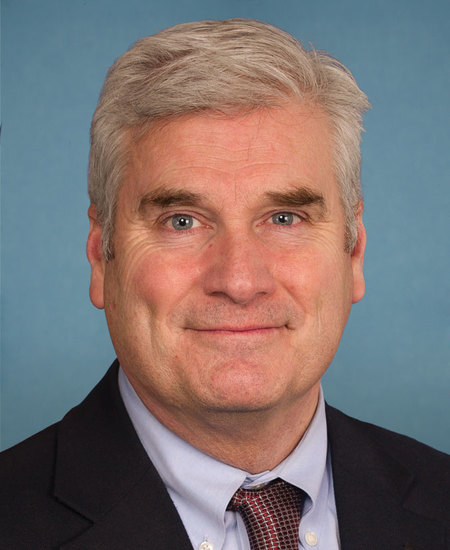
Photo of Tom Emmer
R United States House · District 6 · Minnesota On the 2026 ballot

Rep. Tom Emmer

Compare
Total votes
2,837
all sessions
Attendance
98%
49 missed
Near the chamber average
With party
96%
of cast votes
Higher than 93% of chamber peers
Bipartisan score
2%
crosses aisle rarely
Lower than 94% of chamber peers
Sponsored
514
bills & resolutions
Lower than 99% of chamber peers
Committees
2
assignments
514 bills and resolutions

Sponsored bills

Total
514
Primary
59
Co-sponsor
455
This page
514
matching current filters
Primary HR 3234
Passed · Missouri House · Lead sponsor
Keeping Deposits Local Act

Maddy summaryHR 3234, the "Keeping Deposits Local Act," amends the Federal Deposit Insurance Act to adjust how banks calculate reciprocal deposits that don't count as "funds obtained through a deposit broker." It establishes tiered percentage thresholds based on a bank's total liabilities: 50% for banks under $1 billion, decreasing to 40% for $1-10 billion, 30% for $10-250 billion, 20% for $250 billion-$1 trillion, and 2% for banks over $1 trillion. This change directly affects commercial banks, particularly smaller institutions, by allowing them to hold a larger share of deposits without triggering stricter broker-related regulations. The bill aims to simplify compliance for community banks while maintaining oversight for larger financial institutions.

Passed May 21, 2026 0 co-sponsors
Co-sponsor HR 7320
In committee · Missouri House · Co-sponsor
Minnesota Voter Integrity Act of 2026

Maddy summaryHR 7320, the Minnesota Voter Integrity Act of 2026, requires the Minnesota Secretary of State to submit specific voting records to the Attorney General before the state can receive federal funds under the Help America Vote Act of 2002. It mandates the submission of records related to same-day voter registrations, votes cast under those registrations, and other specified voting records under Minnesota law. This bill does not change voting procedures but ties federal funding eligibility to the disclosure of these administrative records. The requirement directly affects Minnesota's state election administration by imposing a documentation condition for accessing federal election funds.

In committee Feb 2, 2026 1 co-sponsor
Co-sponsor HR 7300
In committee · Missouri House · Co-sponsor
Make Elections Great Again Act

Maddy summaryThe Make Elections Great Again Act (HR 7300) would require voters to present photo identification to cast ballots in person or by mail for federal elections, with limited exceptions for religious objections or military voters. It would establish new requirements for proving U.S. citizenship during voter registration, including documentary proof of citizenship and proof of state residency. The bill would change mail-in ballot procedures by requiring voters to request mail-in ballots (rather than universal mail-in voting), implementing barcode tracking for mail-in ballots, and setting strict deadlines for ballot receipt. These provisions would apply to all states for federal elections held in 2027 or later, affecting how voters register, vote in person, and submit mail-in ballots for federal office elections.

In committee Feb 2, 2026 1 co-sponsor
Co-sponsor HR 7296
In committee · Missouri House · Co-sponsor
SAVE America Act

Safeguard American Voter Eligibility Act or the SAVE America Act This bill requires individuals to provide documentary proof of U.S. citizenship when registering to vote, and requires photo identification to vote, in federal elections. Specifically, the bill prohibits states from accepting and processing an application to register to vote in a federal election unless the applicant presents documentary proof of U.S. citizenship. The bill specifies what documents are considered acceptable proof of U.S. citizenship, such as identification that complies with the REAL ID Act of 2005 that indicates U.S. citizenship. Further, the bill (1) prohibits states from registering an individual to vote in a federal election unless, at the time the individual applies to register to vote, the individual provides documentary proof of U.S. citizenship; and (2) requires states to establish an alternative process to demonstrate U.S. citizenship. Each state must take affirmative steps on an ongoing basis to ensure that only U.S. citizens are registered to vote, which shall include establishing a program to identify individuals who are not U.S. citizens using information supplied by certain sources. Additionally, states must remove noncitizens from their official lists of eligible voters. The bill (1) provides for a private right of action for certain violations, and (2) establishes criminal penalties for certain offenses. Individuals voting in federal elections must present an eligible photo identification document. An individual who votes by absentee ballot must submit a copy of their identification document with both the request for, and the submission of, the absentee ballot.

In committee Jan 30, 2026 1 co-sponsor
Primary HR 7156
In committee · Missouri House · Lead sponsor
SCAM Act

Maddy summaryHR 7156, the SCAM Act, would expand grounds for revoking U.S. citizenship (denaturalization) for naturalized citizens who commit specific offenses within 10 years of becoming citizens. It targets individuals convicted of defrauding federal, state, or local governments (e.g., $10,000+ in public benefit fraud), affiliating with foreign terrorist organizations, or committing aggravated felonies or espionage. If convicted in these categories, the government could automatically revoke citizenship retroactively (as if it never existed) based on evidence that the person lacked good moral character or loyalty to the U.S. at the time of naturalization. This bill directly affects naturalized citizens who commit these offenses within a decade of gaining citizenship, with revocation triggering immediate deportability.

In committee Jan 20, 2026 0 co-sponsors
Co-sponsor HR 224
Signed into law · Missouri House · Co-sponsor
Disabled Veterans Housing Support Act

Maddy summaryHR 224, the Disabled Veterans Housing Support Act, modifies how income is calculated for housing assistance programs by requiring that veterans' service-connected disability compensation (from the VA) be excluded when determining eligibility for low/moderate income housing. This directly affects disabled veterans who receive VA disability payments, ensuring these funds do not count against them for housing assistance under HUD programs. The bill amends the Housing and Community Development Act of 1974 to mandate this exclusion in income calculations. Additionally, it requires a report within one year examining how disability compensation is treated across HUD programs and recommending improvements to better serve veterans.

Signed into law Jan 20, 2026 1 co-sponsor
Co-sponsor HR 845
Passed · Missouri House · Co-sponsor
Pet and Livestock Protection Act

Maddy summaryThis bill, titled "Pet and Livestock Protection Act," is misleading; it actually focuses on gray wolf management. It requires the Secretary of the Interior to reissue a 2020 rule removing gray wolves from the endangered species list within 60 days of enactment. The bill also prohibits courts from reviewing this reissuance. This directly affects gray wolf populations and management policies in states where wolves are present, shifting regulatory control away from federal endangered species protections.

Passed Dec 18, 2025 1 co-sponsor
Co-sponsor HR 452
Signed into law · Missouri House · Co-sponsor
Miracle on Ice Congressional Gold Medal Act

Miracle on Ice Congressional Gold Medal Act This act provides for the award of Congressional Gold Medals to the members of the 1980 U.S. Olympic men's ice hockey team in recognition of the team's achievement at the 1980 Winter Olympic Games.

Signed into law Dec 12, 2025 1 co-sponsor
Co-sponsor HR 225
Passed · Missouri House · Co-sponsor
HUD Transparency Act of 2025

Maddy summaryThe HUD Transparency Act of 2025 requires the Inspector General of the Department of Housing and Urban Development (HUD) to testify annually before specific congressional committees. Each October 1, the IG must report on six key areas: fraud prevention efforts, audit capabilities, program improvements, efficiency recommendations, resource sufficiency for HUD’s mission, and ongoing oversight activities. This bill directly affects HUD’s Inspector General and Congress, mandating structured, annual accountability reporting. It creates a concrete mechanism for Congress to monitor HUD’s oversight effectiveness without altering HUD’s programs or funding. The law focuses on transparency in existing oversight processes, not new policy changes.

Passed Dec 2, 2025 1 co-sponsor
Showing 11 to 20 of 514 bills