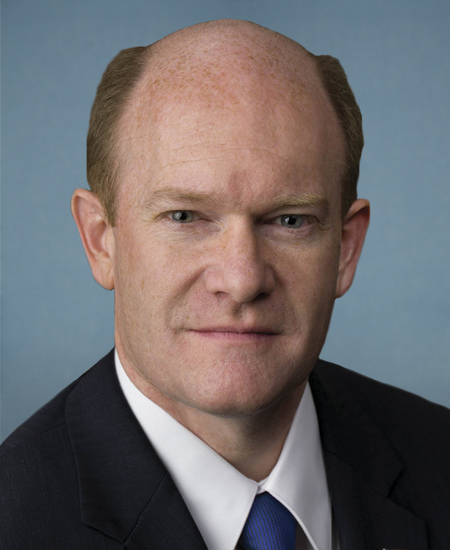
Photo of Christopher A. Coons
D United States Senate · Delaware On the 2026 ballot

Sen. Christopher A. Coons

Compare
Total votes
1,041
all sessions
Attendance
96%
37 missed
Lower than 83% of chamber peers
With party
98%
of cast votes
Near the chamber average
Bipartisan score
2%
crosses aisle rarely
Near the chamber average
Sponsored
1,679
bills & resolutions
Higher than 88% of chamber peers
Committees
19
assignments
1,679 bills and resolutions

Sponsored bills

Total
1,679
Primary
216
Co-sponsor
1,463
This page
1,679
matching current filters
Co-sponsor S 825
Passed · Minnesota Senate · Co-sponsor
Fighting Post-Traumatic Stress Disorder Act of 2025

Maddy summaryS 825 requires the Justice Department to develop a report within 150 days on programs providing evidence-based mental health care for public safety officers, including police, firefighters, EMTs, and 911 dispatchers. The report must outline how to deliver trauma-informed care, peer support, and family services through in-person or telehealth options, while ensuring confidentiality for officers seeking help. It also needs to detail administrative efficiency across states and territories, draft necessary grant conditions, and estimate annual funding needs. This bill does not fund programs but sets a framework for future action based on the high rates of PTSD and suicide among these frontline workers.

Passed Jun 15, 2026 1 co-sponsor
Co-sponsor S 736
Passed · Minnesota Senate · Co-sponsor
Lieutenant Osvaldo Albarati Stopping Prison Contraband Act

Maddy summaryS 736, the Lieutenant Osvaldo Albarati Stopping Prison Contraband Act, amends federal law to increase penalties for providing prohibited items (like phones) to prison inmates. It adds a maximum 2-year prison term for knowingly supplying phones to inmates, specifically targeting violations related to phone trafficking. The bill also requires the Bureau of Prisons to review and update its policies within one year of enactment to better prevent inmate access to prohibited objects and enhance safety for both incarcerated individuals and staff. These changes directly affect prison staff, correctional facilities, and individuals involved in supplying contraband to inmates.

Passed Jun 15, 2026 1 co-sponsor
Co-sponsor S 567
Passed · Minnesota Senate · Co-sponsor
First Rhode Island Regiment Congressional Gold Medal Act

First Rhode Island Regiment Congressional Gold Medal Act This bill provides for the award of a single Congressional Gold Medal to the First Rhode Island Regiment, collectively, in recognition of their dedicated service during the Revolutionary War.

Passed Jun 15, 2026 1 co-sponsor
Co-sponsor SRES 766
In committee · Minnesota Senate · Co-sponsor
A resolution acknowledging and apologizing for the mistreatment of, and discrimination against, lesbian, gay, bisexual, and transgender individuals who served the United States in the uniformed services, the Foreign Service, and the Federal civil service and committing to the pursuit of equal rights, protections, and respect for all LGBT servicemembers and Federal civil servants.

Maddy summaryThis Senate resolution formally acknowledges and apologizes for the decades of discrimination and wrongful termination faced by lesbian, gay, bisexual, and transgender individuals who served in the U.S. military, Foreign Service, and federal civil service. The measure highlights historical policies, such as the "Don't Ask, Don't Tell" rule and the "Lavender Scare," which forced hundreds of thousands of service members to leave their jobs or hide their identities, while also noting recent executive actions that have rescinded protections for gender identity. While the resolution reaffirms a commitment to equal rights and respect for all LGBT government employees, it explicitly states that it does not create any legal claims or settlements for affected individuals.

In committee Jun 11, 2026 1 co-sponsor
Co-sponsor S 4778
In committee · Minnesota Senate · Co-sponsor
Postsecondary Student Success Act of 2026

Maddy summaryThe Postsecondary Student Success Act of 2026 creates a competitive grant program to help colleges and universities support high-need students, such as those from low-income backgrounds, first-generation college attendees, and military-connected individuals. Under this bill, the Department of Education would award funds to eligible institutions for six years to implement specific, evidence-based strategies aimed at improving student retention and graduation rates. Applicants must submit detailed plans outlining how they will use these funds for services like academic advising, career coaching, and emergency financial assistance, with a requirement to include at least one highly proven reform practice. Additionally, the law sets aside a portion of the funding specifically for Tribal Colleges and Universities and mandates an independent evaluation to measure the program's effectiveness in increasing student success.

In committee Jun 11, 2026 1 co-sponsor
Co-sponsor S 789
In committee · Minnesota Senate · Co-sponsor
Critical Minerals Security Act of 2025

Critical Minerals Security Act of 2025 This bill establishes requirements for the Department of the Interior related to securing U.S. access to critical minerals and rare earth element (REE) resources.  Critical minerals mean any mineral, element, substance, or material designated as critical by the U.S. Geological Survey.  REEs mean cerium, dysprosium, erbium, europium, gadolinium, holmium, lanthanum, lutetium, neodymium, praseodymium, promethium, samarium, scandium, terbium, thulium, ytterbium, and yttrium.  First, Interior must report on the critical mineral and REE resources, including recyclable or recycled materials containing those resources, around the world. Among other information, the report must include an assessment of the global ownership and supply of critical mineral and REE resources. Interior must submit the report within a year and every two years thereafter. Next, Interior must establish a process to assist a U.S. person—a U.S. citizen, a non-U.S. National (alien under federal law) lawfully admitted for permanent residence, or an entity organized under U.S. laws—seeking to divest stock in mining, processing, or recycling operations for critical minerals and REEs in a foreign country with finding a purchaser that is not under the control of North Korea, China, Russia, or Iran. Finally, Interior must develop (1) a strategy to collaborate with U.S. allies and partners to develop advanced mining, refining, separation, processing, and recycling technologies; and (2) a method for sharing related intellectual property with U.S. allies and partners to enable those countries to license those technologies and develop their resources.

In committee Jun 10, 2026 1 co-sponsor
Co-sponsor SRES 762
In committee · Minnesota Senate · Co-sponsor
A resolution supporting the designation of the second Friday in June as "National Service and Conservation Corps Day".

Maddy summaryThis resolution supports designating the second Friday in June as National Service and Conservation Corps Day to honor the work of over 140 organizations that engage young adults and veterans in community service projects. These programs, which are descendants of the historic Civilian Conservation Corps, help participants gain skills, earn education awards, and contribute to conservation, disaster response, and infrastructure improvements. The Senate's action calls on citizens to recognize the value of national service and encourages the continued expansion of these existing nonprofit and government-run initiatives.

In committee Jun 9, 2026 1 co-sponsor
Co-sponsor SRES 760
In committee · Minnesota Senate · Co-sponsor
A resolution recognizing the United States-Philippines alliance on the 80th anniversary of diplomatic relations, the 75th anniversary of the Mutual Defense Treaty between the United States of America and the Republic of the Philippines, and the 10th anniversary of the landmark arbitral award upholding Manila's sovereignty against escalating aggression and lawfare by the People's Republic of China in the South China Sea.

Maddy summaryThis Senate resolution commemorates three major milestones in the relationship between the United States and the Philippines: the 80th anniversary of diplomatic ties, the 75th anniversary of the Mutual Defense Treaty, and the 10th anniversary of a 2016 international court ruling that rejected China's territorial claims in the South China Sea. The document formally acknowledges the historical bond between the two nations while condemning China's continued refusal to accept the 2016 arbitral award and its aggressive actions in the region. It highlights recent joint military exercises, expanded defense cooperation agreements, and economic initiatives like the Luzon Economic Corridor as evidence of a strengthened alliance. Ultimately, the resolution urges the President to maintain strong support for the Philippines in defending its sovereignty and upholding freedom of navigation in the Indo-Pacific.

In committee Jun 8, 2026 1 co-sponsor
Primary S 4707
In committee · Minnesota Senate · Lead sponsor
Responsible Artificial Intelligence Defense Act of 2026

Maddy summaryThe Responsible Artificial Intelligence Defense Act of 2026 establishes a new framework for the U.S. Department of Defense to develop and deploy autonomous weapon systems and artificial intelligence capabilities. It requires the Secretary of Defense to maintain continuous human oversight, ensuring that operators can intervene to stop systems acting illegally or unexpectedly. The bill mandates rigorous testing, cybersecurity reviews, and legal assessments before these technologies are prototyped or fielded, while also creating a working group to advise on safety standards. Specific prohibitions prevent the use of AI for nuclear launch decisions or warrantless surveillance of individuals within the United States. Additionally, the act defines different risk levels for these systems and requires annual reports to Congress on their administration.

In committee Jun 8, 2026 0 co-sponsors
Co-sponsor S 4701
In committee · Minnesota Senate · Co-sponsor
Freedom to Travel for Health Care Act of 2026

Maddy summaryThe Freedom to Travel for Health Care Act of 2026 prohibits any person or government entity from restricting, sanctioning, or discriminating against individuals who travel to another state to receive reproductive health care that is legal there. It also protects those who assist travelers and reproductive health care providers from facing penalties for offering services to out-of-state patients, effectively overriding any conflicting state laws. The bill establishes a private right of action allowing affected individuals, organizations, and providers to sue in federal or state court for violations, with provisions for damages and attorney's fees. Additionally, it removes state sovereign immunity defenses for officials enforcing laws that interfere with this travel right, ensuring federal courts can hear such cases directly.

In committee Jun 8, 2026 1 co-sponsor
Showing 91 to 100 of 1,679 bills
Previous 1 9 10 11 168 Next