Maddy summaryHF 3373 appropriates funds from state bond proceeds to design a new interchange at the intersection of Trunk Highway 10/61 and 70th Street (Washington County State-Aid Highway 22) in St. Paul Park. The bill authorizes the state to issue bonds to cover these costs, with the funds designated specifically for preliminary and final design work by the Minnesota Department of Transportation. This project directly affects St. Paul Park residents and commuters using this transportation corridor. The bill focuses solely on funding the design phase, not construction, and would require legislative approval to issue the bonds.
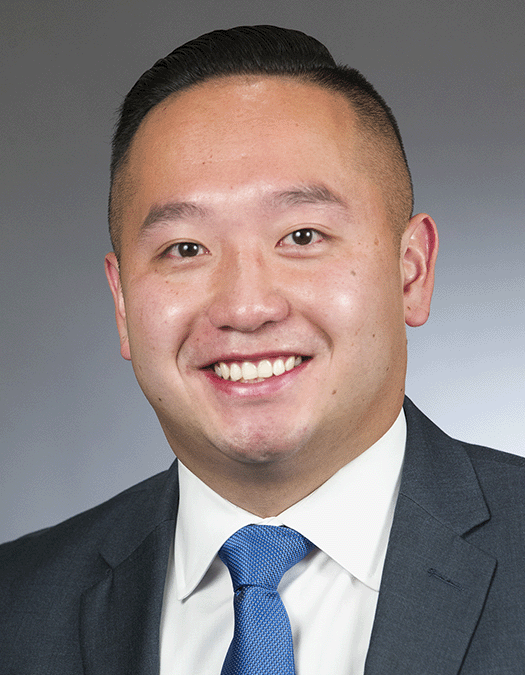
Rep. Fue Lee
Sponsored bills
Maddy summaryHF 3352 proposes a constitutional amendment to allow Minnesota to issue bonds and incur public debt specifically for public information technology systems, licenses, and infrastructure. If approved by voters in 2026, the amendment would add this purpose to the state constitution's list of authorized uses for public debt. The bill does not change current law but requires voter approval to permit state borrowing for these technology-related capital costs. This affects state government operations by enabling new funding mechanisms for IT infrastructure.
Maddy summaryThis bill updates regulations for electric cooperatives and municipal utilities in Minnesota to clarify how they handle billing for small solar and other net metered facilities. It allows these utilities to charge a specific fee to recover fixed costs for small systems while prohibiting them from using other methods to collect those same costs. The legislation also permits electric cooperatives to aggregate multiple customer meters for billing purposes and requires cooperative board directors to use electronic voting or vote by mail. Additionally, the bill improves transparency by ensuring members have better access to cooperative documents and meetings.
Maddy summaryThis bill authorizes the state of Minnesota to use a lease-purchase agreement and the sale of certificates of participation to fund improvements or replacement of its MAXIS system. Under this plan, the state would lease the project from a vendor or financing source and pay for it in installments over a period of up to ten years. The legislation establishes specific rules for how the state must manage the funds, including requirements for insurance, liability, and financial reporting within a dedicated project fund. It also allows the state to transfer money from its general fund to cover expected costs before the financing proceeds are received.
Maddy summaryThis bill establishes new emissions limits and measurement requirements for municipal solid waste incinerators in Minnesota, directly affecting facilities that burn mixed household waste. It requires these facilities to meet updated federal standards for air pollutants and mandates the installation of continuous monitoring systems to track emissions of specific contaminants like dioxin, mercury, and lead. The legislation also defines technical terms related to incinerator operations and sets clear criteria for what monitoring equipment must be used, without specifying exact emission numbers in the text provided.
Maddy summaryThis bill requires the Bureau of Criminal Apprehension to conduct background checks when requested by the Office of the Legislative Auditor. It amends Minnesota law to officially add the Legislative Auditor to the list of agencies authorized to request criminal history information from the Bureau. The change expands access to criminal background records for oversight purposes, allowing the Auditor to verify information related to public safety and financial matters. This provision applies specifically to the Office of the Legislative Auditor and does not alter existing background check procedures for other agencies.
Maddy summaryThis bill creates the Minnesota Business Recovery Loan Program to help businesses that have suffered financial losses due to increased immigration enforcement activities in the state. It appropriates $100 million in fiscal year 2026, with $18 million designated for zero-interest loans to businesses in greater Minnesota and $82 million for zero-interest loans to businesses in the seven-county metropolitan area through nonprofit lenders. To qualify, businesses must be located in Minnesota, owned by state residents, demonstrate a revenue loss of more than 30 percent between enactment and December 1, 2025, and show that losses resulted from staffing shortages, reduced customer access, or other immigration enforcement-related factors. The program provides loans ranging from $25,000 to $200,000 depending on business size and location, which must be used exclusively for business operations in Minnesota and cannot be used to repay prior debt or for real estate speculation.
Maddy summaryHF 1758 requires all health plans covering maternity benefits in Minnesota to provide comprehensive coverage for infertility diagnosis/treatment and standard fertility preservation services. It applies to private health plans, MinnesotaCare, and medical assistance programs, effective January 1, 2026. The law mandates no cost-sharing beyond what's required for maternity coverage (e.g., no extra deductibles), prohibits benefit limits specific to fertility care, and allows up to four completed oocyte retrievals per year. The state will reimburse health plans for coverage costs that wouldn’t have been provided without this law, using funds appropriated annually. This directly affects Minnesotans seeking infertility care through qualifying health insurance.
Maddy summaryHF 2418 requires local governments receiving state funding for capital projects (like roads, schools, or bridges) to establish and maintain dedicated replacement accounts. These accounts must hold funds for future major repairs, replacements, or preservation of the projects, with annual deposits based on depreciation and inflation. Local governments must adopt a written policy outlining how the funds will be used, including safety, maintenance, and sustainability criteria. Failure to comply results in a penalty fee equal to 1% of the state funding amount per year, effective for new projects starting July 1, 2025.
Maddy summaryThis bill directs the Minnesota Department of Health to join the World Health Organization's Global Outbreak Alert and Response Network. The commissioner must identify the necessary application process by September 1, 2026, and submit the application by December 1, 2026. This action aims to integrate the state's health response capabilities with a global system for monitoring and addressing disease outbreaks. The legislation does not alter existing funding or staffing but establishes a specific timeline for this international partnership.