

Maddy summaryHF 970 requires original equipment manufacturers (OEMs) of farm equipment to provide independent repair shops with necessary tools, parts, and documentation on fair and reasonable terms. It directly affects Minnesota farmers and independent repair providers by ensuring they can access repair resources without being forced to use manufacturer-approved services or pay excessive fees. Key provisions include prohibiting OEMs from imposing unreasonable restrictions (like requiring repair shops to become authorized dealers) or charging more for parts/tools than they offer to their own authorized providers. The bill amends Minnesota law to define terms like "authorized repair provider" and "fair and reasonable terms" to clarify these requirements. This applies specifically to digital electronic farm equipment, aiming to increase repair options and reduce costs for farmers.
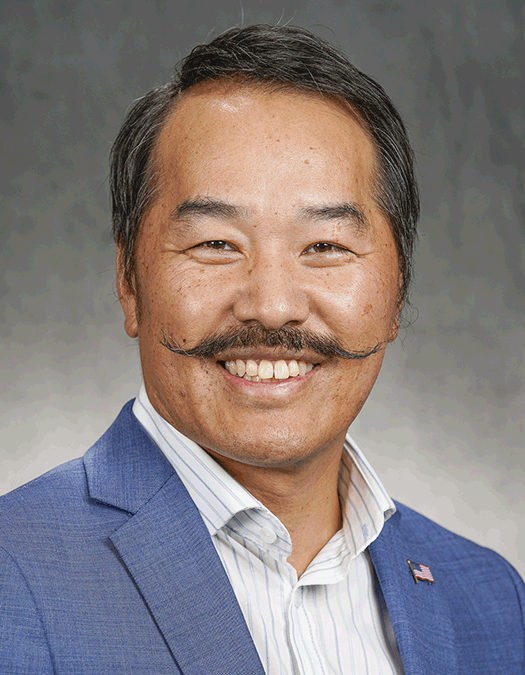
Rep. Ethan Cha
Sponsored bills
Maddy summaryThis bill designates the pea as the official state vegetable of Minnesota. It authorizes the Secretary of State's office to display a photograph of a pea. The legislation applies to state government records and official symbols.
Maddy summaryHF 1795 appropriates state funds for Minnesota's farm-to-school and early childhood care programs, directly supporting schools and child care providers serving children. The bill allocates specific funding for fiscal years 2026 and 2027 to purchase Minnesota-grown fruits, vegetables, meat, poultry, grain, and dairy for these settings, including reimbursements for equipment and food purchases. It also sets aside $150,000 annually for a statewide coordinator to assist farmers and institutions, and allows limited state funding (up to 7.5% of federal funds) to support federal program administration. Eligible entities must participate in federal nutrition programs like the National School Lunch Program.
Maddy summaryThis bill appropriates $2 million from state bond proceeds to fund the design, construction, and equipment for La Lake Park in Woodbury, Minnesota. The funds will support an open-air shelter with restrooms, picnic areas, trails, a trailhead, and stormwater management infrastructure to protect water quality and enhance ecosystems. The state will issue up to $2 million in bonds to cover this appropriation, as authorized under Minnesota bonding statutes. The Metropolitan Council will administer the grant to the city of Woodbury for these park improvements.
Maddy summaryThis bill requires sellers of emotional support dogs to provide written notice to buyers stating that the dog is not a service animal and does not have the special training required for service dogs. The notice must be printed in bold 12-point type and included on the purchase receipt or a separate document, informing buyers that the dog is not entitled to the legal rights and privileges granted to service animals. Additionally, the bill increases criminal penalties for intentionally misrepresenting an emotional support dog as a service dog, raising the offense from a petty misdemeanor to a gross misdemeanor for repeat violations. These changes apply to all sales of emotional support dogs and take effect on August 1, 2026.
Maddy summaryHF 3456 implements recommendations from the state auditor's fire relief association working group by updating Minnesota's firefighter retirement statutes. It clarifies key terms like "firefighting service" to include fire prevention and volunteer emergency medical personnel, and defines "separate from active service" and "break in service" more precisely. The bill adds new rules allowing firefighters who leave service and return to active duty to regain pension eligibility, provided they meet specific service requirements under the relief association's bylaws. This directly affects firefighters who take breaks in service but later return to active roles with their fire department.
Maddy summaryThis bill establishes a $4 million state funding program to support local outdoor recreation projects and trail connections in Minnesota. The legislation authorizes the sale of state bonds to raise the necessary funds, which will then be distributed as matching grants to eligible communities for park development and trail infrastructure. Local governments and organizations seeking to improve outdoor recreation areas or build trail networks can apply for these grants, which require them to contribute their own matching funds. The bill takes effect immediately upon final passage by the legislature.
Maddy summaryThis bill increases funding for Minnesota's Family Homeless Prevention and Assistance Program, raising the annual appropriation from $10.27 million to $45.27 million. The additional funds will be used to reduce homelessness risks and improve program effectiveness, with a portion designated for the housing development fund. The legislation also grants agencies flexibility in awarding grants to existing grantees and allows new grantees in certain areas to work with advisory committees or local care systems without meeting specific statutory requirements. These changes take effect immediately and establish a future funding base of $10.72 million starting in fiscal year 2028.
Maddy summaryThis bill creates a new grant program to provide social services and mental health support to victims of Operation Metro Surge, a federal immigration enforcement operation. The program will fund organizations that help affected individuals with basic needs like housing, food, and employment assistance, as well as mental health care. Eligible applicants include nonprofits, government agencies, tribal nations, and legal service providers, with priority given to areas most impacted by the operation. The bill appropriates unspecified funding from the state's general fund for one-time use through June 2029, requiring grantees to report on program participation and outcomes.
Maddy summaryThis bill creates a refundable sales and use tax exemption for construction materials used in two specific Washington County projects: the Stafford Library Remodel and the South Highway Shop project. It directly affects contractors, suppliers, and the county purchasing these materials for the projects during the purchase period from June 30, 2026, through January 1, 2029. The key mechanism requires taxes to be collected on purchases as normal, then refunded to the county from the state's general fund, with refunds issued only after June 30, 2026. The legislation appropriates state funds to cover the refund amounts and applies retroactively to purchases made within the specified timeframe.