Maddy summaryThis bill modifies Minnesota's nonprofit sales tax exemption to allow certain qualifying organizations to purchase prepared food without paying sales tax, provided they distribute it as part of their charitable, religious, or educational mission. Currently, prepared food purchases by nonprofits are taxable under the exemption rules, but this change specifically exempts food bought by groups already covered under the nonprofit sales tax exemption (such as food banks, shelters, or educational programs). The exemption applies only when the food is distributed during the organization's core mission activities, not for general use. It will take effect for purchases after June 30, 2026.
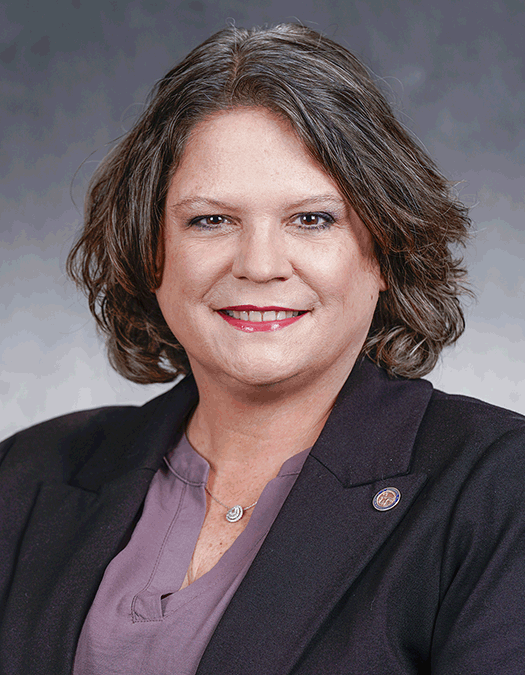
Rep. Cheryl Youakim
Sponsored bills
Maddy summaryHF 1268 modifies rules for common interest communities (like condominiums and homeowners associations) in Minnesota, directly affecting property management companies, community governing bodies, and unit owners. Key provisions include prohibiting property managers from having financial ties to contractors they hire without written disclosure, banning compensation based on fines collected, and requiring written notice for contract renewals. The bill also establishes a "meet and confer" process for disputes and changes notice requirements for community meetings. It prohibits governing bodies from requiring or incentivizing the creation of homeowners associations. These changes aim to increase transparency and fairness in community governance.
Maddy summaryThis bill establishes a task force to examine permanent school trust lands located within or near Tribal lands in Minnesota. The group will include representatives from Tribal nations, state agencies, and legislative leaders to study land exchange policies and identify barriers to transferring these lands. The task force must propose recommendations for land management and funding sources and submit a final report to the legislature by February 2027. State funding is appropriated to cover the administrative and technical support needed for the task force's operations.
Maddy summaryHF 2021 prohibits landlords in Minnesota from discriminating against tenants or prospective tenants who use government rental assistance, housing choice vouchers, or other public aid to pay rent. The bill amends Minnesota Statutes 363A.09 to ban landlords from denying viewings, applications, or rentals based on a tenant's income source, or from advertising they won't rent to voucher users. It directly affects landlords and tenants utilizing federal, state, or local housing assistance programs. The law creates clear, enforceable standards to prevent unfair treatment in housing applications and rentals.
Maddy summaryThis bill prohibits operating motorized watercraft in uncultivated wild rice beds in Minnesota, directly affecting boaters and watercraft operators in affected waterways. The law requires that any watercraft entering these areas must be propelled by hand, such as a canoe or skiff, and bans operating at speeds greater than slow-no-wake within 150 feet of uncultivated wild rice beds. These restrictions aim to protect wild rice habitats from damage caused by boat motors and wake. The bill amends existing Minnesota statutes to add these specific protections for uncultivated wild rice beds.
Maddy summaryHF 309 amends Minnesota Statutes §84.523 to tighten mining restrictions in the Boundary Waters Canoe Area Wilderness (BWCA) and Rainy River headwaters. The bill requires the commissioner of natural resources to determine that proposed mining (for taconite, sand, gravel, or granite) in the Rainy River headwaters would not harm the BWCA before any permits are issued. This modifies existing law by adding this specific assessment step, directly affecting mining operations seeking approval in these areas. The change maintains the general prohibition on mining without legislative approval but adds a new administrative requirement for the commissioner to evaluate environmental impacts. The bill focuses on protecting the BWCA's wilderness character through stricter permitting conditions.
Maddy summaryThis bill establishes a grant program to provide funding for student and staff safety improvements at schools. The Department of Public Safety's School Safety Center will distribute these grants to qualifying public, charter, and nonpublic schools. Each eligible school may receive up to $500,000 for authorized safety projects, provided they demonstrate additional funding sources. The legislation requires that at least half of the grants be awarded to schools located outside the seven-county metropolitan area. Funding is allocated from the state general fund for fiscal year 2027 and remains available until June 30, 2029.
Maddy summaryThis bill allocates $1.5 million from the arts and cultural heritage fund to the City of Minneapolis to create a public memorial honoring Renée Good and Alex Pretti. The memorial will feature statues, educational exhibits, and a space for community reflection, focusing on their deaths and the broader issues of civil rights and immigration enforcement. The project requires a collaborative planning process involving local residents, civil rights groups, artists, and historians, with oversight provided by a partnership including city officials and state legislators. While the state provides the initial funding, the city is permitted to seek additional private donations and partnerships to cover design, programming, and long-term maintenance costs.
Maddy summaryHF 3779 requires all health insurance plans in Minnesota to cover doula services - providing emotional and physical support during pregnancy, birth, and postpartum - without any deductibles, co-pays, or cost-sharing for enrollees. It prohibits health plans from imposing referral requirements, utilization reviews, or quantity limits on this coverage. Starting January 1, 2027, the commissioner of commerce will reimburse health plans for the costs of covering doula services, funded by annual state appropriations beginning in 2028. This bill directly affects health plan enrollees, particularly pregnant people seeking doula support, and health insurance companies that must now include this coverage.
Maddy summaryHF 3555 establishes rules for small, portable solar panels (under 1,200 watts) that homeowners can install to offset personal electricity use. The bill exempts these plug-in solar devices from requiring utility connection agreements, net metering rules, and additional fees or approvals. It also clarifies that utilities cannot be held liable for damage caused by these devices. This directly affects residential users seeking simple, low-barrier solar energy solutions without utility bureaucracy. The bill creates specific definitions and exemptions within Minnesota's energy code for these devices.