Maddy summaryThis bill expands Minnesota's property tax refund program for taxes payable in 2026. It requires the refund calculation to use an eight percent threshold instead of the current twelve percent threshold, which would increase refund amounts for eligible property owners. The change applies only to property taxes due in 2026 and does not affect refunds for other tax years. The legislation is limited to a one-time expansion and does not create permanent changes to the refund system.
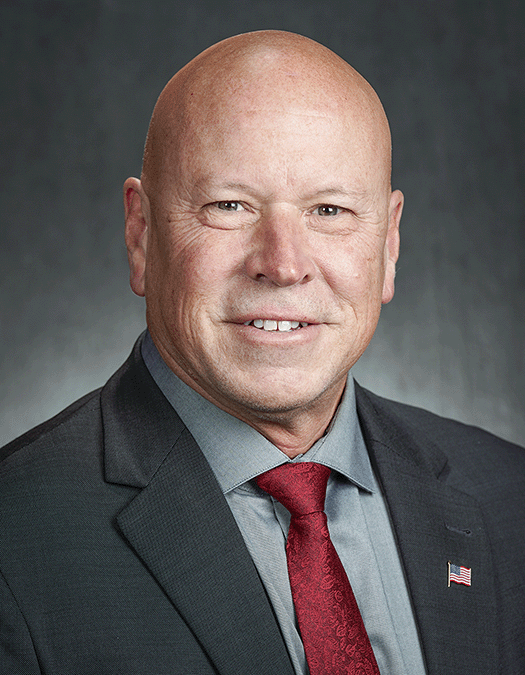
Rep. Wayne Johnson
Sponsored bills
Maddy summaryHF 362 establishes a state licensing system for massage therapists and Asian bodywork therapists in Minnesota. It requires practitioners to meet specific educational standards (including minimum contact hours), pass a credentialing exam, and obtain a license from the Minnesota Department of Health. The bill defines both practices (e.g., Asian bodywork therapy uses techniques like pressing and stretching based on Chinese medical principles), sets application and renewal fees, and includes criminal penalties for practicing without a license. This directly affects therapists seeking to legally provide these services and ensures they meet standardized training and safety requirements, while also providing funding for implementation.
Maddy summaryHF 3657 establishes a task force to study property tax relief for primary homes (homestead properties) in Minnesota. The task force, composed of legislators, local government representatives, and tax officials, must analyze how current tax policies affect homeowners, compare tax burdens over time, and explore options for reducing property taxes with minimal impact on state funding. It will focus specifically on residential properties classified as homesteads under state law, including homes and adjacent land. The task force must submit its recommendations to the legislature by February 1, 2027, but cannot directly change tax rates. This is a study bill, not a tax law change.
Maddy summaryThis bill introduces criminal penalties for assaulting employees of Minnesota housing and redevelopment authorities. It directly affects workers employed by or acting on behalf of these agencies, including paid staff, volunteers, contractors, and those in roles like property management, inspections, and tenant services. Under the new law, assaulting an employee while they are performing official duties or because of their employment is classified as a gross misdemeanor, while the same act if it causes bodily harm becomes a felony punishable by up to two years in prison or a fine of up to $4,000, or both. The changes take effect on August 1, 2026, and apply to crimes committed on or after that date.
Maddy summaryThis bill allows Minnesota local governments to publish official notices on their websites instead of only in qualified newspapers. It directly affects cities, counties, and other political subdivisions that currently must use newspapers for public notices, legal summons, and bid solicitations. The law defines new terms for "website" and "publish" to include online dissemination, and permits local governments to use their own websites or the Minnesota Newspaper Association's statewide notice site when no qualified newspaper exists. For bid solicitations, the bill allows a six-month transition period where both newspaper and online publication are required before online-only publication becomes sufficient. The changes take effect immediately upon final enactment.
Maddy summaryThis bill provides $2 million in funding for intersection improvements in Lake Elmo, specifically at the junction of 10th Street North, Lake Elmo Avenue, and County Road 17B. The money will be used to upgrade traffic control systems, improve drainage, and add facilities for pedestrians and cyclists. To finance this project, the state will issue bonds up to $2 million, which will be repaid through future tax revenues. The funds are directed to Washington County through the state Department of Transportation for construction purposes.
Maddy summaryThis bill creates a refundable sales and use tax exemption for construction materials used in two specific Washington County projects: the Stafford Library Remodel and the South Highway Shop project. It directly affects contractors, suppliers, and the county purchasing these materials for the projects during the purchase period from June 30, 2026, through January 1, 2029. The key mechanism requires taxes to be collected on purchases as normal, then refunded to the county from the state's general fund, with refunds issued only after June 30, 2026. The legislation appropriates state funds to cover the refund amounts and applies retroactively to purchases made within the specified timeframe.
Maddy summaryThis bill modifies Minnesota's "Read Act" to require literacy instruction based on "science of reading" research, emphasizing evidence-based methods like phonics and decoding while explicitly excluding the three-cueing system. It establishes a new Office of Achievement and Innovation within the Department of Education to support literacy implementation and creates a statewide school performance reporting system. The bill also allows school boards to opt out of complying with certain recently enacted state education laws or rules and authorizes fund transfers for education programs through fiscal year 2029. These changes directly affect all Minnesota public school districts, educators, and students by reshaping literacy instruction requirements and school accountability systems.
Maddy summaryHF 2809 establishes a new crime for protesting directly in front of or about a person's home (excluding homes used as businesses). It makes this a misdemeanor, escalating to a gross misdemeanor if the person has a prior conviction under this law or ignores court orders like protection orders. The bill specifically allows peaceful protests about community meetings or assemblies held at locations commonly used for public discussion. This law applies to residential properties only and takes effect August 1, 2025.
Maddy summaryHF 3594 requires private organizations seeking funding from the Minnesota Housing Finance Agency (MHFA) to obtain a certificate of eligibility before receiving any grants, loans, or housing tax credits. This affects housing providers, nonprofits, and commercial entities that apply for MHFA funding. To qualify, applicants must submit proof of state registration, physical addresses in Minnesota, tax identification numbers, and criminal history consent forms for all employees. Certificates expire after two years and can be revoked for false information, ineligibility at issuance, or misuse of public funds. The bill establishes a standardized verification process to ensure accountability for public housing funds.