

Maddy summaryThis bill modifies Minnesota's rules on employment and licensing disqualifications for people with criminal convictions by shifting from an automatic ban to a case-by-case assessment of rehabilitation. It requires employers and licensing agencies to consider evidence such as honorable military discharges, release orders, time served without new convictions, and letters of reference when deciding whether to hire or license someone with a criminal record. Additionally, the bill mandates that if an applicant is denied a job or license due to their criminal history, the authority must provide written notice explaining the reasons, the appeal process, and the earliest date they can reapply. These changes aim to create a more individualized evaluation process while maintaining accountability through required documentation and notification procedures.
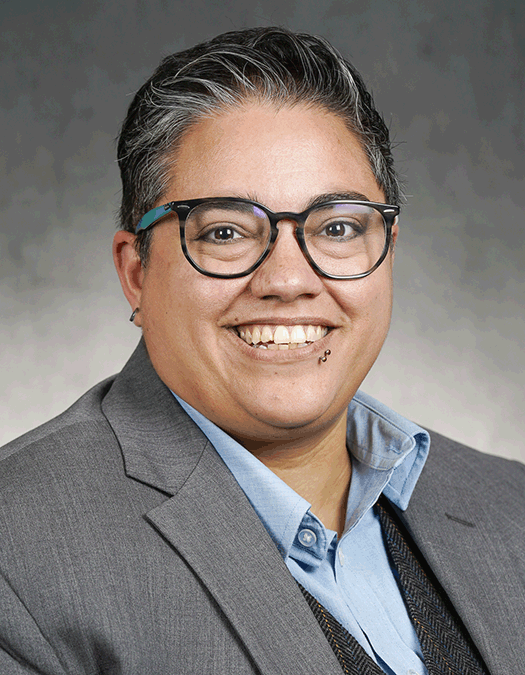
Rep. Brion Curran
Sponsored bills
Maddy summaryThis bill allocates $1.5 million from the arts and cultural heritage fund to the City of Minneapolis to create a public memorial honoring Renée Good and Alex Pretti. The memorial will feature statues, educational exhibits, and a space for community reflection, focusing on their deaths and the broader issues of civil rights and immigration enforcement. The project requires a collaborative planning process involving local residents, civil rights groups, artists, and historians, with oversight provided by a partnership including city officials and state legislators. While the state provides the initial funding, the city is permitted to seek additional private donations and partnerships to cover design, programming, and long-term maintenance costs.
Maddy summaryHF 3779 requires all health insurance plans in Minnesota to cover doula services - providing emotional and physical support during pregnancy, birth, and postpartum - without any deductibles, co-pays, or cost-sharing for enrollees. It prohibits health plans from imposing referral requirements, utilization reviews, or quantity limits on this coverage. Starting January 1, 2027, the commissioner of commerce will reimburse health plans for the costs of covering doula services, funded by annual state appropriations beginning in 2028. This bill directly affects health plan enrollees, particularly pregnant people seeking doula support, and health insurance companies that must now include this coverage.
Maddy summaryHF 3555 establishes rules for small, portable solar panels (under 1,200 watts) that homeowners can install to offset personal electricity use. The bill exempts these plug-in solar devices from requiring utility connection agreements, net metering rules, and additional fees or approvals. It also clarifies that utilities cannot be held liable for damage caused by these devices. This directly affects residential users seeking simple, low-barrier solar energy solutions without utility bureaucracy. The bill creates specific definitions and exemptions within Minnesota's energy code for these devices.
Maddy summaryThis bill clarifies the responsibilities of Minnesota's Department of Corrections regarding licensed juvenile and adult community-based residential correctional facilities. It defines key terms (like "local correctional facility" and "facility administrator"), requires annual inspections to verify compliance with safety standards, and mandates that inspection reports be published online within 30 days. The bill also specifies licensing procedures, including two-year licenses for facilities meeting standards or making satisfactory progress, and requires facilities to provide data through the department's detention system. It directly affects licensed facilities, their administrators, and the Department of Corrections, streamlining oversight without creating new programs.
Maddy summaryThis bill establishes a legal framework in Minnesota to create an interstate agreement called the Interstate Fiscal Sovereignty Compact, which would allow member states to hold federal taxes in a state-controlled escrow fund rather than sending them directly to the federal government. The legislation defines key terms such as "member state" and "triggering event," and sets up a process where employers would deposit withheld federal income, Social Security, and unemployment taxes into this new state treasury fund once the compact is officially activated. Currently, no action is required from employers or the state until a governing body issues an order to start the escrow operations, meaning the bill does not immediately change how taxes are collected or paid. By creating a separate escrow fund, the bill aims to give states more control over federal tax revenue, though it requires other states to pass similar laws and join the agreement for the system to function.
Maddy summaryThis bill requires the Metropolitan Airports Commission to increase transparency regarding flights at Minneapolis-St. Paul International Airport that transport detained immigrants. Specifically, it mandates that the airport operator notify the commission whenever U.S. Immigration and Customs Enforcement arrives or departs with passengers being held in restraints. The legislation also requires the commission to install a live-streaming camera to record these flights and to submit monthly reports detailing the number of detained individuals, including minors, on each trip. These measures are designed to provide the public and state officials with real-time data and regular updates on immigration-related air traffic at the airport.
Maddy summaryThis bill provides a one-time appropriation from the workforce development fund to the Academy for Sciences and Agriculture. The funding is intended to support agricultural education and the annual greenhouse sales program, focusing on student leadership and career success. The grant may be used specifically for equipment upgrades and greenhouse improvements within the program. These funds are designated for expenditure during the fiscal year 2027.
Maddy summaryThis bill appropriates state funds to enhance security for the judiciary and public safety agencies, including specific allocations for protecting the Chief Justice and staffing security units. It establishes a competitive grant program to help courthouses improve their physical safety and security measures, requiring recipients to contribute half of the project costs. Additionally, the legislation modifies existing criminal laws regarding first-degree murder and impersonating a peace officer while creating new offenses related to theft of public funds and misuse of emergency vehicles. The bill also updates firearms policies and authorizes the relevant agencies to create rules to implement these changes.
Maddy summaryThis Minnesota bill creates a $100 million relief program to help small businesses that experienced significant revenue declines between July 2024 and February 2026, which the bill attributes to federal enforcement activity. The program provides grants to operators of indoor retail or food market spaces with at least 25 small tenant businesses, requiring that most funds be used to offer rent forgiveness to existing tenants. To qualify, businesses must be Minnesota-based, have fewer than 50 employees, operate from a physical location, and show at least a 20 percent drop in revenue or sales during the specified period. Grant applications will be processed through a lottery system, with funds usable for payroll, rent, utilities, inventory, and other operational expenses, and the state must report on the program's outcomes by December 2026.