Issue · Healthcare

Healthcare (Women's Health)

Every healthcare bill, vote, and legislator stance in Minnesota, automatically classified by Maddy, our AI policy reader.

Total bills
25
2025-2026 Regular Session
Top supporter
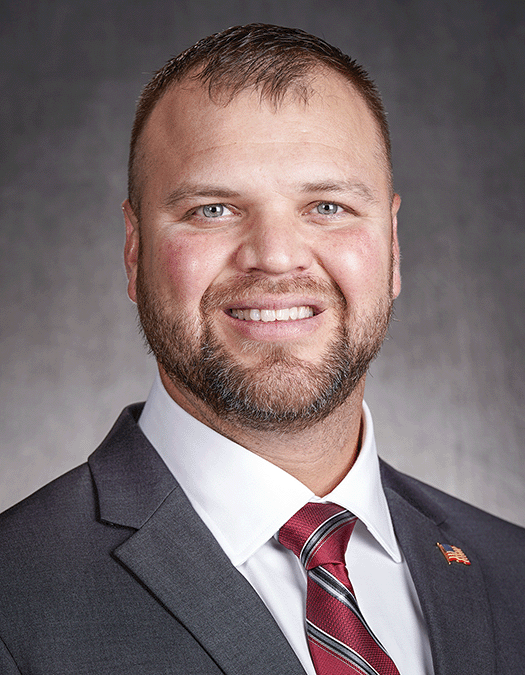
Mike Howard
100% support rate
Top opponent
Andrew Myers
12% support rate
Ranked legislators
10
5 support · 5 oppose
Key legislators

Who's moving women's health in Minnesota

Legislators moving women's health in Minnesota
Legislator Party Stance Support rate Decisive votes
Mike Howard
Mike Howard House · District 51A
D
Strong +
100% 7
Aisha Gomez
Aisha Gomez House · District 62A
D
Strong +
88% 8
Alex Falconer
Alex Falconer House · District 49A
D
Strong +
88% 8
Amanda Hemmingsen-Jaeger
Amanda Hemmingsen-Jaeger Senate · District 47
D
Strong +
88% 8
Andy Smith
Andy Smith House · District 25B
D
Strong +
88% 8
Andrew Myers
Andrew Myers House · District 45A
R
Strong −
12% 8
Ben Bakeberg
Ben Bakeberg House · District 54B
R
Strong −
12% 8
Ben Davis
Ben Davis House · District 6A
R
Strong −
12% 8
Bernie Perryman
Bernie Perryman House · District 14A
R
Strong −
12% 8
Bidal Duran
Bidal Duran House · District 2A
R
Strong −
12% 8
Showing 11–20 of 25 bills

All healthcare bills

in committee · Minnesota · Senate Feb 10, 2025

SF 1167: Maternal death studies requirements clarification

This bill clarifies that Minnesota's Commissioner of Health must conduct maternal death studies, changing the requirement from optional ("may") to mandatory ("must"). It directly affects the Minnesota Department of Health, requiring them to use these studies to improve medical, health, and welfare systems. The key provision is the explicit mandate for these studies to help reduce preventable maternal deaths in the state. The bill does not create new programs but ensures existing requirements are clear and actionable.
Sub-Topics Women's Health
in committee · Minnesota · Senate Feb 3, 2025

SF 926: Sexual and reproductive health services grants appropriation

This bill appropriates $1.5 million for fiscal year 2026 and $1.5 million for fiscal year 2027 from the general fund to the commissioner of health. The funds are designated for grants supporting sexual and reproductive health services, distributed under Minnesota Statutes section 145.925. These grants directly support health service providers offering such care, including clinics and community organizations. The bill creates no new requirements but allocates existing state funds to expand access to these services. It does not change eligibility criteria or create new program rules.
Sub-Topics Women's Health
in committee · Minnesota · House Mar 20, 2025

HF 1580: Changes to born alive infant provisions made.

HF 1580 amends Minnesota law to require medical personnel to provide immediate care to infants born alive during abortion procedures. The bill mandates that such infants be recognized as human persons under the law and that all reasonable medical measures, consistent with standard practice, be taken to preserve their life and health, including proper medical documentation. This directly affects healthcare providers performing abortions in Minnesota who encounter infants born alive. The law takes effect the day after final enactment. It focuses solely on medical care protocols for surviving infants, not on changing abortion access or legality.
Sub-Topics Women's Health
in committee · Minnesota · Senate Feb 13, 2025

SF 1350: Rochester Area Foundation Pamoja Women Program appropriation

This bill appropriates $250,000 from the general fund for the Rochester Area Foundation's Pamoja Women program during fiscal year 2026. The funds are specifically designated to support women's health education and parent education programming. The one-time appropriation is available until June 30, 2027, and directly affects the program's ability to deliver these services in the Rochester area.
Sub-Topics Women's Health
in committee · Minnesota · House Apr 29, 2025

HF 1278: Reproductive health equity grant fund established, and money appropriated.

HF 1278 establishes a one-time $30 million reproductive health equity grant fund to support abortion care access in Minnesota. The bill provides funding to abortion providers, government agencies, and nonprofits whose primary work involves abortion care, with grants designed to increase access, cover uncompensated care for low-income patients, secure facility infrastructure, and fund staff training in trauma-informed care. Eligible organizations must apply through the commissioner of health, who will prioritize applications based on local need, health equity impact, and applicant need. The fund becomes effective July 1, 2025, with grants to begin by January 1, 2026, and includes strict privacy protections requiring confidentiality of patient information.
Sub-Topics Women's Health
in committee · Minnesota · House Mar 13, 2025

HF 1105: Maternal death study requirements clarified.

HF 1105 amends Minnesota law to require the state health commissioner to *conduct* maternal death studies annually, changing the previous language from "may" to "must." This directly affects the Minnesota Department of Health, which must now systematically analyze preventable maternal deaths to improve healthcare systems. The bill mandates these studies to identify preventable causes and inform medical, health, and welfare service planning. Its key provision is making the maternal death study process mandatory, aiming to reduce preventable deaths through data-driven system improvements. The law applies statewide to all maternal health outcomes covered under Minnesota's health system.
Sub-Topics Women's Health
died · Minnesota · Senate Mar 10, 2025

SF 2084: Supporting Women Act

SF 2084, the "Supporting Women Act," would establish a state grant program to fund nonprofit women's pregnancy centers and maternity homes in Minnesota. The bill provides grants to organizations that offer free or low-cost support services - including housing, medical referrals, mental health care, and parenting education - to pregnant women and new mothers in crisis, homelessness, or at risk of homelessness. Grants cannot be used for abortion counseling, referrals, or services (except in life-threatening cases), and recipients must maintain strict privacy protections for client information. The commissioner of health would administer the program and monitor compliance with these requirements.
in committee · Minnesota · House Feb 19, 2025

HF 1189: Rochester Area Foundation funding provided for the Pamoja Women program, and money appropriated.

HF 1189 appropriates $250,000 from Minnesota's general fund for the Rochester Area Foundation's Pamoja Women program during fiscal year 2026. The funding supports two specific services: women's health education and parent education programming. This is a one-time appropriation available until June 30, 2027, and directly affects the Rochester Area Foundation's program operations. The bill does not change existing laws but provides dedicated funding for these community services.
Sub-Topics Women's Health
in committee · Minnesota · House Mar 12, 2025

HF 1319: Sexual and reproductive health services grants funding provided, and money appropriated.

This bill appropriates $1.5 million for fiscal year 2026 and $1.5 million for fiscal year 2027 from the general fund to the commissioner of health. The funds are designated for distribution to organizations providing sexual and reproductive health services under Minnesota Statutes section 145.925. It directly affects community health providers and clinics that offer these services by providing dedicated state funding. The bill makes no changes to existing services or eligibility but allocates specific funding amounts for two consecutive fiscal years.
Sub-Topics Women's Health
in committee · Minnesota · Senate Feb 24, 2025

SF 1113: Medical assistance coverage of birth services provided at home requirement

This bill requires Minnesota Medicaid to cover home birth services for low-risk pregnancies under specific conditions. It directly affects pregnant people choosing home births and eligible providers (certified midwives, nurse-midwives, physicians, or physician assistants). To qualify, recipients must be deemed low-risk with documented prenatal care, have a care plan including consent forms and hospital transfer options, and receive services from an approved provider. Coverage includes prenatal, labor, birth, and postpartum care, with providers paid at 100% of physician rates and facility services at 70% of hospital rates for uncomplicated deliveries.
Showing 11 to 20 of 25 bills