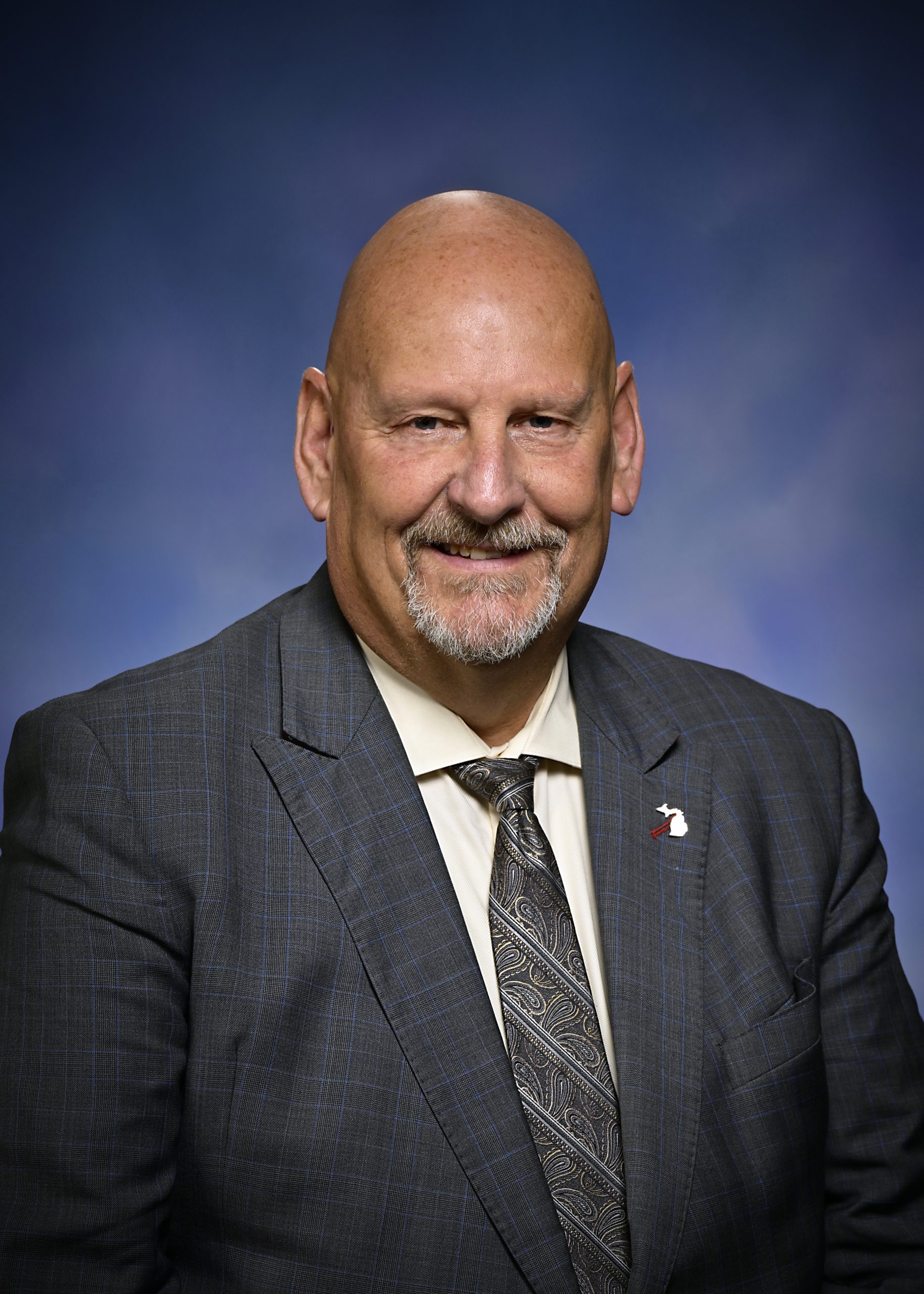
Photo of Curt VanderWall
R Michigan House · District 102 On the 2026 ballot

Rep. Curt VanderWall

Compare
Total votes
4,489
all sessions
Attendance
89%
562 missed
Higher than 83% of chamber peers
With party
97%
of cast votes
Higher than 75% of chamber peers
Bipartisan score
2%
crosses aisle rarely
Lower than 77% of chamber peers
Sponsored
653
bills & resolutions
Near the chamber average
Committees
4
assignments
653 bills and resolutions

Sponsored bills

Total
653
Primary
120
Co-sponsor
533
This page
653
matching current filters
Co-sponsor HB 4824
Signed into law · Michigan House · Co-sponsor
Liquor: other; definition of brand; modify. Amends secs. 105 & 1115 of 1998 PA 58 (MCL 436.1105 436.2115) & adds sec. 604. TIE BAR WITH: HB 4823'25

Maddy summaryHB 4824 updates Michigan's legal definition of "brand" within liquor regulations. This change directly affects liquor producers and sellers who market products under specific brand names, clarifying how brands are recognized under state law. The bill modifies Section 105 of the 1998 Liquor Code (MCL 436.1105) and adds a new Section 604 to establish clearer rules for brand identification. These changes aim to streamline compliance for businesses without altering existing licensing or sales requirements.

Signed into law Jul 29, 2026 1 co-sponsor
Co-sponsor HB 4187
Signed into law · Michigan House · Co-sponsor
Individual income tax: revenue distributions; distribution and use of renew Michigan fund and lapse of interest and earnings from the revitalization and placemaking fund to general fund; modify and provide for. Amends secs. 51, 51g & 696 of 1967 PA 281 (MCL 206.51 et seq.). TIE BAR WITH: HB 4180'25, HB 4181'25, HB 4182'25, HB 4183'25, HB 4184'25, HB 4185'25, HB 4186'25

Maddy summaryHB 4187 modifies Michigan's corporate income tax law by adjusting how the tax base is calculated and clarifying revenue distribution. It requires corporations to add back certain taxes and expenses previously deducted for federal purposes (like state taxes or related-party royalties) and eliminates deductions for oil/gas and mineral-related income and expenses. For the 2021-2022 fiscal year, the bill directs $800 million of corporate tax revenue to the Michigan taxpayer rebate fund, while other years’ revenue flows to the general fund. This directly affects corporations operating in Michigan and the state’s budget allocation process.

Signed into law Jul 29, 2026 1 co-sponsor
Co-sponsor HB 5249
Signed into law · Michigan House · Co-sponsor
Health: emergency services; ambulance operation adaptive care license; create. Amends sec. 20920 of 1978 PA 368 (MCL 333.20920).

Maddy summaryHB 5249 creates a new "adaptive care license" for ambulance operations currently licensed only for basic life support (BLS). It allows these operations to gradually upgrade to provide limited advanced life support (ALS) or advanced life support (ALS) services, provided they demonstrate staffing and equipment readiness for higher care levels by January 1, 2025. The license requires annual documentation of progress toward this upgrade, including training and equipment plans, and must be renewed annually alongside the operation's regular license. This applies specifically to ambulance services owned or contracted by local governments that previously provided only BLS for emergency response.

Signed into law Jul 29, 2026 1 co-sponsor
Co-sponsor HB 4309
Signed into law · Michigan House · Co-sponsor
Health occupations: physician's assistants; physician's assistants licensure compact; provide for. Amends secs. 16337 & 18001 of 1978 PA 368 (MCL 333.16337 & 333.18001) & adds secs. 16187d, 17011b, 17061a, 17511b & 18011b.

Maddy summaryHB 4309 establishes a licensure compact for physician's assistants, allowing them licensed in one participating state to practice in other participating states without needing separate licenses. This directly affects physician's assistants seeking to work across state lines and patients in states participating in the compact. The bill creates legal mechanisms by amending existing law to enable reciprocal licensing agreements between states, removing barriers for PAs to provide care in multiple jurisdictions. It provides the framework for states to join the compact through mutual recognition of licenses, streamlining practice for qualified professionals.

Signed into law Jul 29, 2026 1 co-sponsor
Co-sponsor HB 6156
In committee · Michigan House · Co-sponsor
Individual income tax: credit; credit for certain advanced practice registered nurses who serve as a preceptor; provide for. Amends 1967 PA 281 (MCL 206.1 - 206.847) by adding sec. 282.

Maddy summaryThis bill creates a state income tax credit for advanced practice registered nurses who serve as preceptors for nursing student clinical rotations in Michigan. Eligible nurses can claim up to $1,500 annually, calculated at $500 for every 250 hours of supervision provided, provided they do not receive separate payment for these duties. To receive the credit, nurses must submit a written statement and documentation verifying their hours to the state tax department. The legislation also requires the state to report annually on the number of claims and total credits issued to assess the program's effectiveness.

In committee Jul 14, 2026 1 co-sponsor
Co-sponsor HB 6155
In committee · Michigan House · Co-sponsor
Health occupations: nurses; intravenous therapy procedures; allow licensed practical nurses to perform under certain circumstances. Amends 1978 PA 368 (MCL 333.1101 - 333.25211) by adding sec. 17227.

Maddy summaryThis bill allows licensed practical nurses in Michigan to perform specific intravenous therapy procedures under certain conditions. To qualify, a nurse must complete a board-approved course of at least 20 hours and work under the supervision of a registered nurse, physician, or dentist. The permitted tasks include inserting peripheral IV lines in the hand, forearm, or antecubital area, starting and maintaining fluid infusions, administering IV antibiotics, and monitoring IV sites for complications. However, the law explicitly prohibits licensed practical nurses from handling central lines, blood products, chemotherapy, or total parenteral nutrition.

In committee Jul 14, 2026 1 co-sponsor
Co-sponsor HB 6160
In committee · Michigan House · Co-sponsor
Environmental protection: recycling and waste utilization; recycling of single-use and rechargeable batteries; provide for. Amends heading of pt. 171 & secs. 17101, 17104, 17105b & 17107 of 1994 PA 451 (MCL 324.17101 et seq.); designates secs. 17101 - 17109 as subpt.1 of pt. 171; adds subpt. 2 to pt. 171 & repeals sec. 17105c of 1994 PA 451 (MCL 324.17105c). TIE BAR WITH: HB 6159'26

Maddy summaryThis bill amends Michigan's environmental laws to strengthen regulations on the recycling and disposal of single-use and rechargeable batteries. It establishes a new "battery stewardship" program that will require producers to manage the end-of-life disposal of covered batteries starting in 2028, ensuring they are handled through approved programs rather than general waste. The legislation also sets a sales ban on certain covered batteries beginning in 2028, allowing only those from manufacturers with approved stewardship plans to be sold. Additionally, the bill updates existing definitions and penalties for improper battery disposal while creating a formal process for producers to submit and have their disposal plans reviewed by the state department.

In committee Jul 14, 2026 1 co-sponsor
Co-sponsor HB 6159
In committee · Michigan House · Co-sponsor
Environmental protection: recycling and waste utilization; recycling of single-use and rechargeable batteries; provide for. Amends 1994 PA 451 (MCL 324.101 - 324.90106) by adding secs. 17121 & 17161 to subpt. 2 of pt. 171. TIE BAR WITH: HB 6160'26

Maddy summaryThis bill amends Michigan's Natural Resources and Environmental Protection Act to establish a formal framework for the recycling and end-of-life management of single-use and rechargeable batteries. It creates new legal definitions for key terms such as "covered battery," "producer," and "stewardship organization" to clarify which products and companies are subject to the new regulations. The legislation outlines requirements for producers to participate in battery recycling programs that meet specific collection and recycling efficiency goals. Additionally, it defines the roles and responsibilities of battery recyclers and collection sites to ensure proper handling of batteries sold or distributed in the state.

In committee Jul 14, 2026 1 co-sponsor
Co-sponsor HB 4703
Passed · Michigan House · Co-sponsor
Insurance: health insurers; coverage for group prenatal care services; require. Amends 1956 PA 218 (MCL 500.100 - 500.8302) by adding sec. 3406ss.

Maddy summaryHB 4703 requires health insurers in Michigan to cover group prenatal care services for policyholders. This directly affects health insurers offering coverage in the state and pregnant individuals seeking prenatal care. The bill defines "group prenatal care services" as evidence-based, group-based visits that include health assessments, social support, education, and peer interaction in a family-centered setting. Insurers must now provide this coverage for group prenatal care under their health insurance policies.

Passed Jul 1, 2026 1 co-sponsor
Co-sponsor HCR 8
Passed · Michigan House · Co-sponsor
A concurrent resolution to approve an extension of the state of energy emergency declared on April 2, 2026.

Maddy summaryThis bill extends the state of energy emergency in Michigan by an additional 77 days, effective July 1, 2026. The measure allows the sale of E15 fuel in several counties where current regulations previously restricted it to lower vapor pressure gasoline. By suspending these fuel requirements, the extension aims to increase fuel supply options and help manage rising gas prices for consumers and businesses. The resolution requires approval from both the House and Senate before being sent to the Governor.

Passed Jun 25, 2026 1 co-sponsor
Showing 11 to 20 of 653 bills