Maddy summaryThe Penalties for Polluters Act significantly increases the maximum civil penalties for violations of federal mineral leasing, oil and gas royalty management, and offshore lands laws to better account for inflation. These higher fines apply to companies and individuals who fail to comply with regulations regarding natural resource extraction and environmental protection. The bill also establishes a Penalty Revenue Reinvestment Fund that collects the additional revenue generated by these increased penalties. Half of this fund is distributed to states, Indian tribes, and local governments harmed by violations, while the other half supports federal agencies in enforcing compliance and safety standards.
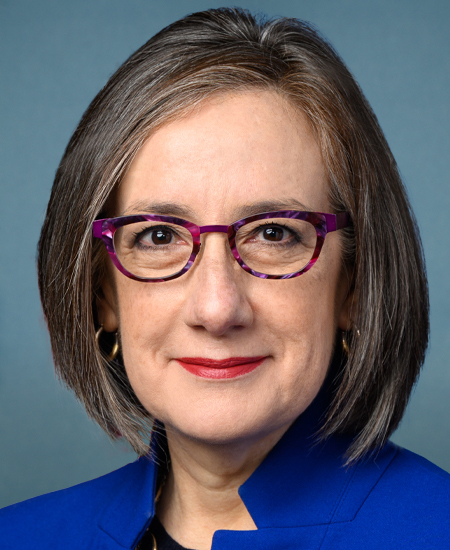
Rep. Andrea Salinas
Sponsored bills
Maddy summaryThe GUARD Act of 2026 requires U.S. national security agencies to evaluate whether humanoid or quadruped robots made by foreign entities pose a risk to national security. If a robot is determined to be unsafe or comes from a country of concern, the Federal Communications Commission will add it to a banned list, preventing its use in U.S. communications networks. The law mandates that agencies report their findings to Congress within specific timeframes, ensuring transparency about these security assessments. Importantly, the rule does not apply to allies such as NATO members or designated Major Non-NATO Allies.
Maddy summaryThis House resolution formally recognizes August as Chicano/Chicana Heritage Month to celebrate the historical contributions of Mexican Americans to the United States. It highlights specific achievements in science, civil rights, labor, and arts, while acknowledging ongoing challenges such as discrimination and underrepresentation in public and private sectors. The bill encourages the observation of this month through appropriate events and activities but does not create new laws or funding mechanisms.
Maddy summaryThe Lifeline for First Responders Act establishes a new federal grant program administered by the National Highway Traffic Safety Administration to support the mental health and well-being of first responders. The program provides funding to eligible entities, including fire services, emergency medical services agencies, and dispatch centers, at all levels of government. Grant funds may be used for evidence-based stress reduction, suicide prevention, confidential counseling, family support services, and outreach programs aimed at reducing stigma. The bill authorizes $7.5 million in appropriations annually for fiscal years 2028 through 2032 to carry out these initiatives.
Maddy summaryThe Data Center Community Reinvestment Act of 2026 imposes a federal excise tax of one cent per kilowatt-hour on electricity consumed by data centers with a peak power load exceeding one megawatt. The revenue generated from this tax is divided equally among five specific government funds: the Land and Water Conservation Fund, the Housing Trust Fund, the Hazardous Substance Superfund, the Highway Trust Fund, and a newly established Energy Technology Trust Fund. This legislation directly affects large-scale data center operators by adding a cost to their energy usage, while directing the collected funds toward infrastructure, environmental cleanup, housing, and energy technology initiatives.
Maddy summaryThe Stop Corrupt Trading Act creates a new federal criminal offense prohibiting the President and Vice President from selling or exchanging nonpublic information gained through their official positions for financial benefit. The bill also makes it illegal for any other person to purchase, sell, or exchange such information with these officials or their closely associated entities. Violations can result in criminal penalties including fines of up to double the transaction value and imprisonment for the President or Vice President, while third parties face significant fines and mandatory forfeiture of proceeds derived from the illicit transactions. Additionally, the Attorney General is authorized to pursue civil actions against violators to recover profits and impose further financial penalties, with a specific requirement for the Office of Government Ethics to refer credible evidence of such conduct to the Justice Department.
Maddy summaryThe Wildfire Response and Readiness Act establishes a national prescribed fire program that requires federal agencies to increase the acreage of controlled burns on public lands by 10 percent annually for a decade. It creates a ten-year national wildfire plan to coordinate landscape-scale forest restoration, reforestation, and watershed protection efforts across federal, state, tribal, and private boundaries. The bill also authorizes new funding for community resilience, including grants for home hardening, satellite monitoring technology, and a joint office dedicated to fire environment data and prediction. Additionally, it modernizes the firefighting workforce by establishing training academies, expanding civilian conservation centers, and providing liability protections for non-federal partners conducting prescribed fires.
Maddy summaryThe Protect American Values Act prohibits the use of federal funds to implement, administer, or enforce a specific Department of Homeland Security rule regarding the "Public Charge" ground of inadmissibility. This legislation directly affects immigrants and mixed-status families by preventing the government from using public benefits as a factor in determining eligibility for lawful permanent resident status. The bill includes a statement of congressional intent arguing that the targeted rule would restrict access to essential services like food, medical care, and housing, while also negatively impacting state and local economies. By cutting off funding for this specific policy, the act aims to maintain current immigration standards and prevent what Congress describes as an unauthorized reversal of long-standing law.
Maddy summaryThis bill, titled the No TSA Data for ICE Act, prohibits the Transportation Security Administration from sharing passenger data with U.S. Customs and Border Protection or U.S. Immigration and Customs Enforcement. It specifically bars these agencies from using TSA information or data from private brokers to perform immigration enforcement functions. Additionally, the legislation prevents the denial, suspension, or early termination of Trusted Traveler programs like PreCheck and Global Entry if an individual's participation in First Amendment-protected activities is the reason. The law defines the restricted data as personally identifiable information about flight passengers obtained from the TSA or private sector entities.
Maddy summaryThe Understanding AI in the Classroom Act directs the National Science Foundation to hold workshops within 18 months of enactment to study how artificial intelligence impacts children's learning, development, and trust in technology. These workshops will involve researchers, educators, school leaders, and parent groups to examine specific concerns such as attention spans, emotional growth, and potential biases affecting different age groups. Following the workshops, the National Science Foundation must produce a public report detailing any identified gaps in current knowledge about AI's effects on students. This legislation focuses on gathering data and understanding risks rather than immediately restricting or mandating the use of AI in schools.