Maddy summaryHRES 744 is a non-binding House resolution supporting the designation of September 21-27, 2025, as "Gold Star Families Remembrance Week." It honors families who lost members in military service (Gold Star Families) and families of veterans, recognizing their sacrifices. The resolution encourages Americans to observe the week through community service and by celebrating the lives of those who died defending the U.S. It does not create new laws or policies but formally recognizes these families annually. This is a commemorative measure, not a legislative change.
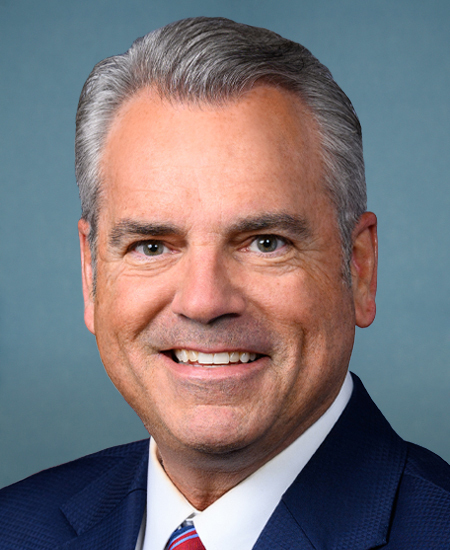
Rep. Mark Alford
Sponsored bills
Maddy summaryThis bill amends the federal tax code to exclude certain overtime pay from taxable income. It directly affects workers who earn overtime under the Fair Labor Standards Act (FLSA) or through specific employer-employee agreements meeting defined conditions (like exceeding 40 hours per week or railway work standards). The key provision defines "qualified overtime compensation" to exclude this pay from federal income tax calculations. The change applies to tax returns filed for 2025 and later. This creates a concrete tax exemption for qualifying overtime earnings.
Maddy summaryHR 5483, the Chloe Cole Act, prohibits health care professionals, hospitals, or clinics from providing certain gender-affirming treatments to minors under 18 that aim to alter their body to align with a gender identity different from their sex assigned at birth. This includes puberty blockers, sex hormones, and specific surgeries, unless the treatment falls under narrow exceptions like medically necessary care for disorders of sexual development, injuries, or detransition. The bill creates a private right for affected minors or their guardians to sue providers for damages in federal court, with strict liability for violations. It applies when interstate commerce is involved (e.g., payments, travel, communications) and sets a 25-year statute of limitations from the minor’s 18th birthday.
Maddy summaryThe Stop CMV Act of 2025 requires hospitals to screen all infants under 21 days old for congenital cytomegalovirus (CMV), a virus that can cause hearing loss and developmental delays. States must establish screening standards - including parent notification - within two years of the law’s enactment, or the federal Advisory Committee on Heritable Disorders will set them. The bill provides federal grants for states to implement screening, improve data systems, and fund research on CMV prevention, diagnostics, and treatments through the CDC and NIH.
Maddy summaryHRES 727 is a symbolic resolution designating October 14, 2025, as a "National Day of Remembrance for Charlie Kirk." It does not create new law but formally honors Charlie Kirk, founder of Turning Point USA and a prominent advocate for free speech and civic education, who died by assassination on September 10, 2025. The resolution encourages educational institutions and citizens to observe the day with activities promoting civic engagement, liberty, and democracy. It directly affects no specific group through policy changes, as it is a commemorative gesture without binding requirements.
Maddy summaryHR 5100 extends the Small Business Innovation Research (SBIR) and Small Business Technology Transfer (STTR) programs through fiscal year 2026, instead of ending on September 30, 2025. This bill directly affects small businesses and research institutions that rely on federal funding for research and development through these programs. The key mechanism is updating expiration dates across multiple program provisions in the Small Business Act to maintain funding authority and program operations for one additional year. The extension does not alter program eligibility, funding levels, or core requirements.
Maddy summaryThis symbolic resolution (HRES 700) condemns the assassination of Charlie Kirk, a conservative campus advocate and founder of Turning Point USA, who was killed on September 10, 2025, at Utah Valley University. It expresses the House's deepest condolences to Kirk’s family, including his wife and children, and honors his work promoting civil discourse among college students. The resolution does not create new laws or policies but serves as a formal expression of the House’s stance on the incident. It directly affects no individuals or groups through legislative action, as it is purely a ceremonial statement.
Maddy summaryHRES 702 is a symbolic resolution condemning the September 10, 2025, assassination of Charlie Kirk, founder of Turning Point USA and a conservative political activist. It expresses condolences to his family, praises first responders, and reaffirms the right to peaceful assembly. As a non-binding resolution, it does not create new laws or policies but serves as a formal statement of condemnation. The resolution directly addresses the House of Representatives' stance on this event, with no direct impact on constituents or legislation.
Maddy summaryHRES 695 is a commemorative resolution honoring Charlie Kirk, a conservative speaker and Turning Point USA leader, following his assassination on September 10, 2025, in Orem, Utah. The resolution condemns the attack, offers condolences to his family, and recognizes first responders. It reaffirms the First Amendment right to peaceful assembly and emphasizes that violence cannot silence democratic participation. This non-binding resolution does not create new laws or policies but serves as a symbolic tribute to Kirk's memory and the principles of democratic engagement.
Maddy summaryHR 5272, the *Protect Elections from Deceptive AI Act*, prohibits the intentional distribution of AI-generated audio or video that falsely represents a federal candidate’s appearance, speech, or conduct in a way that would mislead voters during an election. It directly affects candidates for federal office, political committees, and entities distributing such content with the intent to influence elections or solicit funds. The bill includes key exceptions for news organizations (with clear authenticity disclosures), publications (with explicit statements), and satire. Victims can seek court injunctions or damages for violations, with the burden of proof requiring "clear and convincing evidence." This law aims to prevent AI-generated disinformation from distorting election outcomes.