

In committee Sep 24, 2026
1 co-sponsor
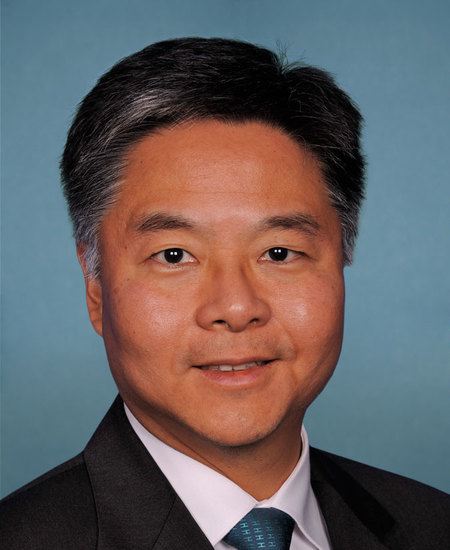
Rep. Ted Lieu
Total votes
2,837
all sessions
Attendance
97%
85 missed
Near the chamber average
With party
98%
of cast votes
Near the chamber average
Bipartisan score
1%
crosses aisle rarely
Near the chamber average
Sponsored
2,328
bills & resolutions
Higher than 93% of chamber peers
Committees
3
assignments
2,328 bills and resolutions
Sponsored bills
Total
2,328
Primary
160
Co-sponsor
2,168
This page
2,328
matching current filters
Directing the President, pursuant to section 5(c) of the War Powers Resolution, to remove United States Armed Forces from hostilities with Iran.
Maddy summaryThis concurrent resolution directs the President to withdraw United States Armed Forces from any hostilities against Iran. It specifically invokes the War Powers Resolution, mandating this removal unless Congress formally declares war or provides specific authorization for military force against Iran. The bill clarifies that it does not prevent the U.S. from acting in self-defense, maintaining a defensive troop presence in the region, or continuing intelligence activities related to threats from Iran.
Failed Sep 24, 2026
1 co-sponsor
In committee Sep 21, 2026
1 co-sponsor
Expressing support for the designation of the week beginning on September 14, 2026, as "National Hispanic-Serving Institutions Week".
Maddy summaryThis House resolution expresses support for designating the week beginning September 14, 2026, as National Hispanic-Serving Institutions Week. It recognizes these colleges and universities, which enroll at least 25 percent Hispanic students, for their role in providing higher education access to low-income and underserved populations. The bill highlights that these institutions serve a significant portion of the nation's undergraduate students and contribute to economic mobility. It calls on the public and interested groups to observe the week with ceremonies and activities during Hispanic Heritage Month.
In committee Sep 17, 2026
1 co-sponsor
Electing a Member to a certain standing committee of the House of Representatives.
Maddy summaryThis procedural resolution elects Representative Blair to the House Committee on Financial Services. The bill directly affects the composition of that specific standing committee by adding one member. It serves as a formal administrative action to fill a seat within the committee structure of the U.S. House of Representatives.
Passed Sep 16, 2026
0 co-sponsors
In committee Sep 16, 2026
1 co-sponsor
Debt-Free College Act of 2026
Maddy summaryThe Debt-Free College Act of 2026 establishes a state-federal partnership that provides federal grants to states to cover the unmet financial need of eligible students attending in-state public colleges, effectively making tuition debt-free for those who qualify. To participate, states must commit to capping tuition increases at inflation levels, maintaining their current level of funding for higher education, and implementing student success programs that support low-income and underserved populations. The bill also creates a separate five-year grant program for specific minority-serving institutions and tribal colleges to help them cover student costs, while simultaneously expanding federal financial aid eligibility to include "Dreamer students" who entered the United States as minors under certain conditions.
In committee Sep 16, 2026
1 co-sponsor
Directing the President, pursuant to section 5(c) of the War Powers Resolution, to remove United States Armed Forces from hostilities with Iran.
Maddy summaryThis concurrent resolution directs the President to withdraw U.S. military forces from hostilities with Iran. It invokes Section 5(c) of the War Powers Resolution, which allows Congress to end ongoing military engagements. The bill permits keeping troops only if they are needed to defend the U.S. or its allies from an immediate attack, provided the President follows specific reporting rules. All other forces must be removed unless Congress has passed a formal declaration of war or a specific authorization for using military force against Iran.
Passed Sep 16, 2026
1 co-sponsor
ASAP Act
Maddy summaryThis bill would require Medicare to cover early detection screening tests for Alzheimer's disease and related dementias starting January 1, 2028. It defines eligible tests as FDA-cleared genomic blood tests, blood product analyses, or equivalent medical imaging methods (like protein expression or whole genome sequencing) that detect pre-symptomatic or early-stage conditions. Medicare beneficiaries would receive this coverage without cost-sharing for these specific screenings. The bill amends Medicare coverage rules to explicitly include these tests under Section 1861(nnn) of the Social Security Act.
In committee Sep 16, 2026
1 co-sponsor
Medically Tailored Home-Delivered Meals Program Pilot Act
Maddy summaryThis bill creates a 6-year Medicare pilot program providing medically tailored home-delivered meals and nutrition counseling to specific high-risk Medicare patients after hospital discharge. It targets individuals with diet-impacted conditions (like diabetes or heart failure) who live at home, have limited mobility, and are at high risk of hospital readmission. Selected hospitals must meet quality standards, screen patients using approved tools, and deliver at least two meals daily meeting nutritional needs while respecting cultural/religious dietary requirements, all without patient cost-sharing. The program requires hospitals to submit data for the Secretary to evaluate health outcomes, readmission rates, and cost savings compared to non-participants. Funding comes from the Medicare Hospital Insurance Trust Fund, offset by reductions to other hospital payments to maintain budget neutrality.
Budget & TaxesSupports Budget & TaxesBill creates federal funding for Medicare pilot program targeting high-risk patients, advancing essential healthcare spending through government appropriation.
HealthcareSupports HealthcareCreates Medicare-funded pilot for medically tailored meals to reduce readmissions, expanding coverage for diet-impacted conditions like diabetes.
In committee Sep 16, 2026
1 co-sponsor
Ask Maddy
·
AI policy assistant
Ask Maddy about Ted Lieu
Scope: idaho
Hi! I can help you understand Ted Lieu's legislative record. What would you like to know?
Try one of these
i
Maddy answers using official bill text and legislative records. Always verify before sharing.
Sources cited inline