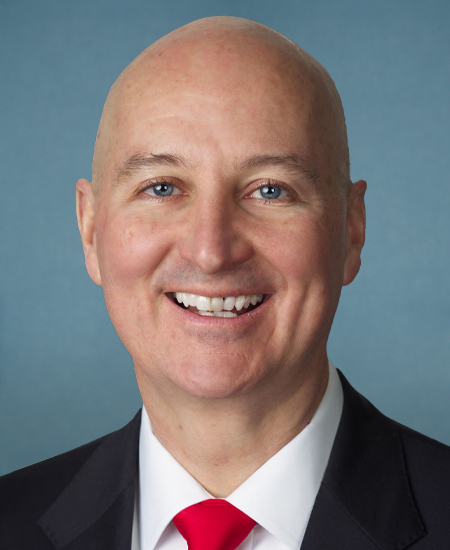
This bill designates a portion of Interstate Route 680 in Omaha, Nebraska, as the Hal Daub Freeway. Harold John Daub Jr. served in the House of Representatives from 1981-1989 and as the mayor of Omaha, Nebraska, from 1995-2001.
Sen. Pete Ricketts
Sponsored bills
Maddy summaryS 3650, the Child Interstate Abortion Notification Act, requires physicians performing abortions on minors traveling across state lines to provide 24 hours of "actual notice" (in person or in writing) to a parent before the procedure, or "constructive notice" (via certified mail) if actual notice isn't possible. The bill directly affects minors under 18 (not emancipated), their parents, and physicians in states where the minor resides but the abortion is performed. Key exceptions include life-threatening medical emergencies, court waivers for parental notification, documented child abuse, or when a parent accompanies the minor. Violations could lead to fines or imprisonment for those transporting minors to bypass parental involvement laws or physicians failing to comply with notification rules.
Maddy summaryS 3632 creates two new federal tax credits to incentivize renewable chemical production: a 15% production credit per pound of qualifying chemicals sold (Section 45BB) and a 30% investment credit for facilities producing them (Section 48F). The bill directly affects U.S. manufacturers meeting strict criteria: chemicals must be 95% biobased, USDA-certified, produced domestically from renewable biomass, and used as chemical intermediates (not for food, fuel, or pharmaceuticals). Credits are limited to $500 million nationally and $25 million per company, with allocations prioritizing job creation, reduced fossil fuel dependence, and sustainability metrics. Both credits expire after five years from enactment.
Maddy summaryS 3616, the Expanding Access to Lending Options Act, amends the Federal Credit Union Act to allow federal credit unions to offer loans with terms up to 20 years (previously capped at 15 years), subject to regulatory approval by the National Credit Union Administration. The bill also clarifies that properties used as collateral must be the principal residence of a credit union member. This change directly affects federal credit unions and their members by potentially expanding loan options for longer-term financing. The amendment modifies existing lending rules without creating new programs or altering eligibility criteria beyond the term length and residence requirement.
Maddy summaryThis bill changes U.S. immigration law to make certain fraud convictions deportable without requiring a minimum fraud loss amount. It targets immigrants (aliens) convicted of fraud against any private individual, fund, corporation, or government entity, removing the previous threshold for deportation. It also adds provisions to revoke citizenship for naturalized citizens convicted of such fraud crimes, requiring courts to cancel their naturalization certificates. The changes apply to fraud committed on or after September 30, 1996, if not previously charged before the bill's enactment.
Maddy summaryThis is a Senate resolution (SRES 573), not a legislative bill, expressing the Senate's position on U.S. leadership in religious freedom. It reaffirms the U.S. commitment to promoting religious freedom globally, encourages the Secretary of State to use diplomatic tools to address foreign violations, and supports existing roles like the Ambassador-at-Large for International Religious Freedom. The resolution does not create new laws or change policies but serves as a symbolic statement urging continued U.S. engagement on this issue. It directly affects U.S. diplomatic efforts and messaging toward countries with religious freedom concerns, such as China and Nicaragua, as cited in the resolution's background.
Maddy summarySRES 547 is a Senate resolution expressing strong support for the U.S.-Japan alliance amid recent tensions with China. It condemns China's economic, military, and diplomatic pressure on Japan - including actions like blocking cultural events, suspending trade, and naval incursions - and reaffirms the U.S. commitment to the security treaty covering the Senkaku Islands. The resolution commends Japan's stance against unilateral changes to regional stability, particularly regarding the Taiwan Strait, and supports Japan's increased defense spending to enhance regional deterrence. It directly affects U.S. diplomatic relations with Japan and China, reinforcing alliance unity without proposing new laws or funding.
Maddy summaryThis bill modifies U.S. export control laws to include Taiwan in specific certification, reporting, and licensing requirements previously listing only New Zealand. It directly affects U.S. military exports and transfers involving Taiwan by adding Taiwan to lists of eligible recipients in multiple sections of the Arms Export Control Act. The key provision creates a new expedited review process (15 days for government-to-government deals, 30 days for others) for defense transfers from U.S. allies (NATO members, Japan, Australia, South Korea, Israel, New Zealand) to Taiwan. This aims to streamline military equipment transfers while requiring a report on implementation within one year.
Maddy summaryThis bill, S 3453 ("No Bounties on Badges Act"), authorizes the Attorney General to offer rewards for information leading to arrests, convictions, or prevention of attacks against U.S. federal law enforcement officers. It specifically creates a program allowing rewards for tips about acts harming or killing officers, conspiracies to do so, or efforts to prevent such attacks. The law directly affects federal law enforcement officers (the targets of potential violence) and individuals who provide actionable information to authorities. It amends existing law to add this reward mechanism under Title 18, U.S. Code, section 3071, without restricting other bounty programs.
Maddy summaryThis bill establishes a federal working group under the Department of Health and Human Services to standardize how loneliness (a subjective feeling) and isolation (an objective lack of social contact) are measured across government and healthcare. The Working Group, composed of HHS agencies and state representatives from areas with high/low mental health practitioner shortages, will develop consistent metrics and definitions for research, public health initiatives, and healthcare tools. It requires the group to submit a report to Congress within one year of enactment, detailing recommendations for unified measurement standards. The effort is limited to improving data collection methods and expires by December 31, 2027.