Maddy summaryThe Affordable Housing Credit Improvement Act of 2025 would reform the Low-Income Housing Credit program, which provides tax credits to developers of affordable housing. It would increase state allocations based on population with annual cost-of-living adjustments, modify tenant eligibility rules to allow higher income limits for some residents, and add protections for domestic violence victims in housing. The bill would simplify rules for rural and Native American housing projects, clarify credit eligibility requirements, and require greater transparency in program administration. These changes would directly affect developers, property owners, and low-income tenants in housing projects that receive LIHC tax credits.
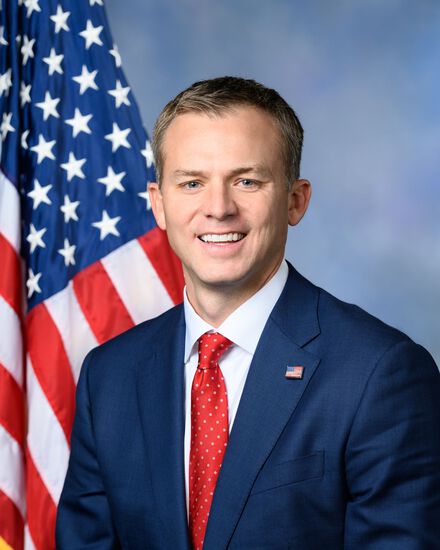
Rep. Blake D. Moore
Sponsored bills
Moab UMTRA Project Transition Act of 2025 This bill allows the Department of Energy (DOE) to convey the Moab site to Grand County, Utah, at no cost when it finishes cleaning up uranium mill tailings (i.e., radioactive waste) at the site. (The Moab site is a uranium milling site located approximately three miles northwest of Moab, Utah.) DOE must retain certain water rights that are necessary to carry out its responsibilities, such as maintaining access to wells and the associated surface footprint of the wells if the remediation of groundwater is ongoing at the time of the conveyance. The conveyance of the site must include a provision that prohibits Grand County from reconveying to a private entity or nonprofit organization any portion of the land conveyed to the county.
Maddy summaryThe Manifest Modernization Act of 2025 updates U.S. customs rules for importers by requiring more detailed public disclosure of shipment information on manifests for vessels, vehicles, and aircraft entering the country. It mandates that public disclosure include the Harmonized Tariff Schedule subheading, country of origin, and the last country the cargo passed through before arrival. This applies to all importers and customs authorities handling manifests for sea, land, or air transport arriving after the 30-day implementation period following the law's passage. The bill directly affects businesses and logistics providers managing international shipments entering the United States.
Maddy summaryThis bill, titled "Secure Family Futures Act of 2025" but actually focused on tax code changes, primarily affects a specific subset of insurance companies. It amends the Internal Revenue Code to exclude certain debts (like bonds or notes) held by these companies from being counted as capital assets (Section 2), and extends their capital loss carryover period to 10 years for losses from foreign expropriation or losses incurred by these companies (Section 3). The changes apply to debts acquired and losses arising after December 31, 2025. The bill's title is misleading, as it does not relate to family policy but is a technical tax amendment targeting defined insurance industry entities.
Sanctioning Russia Act of 2025 This bill imposes penalties on certain persons (individuals and entities) if the President determines that the Russian government or a person acting at Russia's direction is involved with (1) refusing to negotiate a peace agreement with Ukraine; (2) violating a negotiated peace agreement; (3) initiating another invasion of Ukraine; or (4) overthrowing, dismantling, or seeking to subvert the Ukrainian government. If the President makes such a determination, the bill requires certain actions including the President must impose visa- and property-blocking sanctions on specified persons such as the Russian president, certain Russian military commanders, and any foreign person that knowingly provides defense items to the Russian armed forces; the President must increase the rate of duty on all goods and services imported from Russia into the United States to at least 500% relative to the value of such goods and services; the President must increase the rate of duty on all goods and services imported into the United States from countries that knowingly engage in the exchange of Russian-origin uranium and petroleum products to at least 500% relative to the value of such goods and services; the Department of the Treasury must impose property-blocking sanctions on any financial institution organized under Russian law and owned wholly or partly by Russia, and any financial institution that engages in transactions with those entities; and the Department of Commerce must prohibit the export, reexport, or in-country transfer to or in Russia of any U.S.-produced energy or energy product.
Maddy summaryHR 2457, the Mining Schools Act of 2025, establishes a competitive grant program to fund education and training programs for the U.S. mining industry. It directs the Secretary of Energy to award up to 10 annual grants to eligible "mining schools" - defined as accredited engineering programs (including Tribal Colleges) or specific geology/engineering departments at public universities in states with significant mining GDP - to recruit students and enhance curriculum. Grants must support education in critical areas like critical mineral extraction, environmental reclamation, rare earth element processing, and reducing reliance on foreign mineral supplies. The program requires geographic diversity in grant selection and mandates an advisory board (with industry and academic members) to review applications and ensure funds are used for specified educational purposes, with no new federal funds authorized.
Maddy summaryHR 2410 creates a 20% federal tax credit for developers converting older non-residential buildings (at least 20 years old) into affordable housing. The credit applies to qualified conversion costs, requiring that 20% of units be rent-restricted for residents earning 80% or less of the area median income for 30 years. It establishes a $12 billion national credit limit, with $3 billion reserved for conversions in economically distressed areas, and mandates state-level allocation plans prioritizing projects near transit and employment. The bill directly affects developers seeking tax incentives for downtown revitalization, not tenants or local governments.
Maddy summaryHR 2423, the Unfair Tax Prevention Act, amends the U.S. tax code to modify how the base erosion tax applies to certain foreign-owned businesses. It directly affects foreign-controlled entities operating under specific foreign tax systems that impose taxes based on ownership chains, such as those linked to foreign corporations. Key provisions include treating these entities as "applicable taxpayers" for tax purposes, changing a deadline from December 31, 2025, to the bill's enactment date, and counting 50% of their cost of goods sold as a tax benefit while excluding certain other tax rules. The changes apply to taxable years beginning after the bill becomes law.
Maddy summaryThis bill amends the tax code to allow charitable organizations (501(c)(3) nonprofits) to provide grants for college student housing without losing their tax-exempt status. It specifically permits grants to improve or maintain "collegiate housing property" (where most residents are full-time students at a nearby college) but excludes grants for fitness facilities. The change affects charities seeking to fund student housing infrastructure, clarifying that such grants qualify as charitable under existing tax rules. The policy change applies to grants made after the bill's enactment date.
Maddy summaryThis bill requires states receiving Temporary Assistance for Needy Families (TANF) funds to spend at least 25% of their annual grant amount on work-related services. Specifically, states must use these funds for job training, education programs, apprenticeships, short-term benefits, and case management to help individuals create employment plans. The requirement applies to all states administering TANF programs and takes effect October 1, 2026. It directly affects TANF recipients by prioritizing workforce development support through mandatory state spending.