This resolution supports the initiative of Governor Greg Abbott to complete a border wall in Texas and calls on other border state governors to follow suit. It also states that the status quo relating to border security is unsustainable, irresponsible, and dangerous.
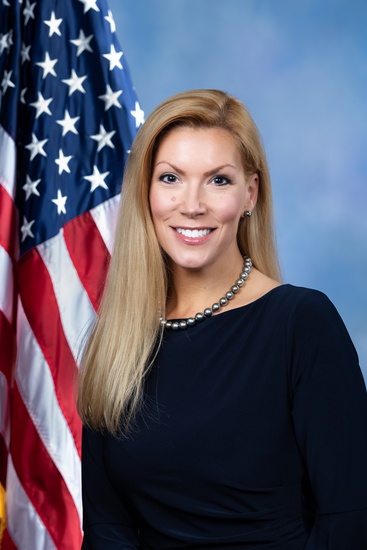
Rep. Beth Van Duyne
Sponsored bills
Justified Action for Securing Our Nation Act or the JASON Act This bill authorizes the Department of Homeland Security (DHS) to suspend the entry of all non-U.S. nationals ( aliens under federal law) or any class of non-U.S. nationals for up to 60 days, if DHS determines that allowing the entry of such individuals would be detrimental to the United States. The bill also establishes that in certain situations, it shall be presumed to be detrimental to allow the entry of any non-U.S. national into the United States, such when the increase in the number of DHS apprehensions at land borders exceed certain thresholds.
Regulatory Accountability Act This bill expands and provides statutory authority for notice-and-comment rulemaking procedures to require federal agencies to consider (1) whether a rulemaking is required by statute or is within the discretion of the agency, (2) whether existing laws or rules could be amended or rescinded to address the problem, and (3) reasonable alternatives to a new rule. For proposed major or high-impact rules that have a specified significant economic impact or adverse effect on the public health or safety, an agency must publish notice of such rulemaking to invite interested parties to propose alternatives and ideas to accomplish the agency's objectives; allow persons interested in high-impact or certain major rules to petition for a public hearing with oral presentation, cross-examination, and the burden of proof on the proponent of the rule; adopt the rule that maximizes net benefits within the scope of the statutory provision authorizing the rule, unless the agency explains the costs and benefits that justify adopting an alternative rule and such rule is approved by the Office of Information and Regulatory Affairs (OIRA); and publish a framework and metrics for measuring the ongoing effectiveness of the rule. Agencies must notify OIRA with certain information about a proposed rulemaking, including specified discussion and preliminary explanations concerning a major or high-impact rule. Further, OIRA must establish certain rulemaking guidelines. Additionally, the bill (1) revises the scope of judicial review of agency actions, and (2) establishes requirements for agencies issuing guidance.
Require Evaluation before Implementing Executive Wishlists Act of 2022 or the REVIEW Act of 202 2 This bill prohibits a final agency rule from taking effect until (1) the agency submits the rule to the Office of Information and Regulatory Affairs (OIRA), and (2) OIRA makes a determination as to whether the rule is a high-impact rule that may impose an annual cost on the economy of at least $1 billion. In addition, an agency must postpone the effective date of a high-impact rule until the final disposition of all actions seeking judicial review of the rule.
Surging Prosecutors to Expedite Alien Removals Act of 2022 This bill requires the Department of Homeland Security (DHS) to establish a ratio of four U.S. Immigration and Customs Enforcement prosecutors for each immigration judge. These prosecutors represent DHS during removal proceedings. DHS must provide a report to Congress within 90 days on the plan and status of achieving the ratio.
Making the CFPB Accountable to Small Businesses Act of 2022 This bill eliminates the requirement that financial institutions must collect data regarding loans made to women-owned, minority-owned, or small businesses. In addition, the Consumer Financial Protection Bureau must justify its decision to not adopt certain alternatives to regulations applicable to small entities.
Flores Settlement Update and Establishment Act of 2022 This bill modifies and provides statutory authority for certain policies pertaining to the treatment of minors without lawful immigration status under the Flores settlement and revises certain human trafficking laws. For example, the bill requires each member of a family unit seeking asylum to take a DNA test to verify familial relationships within 72 hours of the family encountering U.S. Customs and Border Protection.
Closing Loopholes and Ending Asylum Abuse Act of 2022 This bill imposes restrictions on noncitizens ( aliens under federal law) applying for asylum, authorizes asylum seekers to apply for asylum abroad, and requires applicants to apply abroad in certain instances. For example, the bill requires a refugee's persecution or well-founded fear of persecution to stem from a government (or affiliated entity), whereas currently the persecution does not have to stem from a government. The bill also requires an applicant who passes through another country with a U.S. diplomatic mission that processes asylum claims to apply for asylum while physically in that country.
Secure Every School and Protect Our Nation’s Children Act or the STOP II Act This bill reauthorizes and supports various grants to enhance school safety and security initiatives. It also provides statutory authority for the federal clearinghouse of school safety resources. (The clearinghouse identifies and publishes best practices and recommendations for school safety for use by state and local educational and law enforcement agencies, institutions of higher education, health professionals, and the public.)
Maddy summaryThis bill prohibits federal funding for any activities related to Executive Order 14074 (issued May 25, 2022), which aimed to improve policing and criminal justice practices. It directly affects federal agencies that would otherwise implement the executive order's requirements using taxpayer dollars. The key provision blocks all federal funds from being used to carry out the order's provisions, effectively halting its implementation through budgetary means. The bill does not alter the executive order itself but prevents its federal financial support.