

Big Cat Public Safety Act This act revises requirements governing the trade of big cats (i.e., species of lion, tiger, leopard, cheetah, jaguar, or cougar or any hybrid of such species) under the Lacey Act to limit the possession, breeding, and exhibition of big cats. The Lacey Act prohibits any person from importing, exporting, buying, selling, transporting, receiving, or acquiring big cats across state lines or the U.S. border. However, some exemptions are provided for certain entities, such as universities and wildlife sanctuaries. (Sec. 3) The act expands the Lacey Act prohibitions to include a prohibition on possessing or breeding big cats. Breeding means facilitating propagation or reproduction (whether intentionally or negligently), or failing to prevent propagation or reproduction. Owners of big cats that were born before this act's enactment may keep their big cats, but the owners must register them with the U.S. Fish and Wildlife Service. The act modifies the list of entities that are exempt from prohibitions to export, buy, sell, transport, receive, acquire, possess, or breed big cats. The modified list includes exemptions for entities or facilities exhibiting animals to the public if they (1) hold a Class C license in good standing under the Animal Welfare Act, and (2) do not allow individuals to come into direct physical contact with big cats. However, direct contact is allowed if the individual is a trained professional, a veterinarian, or directly supporting conservation programs that do not involve commercial activities and meet other specified restrictions. (Sec. 4) A person who knowingly violates the act must be fined not more than $20,000, or imprisoned for no more than five years, or both. The act considers each violation to be a separate offense. The offense must be deemed to have been committed not only in the district where the violation first occurred, but also in any district in which the defendant may have taken or been in possession of the prohibited wildlife species. (Sec. 5) The act extends forfeiture provisions to fish, wildlife, or plants that are bred or possessed; thus, big cats bred or possessed in violation of the act are subject to forfeiture. (Sec. 6) The Department of the Interior must issue regulations to implement this act.
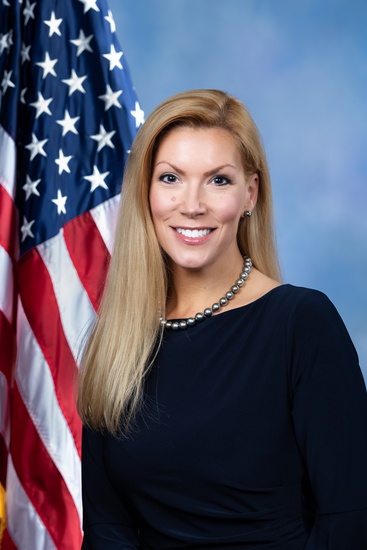
Rep. Beth Van Duyne
Sponsored bills
The Jackie Walorski Maternal and Child Home Visiting Reauthorization Act of 2022 This bill reauthorizes through FY2027, increases funding for, and modifies the Maternal, Infant, and Early Childhood Home Visiting Program. This program supports home visits for expectant and new parents who live in communities that are at-risk for poor maternal and child health outcomes. Changes to the program include setting out requirements for allocating program funds; increasing the percentage of funds reserved for tribal entities; establishing a publicly available dashboard that reports program outcomes; requiring activities to reduce unnecessary data collection, reporting, and other administrative requirements of the program; and allowing for virtual home visits (provided certain conditions are met). The bill also reduces funding for the Medicare Improvement Fund.
This bill prohibits the Department of Defense from paying for or reimbursing (1) any fees or expenses relating to a health care professional gaining a license in a state if the purpose of gaining such license is to provide abortion services, or (2) travel expenses related to abortion services.
Declaring War on the Cartels Act of 2022 This bill enhances the term of federal imprisonment for members of certain transnational criminal cartels (i.e., Mexican cartels) who are repeat offenders. It also establishes penalties for U.S. banks and foreign governments that support or otherwise have dealings with these cartels. Specifically, cartel members are subject to an additional 10 to 20 years imprisonment if they are convicted of certain federal crimes (e.g., crimes of violence, fraud, or sexual exploitation) and have been previously convicted of similar crimes (including at the state or local level) within the last five years. Any U.S. national who is convicted as an accessory to such crimes is also subject to up to 15 years of additional imprisonment. The bill also prohibits cartel members from using U.S. banks to conduct business and subjects any related assets to federal seizure. Banks that intentionally do business with cartel members are subject to civil penalties. Additionally, the bill (1) bars noncitizen cartel members and their immediate family from admission into the United States, (2) authorizes sanctions against foreign governments and persons (individuals or entities) that support cartel activity, and (3) requires certain federal agencies to work with foreign governments on combatting cartels. The bill applies to members of the following cartels: The Sinaloa Cartel, The Jalisco New Generation Cartel, The Beltran-Leyva Cartel, The Gulf Cartel, The Los Zetas Cartel, The Tijuana Cartel, and The La Familia Michoacána/Knights Templar Cartel.
Lymphedema Treatment Act This bill provides for Medicare coverage of lymphedema compression treatment items. Specifically, the bill provides for coverage of standard and custom fitted gradient compression garments and other approved items that are prescribed by a physician or other specified health care professional to treat lymphedema.
Senior Citizens' Freedom to Work Act of 2021 This bill eliminates provisions that reduce Social Security retirement benefits for certain beneficiaries who have outside income. Currently, benefits are reduced for beneficiaries who are younger than full retirement age if they earn more than $18,960 in outside income in a year.
Renewing Investment in American Workers and Supply Chains Act This bill classifies nonresidential real property and residential rental property as 20-year property for depreciation purposes.
Maddy summaryHRES 1114 is a non-binding House resolution expressing support for recognizing "National Police Week" as a way to honor law enforcement officers across the United States. The resolution acknowledges the service and sacrifices of law enforcement officers, particularly those who have died in the line of duty, and specifically references 619 officers who died in 2021 as listed in the resolution. This resolution does not create new laws or allocate funds but serves as a symbolic gesture to encourage public recognition of law enforcement personnel. It calls for Americans to observe National Police Week by honoring officers and raising awareness about their essential role in community safety. The resolution was introduced by multiple members of Congress and referred to the Committee on the Judiciary.
This resolution urges the Biden administration to (1) remove Vice President Kamala Harris as the head of any executive branch task force or strategy related to immigration, (2) appoint an experienced and competent leader to replace Vice President Harris as the head of the Biden administration's strategy to address the root causes of migration, and (3) immediately provide U.S. Customs and Border Protection with the adequate support and resources to do their job effectively and adequately. The resolution also urges the administration to take action to protect American communities from fentanyl.
This resolution expresses the sense of the House of Representatives that (1) the claims made by the members of the Texas legislature who have fled to the nation's capital from Texas are unfounded at best and deceiving at worst, and (2) their actions have further resulted in their abandonment of their responsibilities and duty to fulfill their oath of office. The resolution also urges the House Sergeant at Arms, the U.S. Capitol Police, and the Department of Justice to cooperate with the Texas Department of Public Safety in their efforts to return these members to Texas.