This resolution expresses the sense of the House of Representatives that research and promotion boards support efforts to develop new markets and strengthen existing markets via research, education, and promotion.
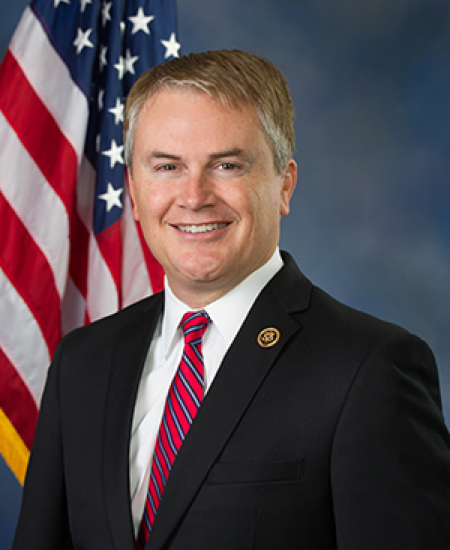
Rep. James Comer
Sponsored bills
Maddy summaryHR 3358, the Mission not Emissions Act, prohibits federal contractors from being required to report greenhouse gas emissions or climate-related financial risks. The bill blocks compliance with the proposed Federal Acquisition Regulation rule that would have mandated contractors to disclose Scope 1, Scope 2, and Scope 3 emissions, create emissions inventories, or set emissions reduction targets for validation. It directly affects businesses holding federal contracts by removing these specific reporting obligations. The law focuses solely on eliminating disclosure requirements, not on changing emissions standards or reduction efforts.
Maddy summaryHR 3755, the Industrial Hemp Act of 2023, clarifies federal definitions and regulations for industrial hemp production. It defines industrial hemp as the *Cannabis sativa L. plant* (excluding cannabinoid resin from stalks or seeds) and requires hemp farmers to designate their crop as "industrial hemp" or "hemp for any purpose" when applying for state or federal programs. The bill mandates visual inspections for industrial hemp producers, with documentation requirements (like seed tags or harvest records) if inspections fail, and imposes a 5-year program ineligibility for producers who knowingly grow crops inconsistent with their designation. This directly affects hemp farmers, state regulators, and the agricultural industry by creating a clearer legal framework for industrial hemp cultivation.
Maddy summaryHJRES 44 is a congressional resolution seeking to block a 2021 rule by the Bureau of Alcohol, Tobacco, Firearms, and Explosives (ATF). The rule classified firearms with stabilizing braces as "short-barreled rifles," which would have required additional licensing and regulation. This resolution uses a specific legal process (under Title 5, U.S. Code) to formally disapprove the ATF rule, meaning the rule would no longer be in effect. It directly affects firearm owners, manufacturers, and dealers who would have been subject to the rule’s requirements.
Maddy summaryHR 277 would require Congress to approve major federal regulations before they take effect. Major rules are defined as those with significant economic impact ($100 million+ annually), major cost increases for consumers or industries, or significant adverse effects on competition, employment, or innovation. Agencies must submit detailed information about these rules to Congress, including cost-benefit analyses, before they can take effect. Congress would have 70 session days to approve the rule with a joint resolution; if they don't act within that timeframe, the rule would not take effect. This would increase congressional oversight of federal regulations and require more detailed information about proposed rules before they become law.
Maddy summaryHJRES 42 is a congressional resolution disapproving the District of Columbia Council's approval of the *Comprehensive Policing and Justice Reform Amendment Act of 2022* (D.C. Act 24-781), which the Council enacted on January 19, 2023. This resolution, introduced by 18 House members on March 9, 2023, formally expresses Congress's objection to the DC law but does not alter the law itself or its implementation in the District. The resolution targets the DC Council’s action under the Home Rule Act, requiring Congress to formally disapprove such local legislation before it takes effect. It affects DC’s local policing policies but does not directly change federal law or impact residents beyond this procedural disapproval.
Maddy summaryHR 3007, the Mammoth Cave National Park Boundary Adjustment Act of 2023, would add approximately 980 acres of land in Edmonson and Barren Counties, Kentucky, to Mammoth Cave National Park. The bill directs the National Park Service to acquire this specific land, as shown on a 2022 map, for inclusion in the park. This adjustment expands the park's boundaries to incorporate privately owned land adjacent to the existing park area. The change affects landowners in the designated area by transferring their property into federal park management. The bill does not alter park operations or fees but formally extends the park's protected boundaries.
Maddy summaryThis bill requires that AM radio receivers be included as standard equipment in all new motor vehicles (such as cars and trucks) sold in the United States, with a rule to be issued by the Department of Transportation within one year. The rule must ensure AM radio is easily accessible on the dashboard and allows manufacturers to use digital AM radio technology instead of traditional AM. During the one-year period between the bill's enactment and the rule's effective date, manufacturers must clearly label vehicles without AM radio. The bill also directs a study to evaluate whether an alternative system could deliver emergency alerts as reliably as AM radio across the country, especially during crises.
Maddy summaryHR 3238, the Affordable Housing Credit Improvement Act of 2023, updates the Low-Income Housing Tax Credit (LIHTC) program to increase the availability of affordable housing across the United States. The bill makes several key changes including increasing state funding formulas, modifying tenant eligibility rules to better serve vulnerable populations (such as domestic violence victims and students), and expanding credit eligibility for projects in rural and Native American communities. Specific provisions raise the credit for properties serving extremely low-income households, clarify rules around tenant income increases, and require housing providers to protect victims of domestic violence. The bill also updates terminology from "low-income" to "affordable" throughout the tax code and enhances program transparency through data sharing requirements. These changes aim to make the LIHTC program more effective at creating and preserving affordable housing units for low-income households nationwide.
Maddy summaryThe Protecting Taxpayers and Victims of Unemployment Fraud Act allows states to retain 25% of funds recovered from fraudulent unemployment claims (for pandemic-related benefits) to improve fraud prevention systems. States can use these retained funds to modernize unemployment systems, hire fraud investigators, reimburse administrative costs, or conduct other fraud prevention activities. The bill requires states to use specific data matching systems like the National Directory of New Hires to detect fraud more effectively. It modifies federal rules to ensure states can use recovered funds without violating deposit requirements. This legislation aims to reduce unemployment fraud while protecting taxpayers and victims of fraud.