

Defending Ukraine Sovereignty Act of 2022 This bill authorizes security assistance for Ukraine, requires sanctions against Russia if it escalates hostilities in or against Ukraine, and addresses related issues. The bill (1) authorizes the Department of Defense to use various authorities to provide and expedite the delivery of defense articles to support Ukraine's armed forces, (2) allows the President to exercise drawdown authority to provide defense articles to Ukraine, and (3) authorizes the Department of State to provide International Military Education and Training assistance to Ukraine. The President must periodically determine whether Russia's government is significantly escalating hostilities in or against Ukraine and whether such an escalation has the aim or effect of undermining Ukraine's government or interfering with Ukraine's sovereignty or territorial integrity. If the President determines that Russia's government has engaged in such escalation, the President must impose sanctions on (1) certain government officials, including Russia's president and prime minister; (2) certain Russian financial institutions; (3) entities involved in certain transactions involving Russian debt; (4) entities (and corporate officers of such entities) involved in constructing or operating Russia's Nord Stream 2 natural gas pipeline; and (5) certain entities involved in Russian resource extraction industries. The President may terminate such sanctions after certifying to Congress that Russia's government has taken certain actions, such as entering into an agreed settlement with Ukraine's legitimate democratic government. The bill also authorizes Radio Free Europe/Radio Liberty to explore opening new bureaus to reach new audiences on Russia's periphery. The State Department must establish an initiative to deepen and foster ties with the Baltic states.
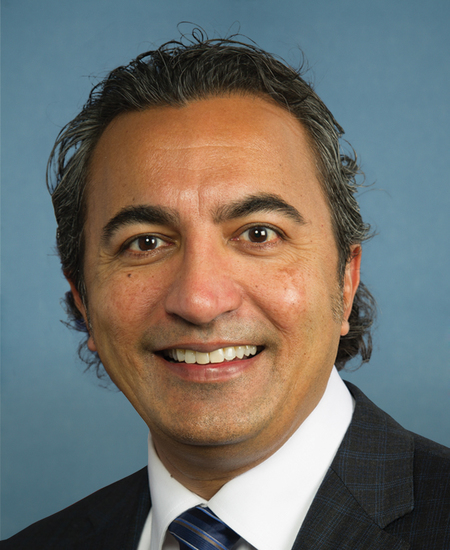
Rep. Ami Bera
Sponsored bills
Repeal Existing Policies that Encourage and Allow Legal HIV Discrimination Act of 2022 or the REPEAL HIV Discrimination Act of 2022 This bill addresses federal and state laws, policies, and regulations that may burden people living with HIV/AIDS. Specifically, the bill directs the Department of Justice (DOJ), the Department of Health and Human Services (HHS), the Department of Defense (DOD), and the White House Office of National AIDS Policy to initiate a national review of federal (including military) and state laws, policies, regulations, and judicial precedents and decisions regarding criminal and related civil commitment cases involving people living with HIV/AIDS. DOJ must transmit to Congress and make publicly available the results of such review with related recommendations. The White House Office of National AIDS Policy must also develop and publicly release guidance to assist states with handling relevant cases. The office, DOJ, HHS, and DOD must transmit to the President and Congress any proposals necessary to implement adjustments to federal laws, policies, or regulations. This bill shall not be construed to discourage the prosecution of individuals who act with the intent to do harm to another individual by intentionally transmitting HIV.
Welcoming Evacuees Coming from Overseas to Mitigate Effects of Displacement Act of 2021 or the WELCOMED Act of 2021 This bill makes certain individuals from Afghanistan eligible for any benefit that is available to a refugee, such as resettlement assistance. Specifically, this bill shall apply to a national of Afghanistan (or an individual with no nationality who last habitually resided in Afghanistan) who is temporarily paroled into the United States for urgent humanitarian reasons or significant public benefit during the four-year period beginning on July 1, 2021.
America's Cultivation of Hope and Inclusion for Long-term Dependents Raised and Educated Natively Act of 2021 or the America's CHILDREN Act of 2021 This bill provides lawful permanent resident status to certain college graduates who entered the United States as children and addresses other immigration-related issues. Specifically, this bill allows an alien to apply for lawful permanent resident status if the alien (1) was lawfully admitted into the United States as a dependent child of an alien on a temporary worker visa, (2) was in the United States with such status for at least four years, (3) has graduated from an institution of higher education in the United States, and (4) is not deportable or otherwise inadmissible. In addition, the alien must have been lawfully present in the United States for at least 10 years at the time of the application. The bill also modifies various provisions related to the calculation of an alien's age for immigration purposes and the priority date of certain immigration-related applications.
Hong Kong People's Freedom and Choice Act of 2021 This bill provides for temporary protected status (TPS) for qualifying Hong Kong residents and contains other immigration-related provisions. Hong Kong shall be treated as a TPS-designated territory for 18 months starting from this bill's enactment. (Qualifying nationals of a TPS-designated territory or country may not be removed from the United States and shall have employment authorization while the designation is in effect.) Furthermore, Hong Kong shall be treated as separate from China for the purposes of various numerical limitations on immigrant visas. (In the treaty that transferred sovereignty of Hong Kong to China, China pledged that Hong Kong "will enjoy a high degree of autonomy.") The bill also establishes Priority Hong Kong Resident status for qualified individuals. To obtain such status, an individual must meet certain requirements, such as having resided in Hong Kong for at least ten years as of the day of this bill's enactment and not having citizenship in any jurisdiction other than China, Hong Kong, or Macau. For seeking refugee status or asylum, a Priority Hong Kong Resident may establish a well-founded fear of persecution based on various factors, such as fear based on the individual's significant role in certain protests against China's encroachment into Hong Kong's autonomy. The Department of Homeland Security (DHS) or the Department of State may provide special immigrant status to an eligible Priority Hong Kong Resident with a bachelor's or graduate degree if DHS determines that doing so would provide a significant benefit to the United States.
Amend the Code for Marriage Equality Act of 2021 This bill amends the Internal Revenue Code, the Social Security Act (SSAct), and other federal laws to replace (1) references to wife or husband with references to spouse , and (2) references to husband and wife or husband or wife with references to married couple or married person. For purposes of federal laws or regulations, marriage is defined as a legal union between two people as spouses. The bill eliminates a definition of spouse that refers only to a person of the opposite sex who is a husband or a wife. Requirements concerning compensation to a surviving wife after the disability or death of a person employed at a military, air, or naval base outside the United States are revised to make surviving spouses eligible for such compensation. The bill makes similar revisions to the Family and Medical Leave Act of 1993 and the Federal Mine Safety and Health Act of 1977. The bill revises title II (Old Age, Survivors and Disability Insurance) of the SSAct to consolidate separate provisions for a wife's insurance benefits and a husband's insurance benefits into a single standard for a spouse's insurance benefits. Criminal penalties that currently apply to persons who threaten to kill, kidnap, or inflict bodily harm upon a former President's wife or widow are revised to apply to threats made to a former President's spouse or surviving spouse.
Disarm Hate Act The bill expands the categories of persons who are prohibited from receiving or possessing a firearm. Specifically, it prohibits firearm sale or transfer to and receipt, possession, shipment, or transport by a person (1) who has been convicted of a misdemeanor hate crime, or (2) who has received an enhanced hate crime misdemeanor sentence.
Greater Leadership Overseas for the Benefit of Equality Act of 2021 or the GLOBE Act of 2021 This bill contains provisions related to (1) the protection of LGBTQI individuals globally; and (2) immigration protections for vulnerable individuals. The bill establishes (1) an interagency group to respond to urgent threats to LGBTQI people in foreign countries, and (2) a permanent Special Envoy for the Human Rights of LGBTQI Peoples in the Department of State. The President shall impose visa-blocking sanctions on foreign persons responsible for violating the human rights of individuals based on sexual orientation, gender identity, or sex characteristics. The State Department shall establish the Global Equality Fund to provide assistance to nongovernmental organizations working to advance and protect human rights. The U.S. Agency for International Development shall establish the LGBTQI Global Development Partnership to work with the private sector and nongovernmental organizations to support LGBTQI rights. The bill removes prohibitions against providing foreign assistance to nongovernmental organizations that offer certain medical services (e.g., abortion-related services) using non-U.S. government funds. The bill contains several immigration-related provisions, such as those establishing that persecution based on sexual orientation or gender identity may form the basis of an asylum request, allowing certain applicants to file asylum claims more than a year after their arrival in the United States, including a permanent partnership between two partners as a marriage for immigration law purposes, providing for free counsel in certain immigration proceedings, and granting U.S. citizenship to a child born abroad through assistive reproductive technology from a U.S. citizen who is the child's nonbiological parent.
Afghan Allies Protection Act of 2021 This bill provides for 4,000 additional special immigrant visas to qualified nationals of Afghanistan who were employed by or on behalf of the United States or the International Security Assistance Force after October 6, 2001. The visa allotment, in addition to any unused allocations of such special immigrant visas since FY2015, shall be available beginning FY2021, and unused visas shall carry over to subsequent fiscal years until exhausted.
Conrad State 30 and Physician Access Reauthorization Act This bill modifies the Conrad 30 Waiver program, which incentivizes qualified foreign physicians to serve in underserved communities. It also extends statutory authority for the program for three years from this bill's enactment. Aliens coming to the United States under a J-1 nonimmigrant visa to receive medical training typically must leave the country and reside for two years abroad before being eligible to apply for an immigrant visa or permanent residence. The Conrad program waives this requirement for individuals who meet certain qualifications, including serving for a number of years at a health care facility in an underserved area. The bill increases the number of waivers that a state may obtain each fiscal year from 30 to 35 if a certain number of waivers were used the previous year, and provides for further adjustments depending on demand. An alien physician may be employed at an academic medical center to meet the Conrad program's employment requirements if the alien's work is in the public interest, even if the medical center is not in an underserved area. Employment contracts for alien physicians under the Conrad program shall contain certain information, such as the maximum number of on-call hours per week the physician shall have to work. Certain alien physicians (along with the physician's spouse and children) shall be exempt from the direct annual numerical limits on immigration, including those physicians that have met certain requirements related to visas for physicians to serve in underserved areas.