Law Enforcement De-Escalation Training Act of 2022 This bill directs the Department of Justice (DOJ) to develop scenario-based training curricula (or identify existing curricula) that includes topics such as alternatives to the use of force, de-escalation tactics, and safely responding to an individual experiencing a mental, behavioral health, or suicidal crisis. The bill also directs DOJ to make grants to states for costs associated with providing the training to law enforcement officers or mental health professionals.
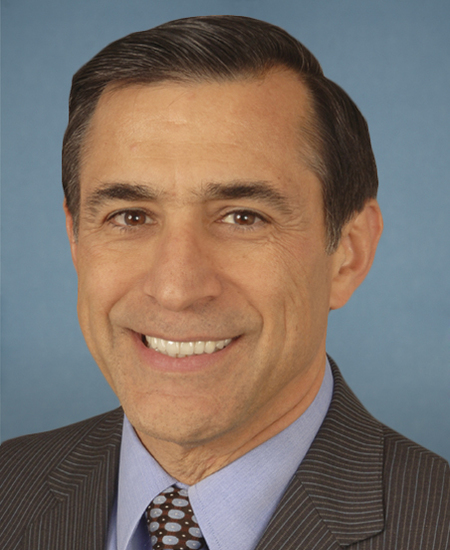
Rep. Darrell Issa
Sponsored bills
American Confidence in Elections Act or the ACE Act This bill addresses election administration and security, campaign finance, and other related provisions. Among other provisions, the bill reduces certain election assistance payments for states and local jurisdictions that allow noncitizens to vote in state and local elections, establishes certain requirements related to election and political mail, prohibits foreign nationals from making contributions or donations in connection with state or local ballot initiatives or referenda, repeals certain limits on coordinated party expenditures and aggregate contributions by individuals, terminates the Presidential Election Campaign Fund and requires remaining funds to be transferred to the 10-Year Pediatric Research Initiative Fund, and prohibits the use of federal funds to establish a Disinformation Governance Board.
Body Armor Safety Act of 2022 This bill requires body armor (for use by law enforcement) to comply with certain safety requirements in order to be imported into the United States. It also establishes new criminal offenses related to fraud in connection with such body armor.
Secure Every School and Protect Our Nation’s Children Act or the STOP II Act This bill reauthorizes and supports various grants to enhance school safety and security initiatives. It also provides statutory authority for the federal clearinghouse of school safety resources. (The clearinghouse identifies and publishes best practices and recommendations for school safety for use by state and local educational and law enforcement agencies, institutions of higher education, health professionals, and the public.)
Supreme Court Police Parity Act of 202 2 This bill grants the Marshal of the Supreme Court and the Supreme Court Police the authority to protect any member of the immediate family of the Chief Justice, any Associate Justice, or any officer of the Supreme Court if the Marshal determines that such protection is necessary.
No Alternatives to Detention for Illegals Act of 2022 This bill prohibits the Department of Homeland Security (DHS) from enacting any program that provides alternatives to detention for a non-U.S. national ( alien under federal law) who is in DHS custody and housed at an immigration detention center.
Immigration Transparency and Transit Notification Act of 2022 This bill requires notifications to certain officials before an unaccompanied alien child or a non-U.S. national ( alien under federal law) without lawful immigration status may be placed in or transported to a state or local jurisdiction. The bill also authorizes the office of the governor of the relevant state to prohibit the placement or transportation. At least seven calendar days before taking such an action, the Department of Homeland Security (DHS) or the Department of Health and Human Services (HHS) must notify (1) the relevant state governor's office, (2) the state attorney general's office, (3) the county or municipal government, (4) local law enforcement, and (5) federal and state legislators representing the relevant jurisdiction. The action may not take place if the state governor's office objects no later than three calendar days after receiving the notification. This authority to object shall not apply if the action is to place an unaccompanied child with, or transport the child to, a family member.
Stop the Betrayal Act of 2022 This bill prohibits using federal funds to transport an unlawfully present non-U.S. national ( alien under federal law) into a U.S. region that is not within the border jurisdiction of U.S. Customs and Border Protection, unless such transportation is for (1) enforcing immigration laws, or (2) bringing an unaccompanied alien child to a Department of Health and Human Services facility.
Putin Accountability Act This bill imposes sanctions pertaining to Russia and addresses related issues. The President must impose sanctions, with some exceptions, on individuals and entities that knowingly and directly provide specialized financial messaging services to Russia's central bank (or enables access to such services); entities responsible for constructing, financing, or operating Nord Stream 2 (a pipeline constructed to increase Russian natural gas exports) and the corporate officers and controlling shareholders of such entities; individuals and entities in Russia involved in kleptocracy, Russian government activities to subvert U.S. democratic institutions and interests, or Russian government disinformation campaigns against the United States; and entities that are Russian state development corporations, as well as any officials of such an entity. The President must impose property-blocking sanctions on such individuals and entities and also visa-blocking sanctions on the individuals. The President must also (1) issue regulations to prohibit U.S. individuals and entities from dealing in Russian sovereign debt; and (2) issue a determination as to whether certain specified Russian individuals meet the criteria to be subject to sanctions under various authorities, including this bill. The Department of State must (1) designate Russia a state sponsor of terrorism, and (2) report to Congress a determination of whether Russia-affiliated armed entities in the Donbas region of Ukraine meet the criteria to be designated as foreign terrorist organizations. The bill prohibits expending funds to engage with Russia's government on cyber issues or arms control negotiations until certain conditions have been met.
Federal Prisons Accountability Act of 2022 This bill modifies the appointment procedures and term of service for the Director of the Bureau of Prisons. Currently, the director is appointed by the Attorney General. This bill requires the director to be appointed by the President and confirmed by the Senate. The bill also limits the director to a single term of 10 years.