Energy Prices Require Including Climate Externalities Act of 2021 or the Energy PRICE Act of 2021 This bill requires the Federal Energy Regulatory Commission (FERC) to direct electric utilities to take greenhouse gas emissions into account when they set their rates for the wholesale sale of electricity. Specifically, if FERC determines that the rates do not incorporate the cost of such emissions to public health, safety, or welfare, then FERC must find that the rates are unjust, unreasonable, unduly discriminatory, or preferential.
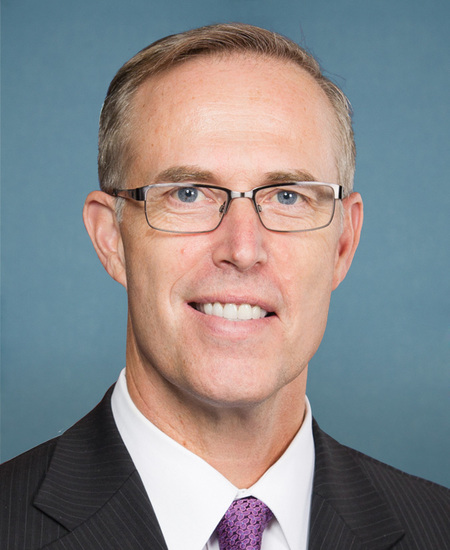
Rep. Jared Huffman
Sponsored bills
Emergency Reporting Act This bill requires the Federal Communications Commission (FCC) to report on certain activations of the Disaster Information Reporting System (the system through which communications providers report their operational status during times of crisis) and to adopt specified rules related to network outage reporting. If the system was activated for at least seven days, the FCC must issue a preliminary a report that includes (1) the number and duration of any service outages, (2) the approximate number of users or the amount of infrastructure potentially affected by a service outage, and (3) the number and duration of any outages at public safety answering points (PSAPs) that prevent the PSAPs from receiving and routing emergency calls to emergency service personnel. The FCC must also hold at least one public field hearing in the area affected by the event, and it must issue a final report that includes recommendations on how to improve the resiliency of affected communications or networks recovery efforts. The FCC must also determine the circumstances under which it shall require certain service providers to notify a PSAP of a communications service disruption that prevents the origination of 9–1–1 calls or the delivery of information that allows the PSAP to identify the number of or locate a 9–1–1 caller. Further, the FCC must require this notification to be made and specify the appropriate timing of the notification.
Preserving Home and Office Numbers in Emergencies Act of 2021 or the PHONE Act of 2021 This bill restricts the reassignment of a telephone number assigned to a subscriber for the provision of fixed wireline voice service. Specifically, for up to one year after a major disaster has been declared, a number may not be reassigned except at the request of the subscriber. At the request of a subscriber, this prohibition must be extended for an additional year. Further, a subscriber may cancel service without a cancellation fee and resubscribe with the same number and no fee if the subscriber is located in a disaster area and the residence where the number is located is inaccessible or uninhabitable.
This resolution reaffirms the House of Representatives' commitment to media diversity and expresses its pledge to eliminate barriers to such diversity.
Generating Resilient, Environmentally Exceptional National Streets Act or the GREEN Streets Act This bill establishes national goals to reduce carbon dioxide and other greenhouse gas emissions and improve the resilience of the transportation system. Specifically, the bill directs the Department of Transportation (DOT) to establish minimum standards for states to decrease greenhouse gas emissions and per capita vehicle miles traveled (VMTs) on the National Highway System; DOT to establish measures for states to assess and reduce carbon dioxide; states and metropolitan planning organizations (MPOs) to consider projects and strategies that reduce carbon dioxide and other greenhouse gas emissions and decrease per capita VMT's; states and MPOs to publish an analysis of the impact on per capita VMTs and mobile source greenhouse gas emissions for each project that adds new lanes or otherwise increases traffic capacity and costs more than $25 million; states that are out of compliance with the per capita VMT standards or carbon dioxide or greenhouse gas emission measures to dedicate federal highway funding to achieve compliance; and DOT to establish national transit access standards and performance measures for transit accessibility, transit stop distance, and transit mode share.
Medium- and Heavy-Duty Electric Vehicle Infrastructure Act of 2021 This bill directs the Environmental Protection Agency to establish a rebate program that encourages the purchase and installation of electric vehicle charging equipment for medium-duty electric vehicles and heavy-duty electric vehicles.
Sport Fish Restoration, Recreational Boating Safety, and Wildlife Restoration Act of 2021 This bill reauthorizes through FY2025 the Sport Fish Restoration and Boating Trust Fund, which provides funding for, including fisheries conservation and management, water and boating infrastructure, and recreational boating safety, among other things. The bill modifies use of the Federal Aid to Wildlife Restoration Fund, which supports wildlife restoration, conservation, and hunter education and safety programs. Of the funds disbursed for the purposes of the Sport Fishing and Boating Partnership Council, a portion of such funds remaining unobligated prior to FY2020 shall be used to study (1) the impact of derelict recreational vessels on recreational boating safety and recreational fishing, and (2) the options and methods for recycling for recreational vessels. The Government Accountability Office (GAO) shall conduct a study on recreational boating access. In carrying out the study, the GAO shall consult with the Sport Fishing and Boating Partnership Council and the National Boating Safety Advisory Council on the design, scope, and priorities of such study.
Green New Deal for Public Schools Act of 2021 This bill provides environmental and educational resources to public elementary and secondary schools and Bureau of Indian Education (BIE) schools. Specifically, the bill requires the Department of Energy's (DOE's) Office of Energy Efficiency and Renewable Energy to provide climate capital facilities grants to eligible entities (e.g., public schools and BIE schools). Grant recipients must use these funds to construct new, or convert existing facilities into, healthy zero-carbon schools. Healthy zero-carbon school refers to a school with highly energy-efficient facilities that produce or procure sufficient carbon-free and pollution-free renewable energy to meet the school's needs. Next, the bill directs the Department of Education (ED) to award resource block grants to qualified local educational agencies (LEAs) to hire and retain educators and support staff in high-need schools. ED must award grants to eligible consortia of LEAs for educational equity planning and implementation. In addition, ED must establish the Climate Change Resiliency Program to increase the resiliency of public and BIE schools during climate change-related events, natural disasters, and public health crises. Further, ED must establish a related grant program for state educational agencies. Grant recipients must use these funds for certain activities (e.g., green infrastructure projects). The bill establishes the Office of Sustainable Schools within ED to (1) administer the resource block grant and educational equity grant programs, and (2) coordinate with DOE and the White House Office of Domestic Climate Policy on climate capital facilities grants and the Climate Change Resiliency Program.
Processing Revival and Intrastate Meat Exemption Act or the PRIME Act This bill expands the exemption of custom slaughtering of animals from federal inspection requirements. Under current law, the exemption applies if the meat is slaughtered for personal, household, guest, and employee uses. The bill expands the exemption to include meat that is slaughtered and prepared at a custom slaughter facility in accordance with the laws of the state where the facility is located; and prepared exclusively for distribution to household consumers in the state or restaurants, hotels, boarding houses, grocery stores, or other establishments in the state that either prepare meals served directly to consumers or offer meat and food products for sale directly to consumers in the state. The bill does not preempt any state law concerning (1) the slaughter of animals or the preparation of carcasses, parts thereof, meat and meat food products at a custom slaughter facility; or (2) the sale of meat or meat food products.
Legacy Roads and Trails Act This bill directs the Department of Agriculture (USDA) to establish the Forest Service Legacy Roads and Trails Remediation Program. Specifically, under the program, the Forest Service, taking into account predicted changes in weather and hydrology related to global climate change, shall carry out storm damage risk reduction, including deferred maintenance, repairs, road and trail relocation, and associated activities on roads, trails, tunnels, and bridges under the jurisdiction of the Forest Service; restore waterways and natural migration of fish and other aquatic species by removing or replacing culverts or other infrastructure from such waterways; and decommission unneeded roads. In implementing the program, the Forest Service shall give priority to projects that protect or restore water quality and watershed function; a watershed that supplies a public drinking water system; the habitat of a threatened, endangered, or sensitive fish or wildlife species, or a species of conservation concern; or a watershed for which the Forest Service has completed a watershed protection and restoration action plan. The Forest Service shall identify the minimum road system needed for each unit of the National Forest System. USDA shall review, and may revise, an identification of the minimum road system in accordance with federal regulations relating to the administration of the forest transportation system.