

Improving Medicare Coverage Act This bill temporarily expands eligibility for Medicare. It also temporarily establishes a premium and cost-sharing assistance program for low-income beneficiaries. Specifically, the bill lowers the age of eligibility for Medicare from 65 to 60. The Centers for Medicare & Medicaid Services must establish procedures to provide for automatic enrollment of qualifying individuals. Enrollment must be completed within 11 months of the bill's enactment. The bill also establishes a program under Medicare to assist low-income Medicare beneficiaries with premiums, coinsurance, deductibles, and other costs. Currently, such assistance is provided through Medicare Savings Programs, which are administered by state Medicaid programs. The bill also establishes a related special enrollment period under Medicare, expands eligibility for assistance to beneficiaries with income up to 200% of the federal poverty line, and provides for joint eligibility determinations with respect to the bill's program and the low-income subsidy program under the Medicare prescription drug benefit. The bill's provisions generally take effect six months after the bill's enactment and terminate five years later.
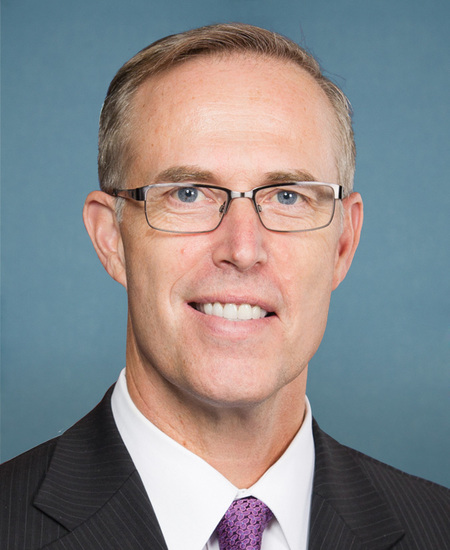
Rep. Jared Huffman
Sponsored bills
Prohibition of Medicaid Funding for Conversion Therapy Act This bill prohibits state Medicaid programs from covering conversion therapy. The bill defines conversion therapy as any practice or treatment that seeks to change a person's sexual orientation or gender identity in exchange for monetary compensation.
U.S.A. Beef Act This bill modifies label requirements for meat food products of cattle. Specifically, the bill prohibits the label of cattle meat or a meat food product of cattle from bearing the phrase Product of U.S.A. unless such meat or meat food product is exclusively derived from one or more cattle born, raised, and slaughtered in the United States. The requirement does not apply to cattle meat or a meat food product of cattle that is intended and offered for export to a foreign country.
Harlem Hellfighters Congressional Gold Medal Act This bill provides for the award of a Congressional Gold Medal to the 369th Infantry Regiment, commonly known as the Harlem Hellfighters, in recognition of their bravery and outstanding service during World War I.
No Federal Funding for Confederate Symbols Act This bill prohibits federal funds from being used for the creation, maintenance, or display of any Confederate symbol on federal public land or other federal property. An exception to such prohibition is provided (1) if the use of such funds is necessary to allow for the removal of the Confederate symbol to address public safety; or (2) in the case of a Confederate symbol created, maintained, or displayed in a museum or educational exhibit.
This resolution expresses the sense of the House of Representatives that policies concerning medication abortions should be grounded in science, be based on a review of medical evidence, and ensure equitable access for patients.
This resolution supports (1) the goals of Wildfire Preparedness Week, and (2) resources and educational initiatives that communicate how affected communities can prevent wildfires and react during a wildfire.
Choose Medicare Act This bill requires the Department of Health and Human Services (HHS) to establish public health insurance plans and addresses health insurance costs. Such public plans must be offered on health insurance exchanges and (1) meet the requirements of a qualified health plan; (2) cover benefits at the gold plan level; and (3) cover reproductive services, including abortions. Additionally, the bill makes a series of changes related to health insurance costs, including requiring employers to refer employees to health care navigators to assist with enrollment, establishing an annual limit on out-of-pocket costs for services under Medicare, providing HHS with the authority to negotiate prices under the Medicare prescription drug benefit program, expanding the premium-assistance credit by benchmarking the credit amount to the second-lowest cost gold plan and increasing the income threshold for eligibility, requiring qualified health plans to reduce cost sharing for low-income plan holders, providing funding for states to provide reinsurance to health insurance issuers and to assist individuals with out-of-pocket costs for plans offered through health insurance exchanges, applying the premium rate-setting requirements to large group health plans, and requiring HHS or states to take corrective actions to address unreasonable premium rates set by insurance issuers.
Migratory Bird Protection Act of 2021 This bill prohibits the incidental taking (e.g., capturing or killing) of migratory birds by commercial activities unless the activity is authorized under a permit or is identified as posing de minimis risk to migratory birds. The U.S. Fish and Wildlife Service (USFWS) must regulate such incidental taking, including by (1) issuing general permits for certain industries, (2) creating a mitigation fee for any incidental taking of migratory birds, and (3) identifying categories of de minimis risk activities that are exempt from liability for the taking of migratory birds. In addition, the USFWS must establish and maintain a research program (1) to evaluate the impacts of commercial activities on birds, (2) to evaluate the effectiveness of best management practices and technologies to avoid or minimize such impacts, and (3) to develop new or improved best management practices and technologies.
Fire Information and Reaction Enhancement Act or the FIRE Act This bill directs the National Oceanic and Atmospheric Administration (NOAA), in collaboration with the U.S. weather industry and such academic entities as NOAA considers appropriate, to establish a program within NOAA to improve wildfire forecasting and detection. The Office of Oceanic and Atmospheric Research of NOAA shall establish a program to create one or more weather research testbeds, in partnership with industry and academic partners, to develop improved detection of and forecast capabilities for wildfire events and their impacts.