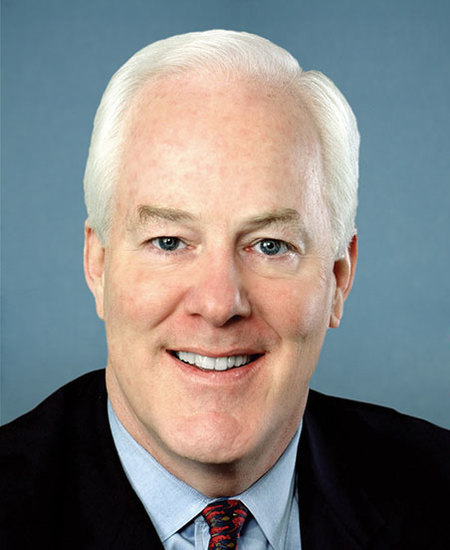
Photo of John Cornyn
R United States Senate · Texas

Sen. John Cornyn

Compare
Total votes
1,044
all sessions
Attendance
98%
19 missed
Near the chamber average
With party
93%
of cast votes
Higher than 92% of chamber peers
Bipartisan score
4%
crosses aisle rarely
Lower than 94% of chamber peers
Sponsored
1,503
bills & resolutions
Near the chamber average
Committees
17
assignments
1,503 bills and resolutions

Sponsored bills

Total
1,503
Primary
367
Co-sponsor
1,136
This page
1,503
matching current filters
Co-sponsor S 26
In committee · Delaware Senate · Co-sponsor
SNOOP Act of 2023

Maddy summaryThis bill raises the reporting threshold for payment platforms like PayPal or Venmo. It requires these platforms to report transaction data only if a business receives over $20,000 in payments across more than 200 transactions in a year. This change directly affects payment processors and their business users by reducing the volume of transactions they must report to the IRS.

In committee Jan 23, 2023 1 co-sponsor
Co-sponsor S 9
In committee · Delaware Senate · Co-sponsor
Protecting America’s Strategic Petroleum Reserve from China Act

Maddy summaryThis bill prohibits the U.S. Secretary of Energy from selling petroleum products from the Strategic Petroleum Reserve (SPR) to entities controlled by the Chinese Communist Party or to any buyer unless they guarantee the oil won't be exported to China. It directly affects the Department of Energy (which manages the SPR) and any companies or entities seeking to purchase SPR oil with potential Chinese ties. The key mechanism requires the Secretary to block sales to China-linked entities or impose strict export restrictions on all sales. The bill aims to prevent SPR oil from reaching China, without creating new programs or altering existing SPR management rules.

In committee Jan 23, 2023 1 co-sponsor
Co-sponsor S 5168
Signed into law · Delaware Senate · Co-sponsor
Energy Security and Lightering Independence Act of 2022

Energy Security and Lightering Independence Act of 2022 This bill authorizes an alien crewman to obtain a permit to land in the United States for up to 180 days if, during this period, the crewman will perform ship-to-ship liquid cargo transfer operations involving a vessel engaged in foreign trade. Currently, an alien crewman may obtain a permit to land for up to 29 days.

Signed into law Jan 5, 2023 1 co-sponsor
Primary S 4926
Signed into law · Delaware Senate · Lead sponsor
Respect for Child Survivors Act

Respect for Child Survivors Act This act requires the Federal Bureau of Investigation (FBI) to use a multidisciplinary team with investigations of child abuse and related crimes. The act also reauthorizes grants for children's advocacy centers (CACs). CACs use a multidisciplinary response to coordinate the investigation, treatment, and prosecution of child abuse cases. (Sec. 2) This section requires the FBI to use a multidisciplinary team with any investigation of child sexual exploitation or abuse, the production of child sexual abuse material, or child trafficking. The FBI must also use a trained child adolescent forensic interviewer in these investigations. These requirements do not apply if a multidisciplinary team or an interviewer is unavailable or is otherwise inconsistent with applicable federal law. In implementing these requirements, the FBI must use and coordinate with multidisciplinary teams based at CACs. (Sec. 3) This section modifies and reauthorizes through FY2028 grants for regional and local CACs, as well as for technical assistance and training. Grants for CACs are administered by the Office of Juvenile Justice and Delinquency Prevention (OJJDP) within the Department of Justice. It adds a finding stating that a key to a child victim healing from abuse is access to supportive and healthy families and communities. The section modifies grant provisions for regional CACs, including by directing the OJJDP to maintain (in addition to establish) regional CACs; adding, as a new program objective, the provision of technical assistance, training, coordination, and organizational capacity support for state chapters; and requiring the OJJDP to consider, as an additional selection criteria, proposals for regional CACs that best result in supporting state chapters. The section also modifies grant provisions for local CACs, including by adding as new grant purposes (1) the establishment and maintenance of a network of care for child abuse victims, and (2) the development and dissemination of practice standards for care and best practices in program evaluation. Finally, the section modifies the criteria that the OJJDP may use to evaluate local CAC programs.

Signed into law Jan 5, 2023 0 co-sponsors
Primary S 3946
Signed into law · Delaware Senate · Lead sponsor
Abolish Trafficking Reauthorization Act of 2022

Abolish Trafficking Reauthorization Act of 2022 This act reauthorizes various antitrafficking programs, establishes a national strategy on cybercrime against individuals, and expands information sharing and data collection requirements regarding human trafficking. TITLE I--GRANTS RELATING TO HUMAN TRAFFICKING PREVENTION AND ASSISTANCE FOR VICTIMS OF HUMAN TRAFFICKING (Sec. 101) This section allows funds provided by the Department of Justice (DOJ) for human trafficking training and technical assistance programs to be used for programs funded through the Office of Community Oriented Policing Services that build law enforcement capacity to identify and respond to human trafficking, such as the Interdiction for the Protection of Children Program. (Sec. 102) This section allows a victim of human trafficking (e.g., sex trafficking) to pursue a civil claim against persons who attempt or conspire to benefit from the human trafficking in addition to persons who benefit from the human trafficking. (Sec. 103) This section generally requires grantees and subgrantees that receive funding from DOJ or the Department of Health and Human Services (HHS) to assist victims of trafficking in the United States to protect the confidentiality and privacy of the individuals they serve and their families. (Sec. 104) This section authorizes HHS to make grants to states to develop, improve, or expand programs that help child welfare agencies identify and respond to (1) children who are victims of child abuse and neglect and of sexual abuse because they are identified as victims of sex trafficking or severe forms of trafficking in persons; and (2) child-welfare-involved children who are (or are at risk of being) victims of one or more forms of trafficking in persons. This section also expresses the sense of Congress that health care and social service licensing boards and professional membership associations should facilitate access to trafficking-specific training. (Sec. 105) This section reauthorizes the Domestic Trafficking Victims' Fund through FY2027. It also makes permanent the requirement for courts to impose a special assessment on nonindigent persons or entities convicted of certain federal trafficking-related offenses including peonage, slavery, or trafficking in persons; sexual abuse; sexual exploitation and other child abuse; transportation for illegal sexual activity; and certain human smuggling offenses. The special assessments are deposited into the Domestic Trafficking Victims' Fund and support programs for victims of human trafficking. Additionally, this section reauthorizes through FY2027 various grants, programs, and activities that combat human trafficking and assist victims, including training for airport and airline personnel to identify and report human trafficking; the Human Exploitation Rescue Operation (HERO) Child-Rescue Corps Program; grants for the Rape, Abuse & Incest National Network; the Human Smuggling and Trafficking Center; the Presidential Award for Extraordinary Efforts To Combat Trafficking in Persons; additional benefits through HHS and DOJ for domestic victims of severe forms of trafficking; and research on domestic and international trafficking in persons. TITLE II--COMPENSATION OF VICTIMS OF HUMAN TRAFFICKING (Sec. 201) This section modifies federal bankruptcy laws to specify that a debtor may not discharge in bankruptcy debts for an injury to an individual related to a trafficking offense under federal criminal law. This includes an injury caused by an instance in which the debtor knowingly benefitted financially, or by receiving anything of value, from participation in a venture that the debtor knew or should have known engaged in an trafficking offense under federal criminal law. TITLE III--CYBER HARASSMENT PREVENTION Subtitle A--Cybercrime Statistics (Sec. 311) This section requires DOJ to develop a national strategy to reduce, investigate, and prosecute cybercrimes against individuals. The strategy supplements the National Strategy to Combat Human Trafficking and the National Strategy for Child Exploitation Prevention and Interdiction. Additionally, this section specifies that the House and Senate Judiciary Committees are appropriate committees to which the National Academy of Sciences must submit its report on cybercrime taxonomy. Subtitle B--Prioritizing Online Threat Enforcement (Sec. 321) This section requires DOJ to ensure that there are at least 10 additional agents at the Federal Bureau of Investigation (FBI) to investigate cybercrimes against individuals. DOJ must also ensure that there is at least one attorney in each U.S. Attorney office who is responsible for investigating and prosecuting cybercrimes against individuals. Finally, this section requires DOJ to implement a training program for FBI agents related to investigating and prosecuting cybercrimes against individuals, including relevant forensic training. (Sec. 322) This section requires the Office for Victims of Crime within DOJ to report on the nature, extent, and amount of funding under the Victims of Crime Act of 1984 for victims of cybercrimes against individuals. The Victims of Crime Act of 1984 established the Crime Victims Fund, which provides funding to support victims of crime through various federal programs and state and local victim assistance and compensation initiatives. (Sec. 323) This section allows the Department of State to exchange information with foreign governments pursuant to a bilateral or multilateral agreement that provides for the sharing of information related to individuals who are convicted of sex offenses against minors. Further, it specifies that an individual may not be issued or reissued a passport without a unique identifier solely because the individual has moved or otherwise resides outside the United States. (Sec. 324) This section requires DOJ to disseminate information and provide training and technical assistance to help states and local governments (1) investigate, prosecute, pursue, prevent, understand, and mitigate the impact of physical, sexual, and psychological abuse of cybercrime victims; the exploitation of cybercrime victims; and the deprioritization of cybercrime; and (2) assess, address, and mitigate the physical and psychological trauma to victims of cybercrime. TITLE IV--OTHER FEDERAL IMPROVEMENTS RELATING TO HUMAN TRAFFICKING (Sec. 401) This section requires DOJ and the Department of Homeland Security (DHS) to provide incentive pay to individuals who are appointed to positions requiring significant cyber skills, including to protect victims of trafficking, prevent trafficking in persons, or prosecute technology-facilitated crimes against children. (Sec. 402) This section prohibits federal agencies from requiring a survivor of human trafficking who is less than 18 years of age or a homeless youth to obtain the consent or signature of a parent or guardian to receive a government-issued identification card. Additionally, it prohibits federal agencies from charging a fee for the identification card. (Sec. 403) This section allows DOJ to use amounts in its Assets Forfeiture Fund to reimburse operating expenses and program costs incurred by crime-tip organizations that meet certain criteria (e.g., annually waive their qualification for awards for information leading to forfeiture and payments from equitably shared forfeiture funds) and offer rewards for information about violations of federal criminal laws prohibiting human trafficking. (Sec. 404) This section requires DOJ to include additional information in its annual report on U.S. government efforts to combat human trafficking. First, with respect to noncitizen victims of human trafficking whose application for continued presence, T nonimmigrant status (a T-visa), or U nonimmigrant status (a U-visa) are denied, DOJ must include the reason for the denial and the length of time for the denial to be issued. Second, DOJ must include disaggregated data regarding the number of victims trafficked by third parties and by family members, victims trafficked by victim age, and victims trafficked by the type of trafficking. (Sec. 405) This section requires DOJ and HHS to report biennially on the status of various data collection and reporting requirements related to trafficking. (Sec. 406) This section requires DOJ and DHS to each establish a team of at least 10 agents to exclusively investigate labor trafficking.

Signed into law Jan 5, 2023 0 co-sponsors
Co-sponsor S 3519
Signed into law · Delaware Senate · Co-sponsor
Butterfield Overland National Historic Trail Designation Act

Butterfield Overland National Historic Trail Designation Act This act designates the trail extending approximately 3,292 miles and following the route operated by the Butterfield Overland Mail Company, known as the Ox-Bow Route, to transport mail and passengers between the eastern end points of St. Louis, Missouri, and Memphis, Tennessee, and extending westward through the states of Arkansas, Oklahoma, Texas, New Mexico, and Arizona, to the western end point of San Francisco, California, as the Butterfield Overland National Historic Trail. The United States shall not acquire for the trail any land or interest in land outside of the exterior boundary of any federally administered area without the consent of the owner of such land or interest in land. The Department of the Interior may not use eminent domain or condemnation in carrying out this act.

Signed into law Jan 5, 2023 1 co-sponsor
Co-sponsor S 450
Signed into law · Delaware Senate · Co-sponsor
Emmett Till and Mamie Till-Mobley Congressional Gold Medal Act of 2021

Emmett Till and Mamie Till-Mobley Congressional Gold Medal Act of 2021 This act provides for the posthumous presentation of a Congressional Gold Medal in commemoration of Emmett Till and Mamie Till-Mobley. After it is awarded, the medal shall be given to the National Museum of African American History and Culture.

Signed into law Jan 5, 2023 1 co-sponsor
Co-sponsor S 5230
Signed into law · Delaware Senate · Co-sponsor
Billy's Law

Billy's Law or the Help Find the Missing Act This act provides statutory authority for the Department of Justice (DOJ) to maintain the National Missing and Unidentified Persons System (NamUs) consistent with its existing purpose and structure. NamUs is a national information clearinghouse and resource center for cases involving missing persons and unidentified or unclaimed remains. NamUs is administered by the National Institute of Justice within DOJ. The act also establishes new requirements. First, it requires a law enforcement agency that submits a missing child report to the National Crime Information Center (NCIC) to also submit the missing child report to NamUs. The NCIC is a computerized index of criminal justice data and files for reports of missing and unidentified persons. Current law requires law enforcement agencies to submit missing child reports to the NCIC database but not to the NamUs databases. Second, the act establishes requirements to facilitate data sharing between the NCIC database and the NamUs databases with respect to missing and unidentified persons. Specifically, the act requires DOJ to give the National Institute of Justice access to the NCIC missing person and unidentified person records for the purpose of validating cases and reconciling data with NamUs. Additionally, the act requires DOJ to assess the NCIC and NamUs systems and governing statutes, policies, and procedures and create a plan for NCIC to automatically transmit certain records to NamUs. Third, the act requires DOJ to report to forensic medicine service providers and law enforcement agencies on best practices for collecting, reporting, and analyzing data and information on missing persons and unidentified human remains. DOJ must also report to Congress biennially on the status of the NCIC database and the NamUs databases. The report must describe the process of information sharing between the NCIC database and NamUs databases.

Signed into law Dec 27, 2022 1 co-sponsor
Primary S 4003
Signed into law · Delaware Senate · Lead sponsor
Law Enforcement De-Escalation Training Act of 2022

Law Enforcement De-Escalation Training Act of 2022 This act directs the Department of Justice (DOJ) to develop scenario-based training curricula (or identify existing curricula) that includes topics such as alternatives to the use of force, de-escalation tactics, and safely responding to an individual experiencing a mental, behavioral health, or suicidal crisis. The act also directs DOJ to make grants to states for costs associated with providing the training to law enforcement officers or mental health professionals.

Signed into law Dec 27, 2022 0 co-sponsors
Showing 1,011 to 1,020 of 1,503 bills