Maddy summaryS 70 requires the President to designate Ansarallah (the Houthi movement) as a foreign terrorist organization within 30 days of the bill’s enactment. It then mandates a subsequent 30-day determination on whether specific individuals - Abdul Malik al-Houthi, Abd al-Khaliq Badr al-Din al-Houthi, and Abdullah Yahya al-Hakim - are officials, agents, or affiliates of Ansarallah. If confirmed, these individuals would face U.S. sanctions under existing law. The bill directly targets Ansarallah and its designated leaders for actions linked to international terrorism.
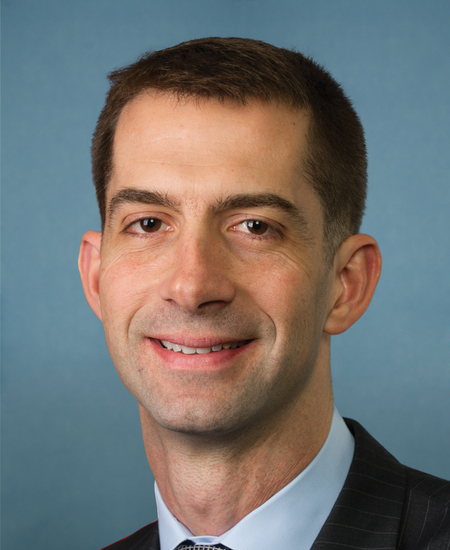
Sen. Tom Cotton
Sponsored bills
Maddy summarySRES 19 is a Senate resolution honoring former President Jimmy Carter's life and legacy, commending his decades of public service, humanitarian work, and diplomatic achievements including the Camp David Accords and founding The Carter Center. The resolution specifically recognizes his Nobel Peace Prize, efforts to combat diseases like Guinea worm, and 30+ years of Habitat for Humanity homebuilding. It formally mourns his passing and extends condolences to his family, while highlighting his role in establishing U.S.-China diplomatic relations and creating the Departments of Education and Energy. As a symbolic resolution with no policy impact, it directly affects no individuals or entities but serves as a formal Senate tribute to Carter's historical contributions.
Maddy summaryThis bill creates a legal safe harbor for generic drug manufacturers, protecting them from patent infringement lawsuits when they market drugs for unpatented uses. It specifically shields companies that submit abbreviated drug applications (like 505(j) applications) and avoid referencing patented conditions of use in their labeling, promotion, or marketing. The key provision ensures that describing a generic drug as therapeutically equivalent to a brand-name product - without referencing the patented use - does not constitute infringement of method-of-use patents. This directly affects generic drug companies and brand-name pharmaceutical firms, clarifying that certain labeling practices (called "skinny labels") are legally permissible under patent law.
Maddy summaryThis bill imposes sanctions targeting Chinese police entities and individuals operating in the U.S. It directly affects provincial/municipal police departments in China (specifically naming Xinjiang and Fujian), their senior leadership, employees, family members, and those linked to the United Front Work Department. Key provisions include blocking U.S. property transactions involving targeted entities, denying visas or revoking existing visas for affected individuals, and prohibiting U.S. agencies from participating in foreign investigations related to these targets. The sanctions apply to anyone acting under Chinese police direction or establishing a covert Chinese police presence in the United States.
Maddy summaryS 63, the "CBW Fentanyl Act," amends U.S. law to impose sanctions on foreign countries associated with officials who commit "covered acts" related to chemical or biological programs. It targets actions involving specific substances like benzylfentanyl (a fentanyl analog) and precursors, requiring the President to report on such acts and impose tiered sanctions - including suspending scientific cooperation, banning exports of controlled items, and restricting procurement from chemical/biological sectors - within 30-210 days. Sanctions escalate if countries fail to address violations, provide information, or comply with treaties like the Chemical Weapons Convention. The bill directly affects foreign governments and entities linked to these programs, with sanctions terminating after 1 year if compliance is achieved. (Note: Despite the title referencing fentanyl, the bill focuses on broader chemical/biological program violations under existing international treaties.)
Maddy summaryThis bill would allow individuals with a valid concealed carry permit from their home state to carry concealed handguns in other states that either permit concealed carry for residents or don’t ban it entirely. It applies to permit holders who are federally eligible to possess firearms, require government-issued ID, and must follow the host state’s specific restrictions (like where carry is prohibited). The bill does not override state laws on issuing permits but ensures reciprocity for those who legally carry in their home state, excluding machineguns and destructive devices.
Maddy summaryS 34, the Justice for 9/11 Act, directly affects Khalid Shaikh Mohammad, Walid Muhammad Salih Mubarak Bin ‘Attash, and Mustafa Ahmed Adam al Hawsawi - three individuals detained at Guantanamo Bay for their alleged roles in the 9/11 attacks. The bill mandates that their plea agreements and judgments cannot block military trials under Chapter 47A of Title 10 for the 9/11 attacks, makes the death penalty available in such trials, and requires them to remain in solitary confinement at Guantanamo Bay under strict conditions. Specifically, it prohibits contact with foreign nationals, restricts psychological treatment to only what medical authorities at Guantanamo authorize, and bans their transfer to the continental U.S. or any other country. The law overrides prior legal barriers to ensure these individuals face trial under military law with these specific confinement and sentencing provisions.
Maddy summaryThe Prison Staff Safety Enhancement Act requires the Justice Department's Inspector General to review how often Bureau of Prisons staff face sexual harassment or assault by inmates, including analyzing past punishments used over the last five years. Within one year of the bill's enactment, the Inspector General must complete this review and submit a report to Congress and the Attorney General within 180 days. Based on the report, the Attorney General will then establish national standards for preventing and addressing such incidents against prison staff within one year. This process aims to improve safety protocols for correctional officers and other Bureau of Prisons employees.
Maddy summarySRES 935 is a non-binding Senate resolution condemning President Biden's December 12, 2024, commutation of Michael Conahan's prison sentence. It states the Senate believes the commutation undermined the rule of law, as Conahan - a judge convicted of accepting kickbacks in exchange for sentencing over 2,300 children to private juvenile detention centers - was not individually reviewed. The resolution expresses disapproval of the commutation process and asserts it contradicted the intended purpose of presidential clemency. As a symbolic expression of opinion, the resolution does not alter legal outcomes or affect any individuals directly.
Maddy summaryThis bill restores a legal presumption that courts should grant permanent injunctions to stop ongoing or willful patent infringement, directly benefiting small patent owners like individual inventors, startups, and universities. It requires courts to assume an injunction is warranted after a final finding of infringement, shifting the burden to defendants to prove why an injunction shouldn’t issue. The key change reverses recent court practices that made it harder for smaller entities to secure injunctions against large companies. This aims to strengthen patent enforcement by returning to a historical standard for equitable remedies. The bill does not alter patent validity or licensing terms, focusing solely on injunction procedures.