Maddy summaryThis bill requires the U.S. government to replace the term "West Bank" with "Judea and Samaria" in all official documents, communications, and materials. It prohibits federal funds from being used to create or distribute any materials referencing the territory as the "West Bank," with limited exceptions for international treaties and a Secretary of State waiver process. The bill amends multiple existing laws (including the Foreign Assistance Act and Taylor Force Act) to update references from "West Bank" to "Judea and Samaria" throughout U.S. legislation. It does not change U.S. policy on the territory’s status or affect any people or communities directly - it only mandates a terminology shift in government communications.
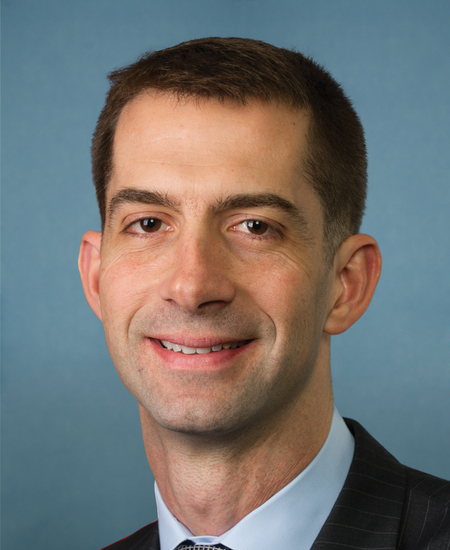
Sen. Tom Cotton
Sponsored bills
Maddy summaryThis bill amends federal law to increase penalties for obstructing justice through picketing or parading near judicial buildings. Specifically, it raises the maximum prison sentence for such offenses under 18 U.S.C. § 1507 from one year to five years. The law directly affects individuals who engage in protests or demonstrations that interfere with court operations near the Supreme Court or other judicial facilities. The key change is a stricter criminal penalty for obstructing justice, not a new policy or program.
Maddy summaryThe Fair Access to Banking Act (S 401) prohibits large financial institutions ($10 billion+ in assets) and payment networks from denying services to lawful businesses based on political or reputational factors, such as the type of legal business they operate. It requires banks to justify denials using objective, risk-based standards instead of category-based decisions, and mandates written explanations for denials. The law enables lawsuits against violators with treble damages and civil penalties up to 10% of service value (capped at $10,000 per violation). It directly affects major banks, payment processors, and credit unions that serve large-scale customers, ensuring fair access for businesses operating within federal law.
Maddy summaryThis bill would eliminate diversity, equity, and inclusion (DEI) programs across federal agencies by requiring the closure of DEI offices, rescinding related executive orders (including those on racial equity and LGBTQ+ inclusion), and prohibiting federal funds from being used for DEI-related activities. It defines "prohibited diversity, equity, or inclusion practice" as including training that asserts certain groups are inherently superior or inferior, or requiring employees to sign statements about such concepts. The bill affects all federal agencies, personnel, contractors, and grantees by banning DEI training, offices, and related activities while exempting Equal Employment Opportunity offices and disability-related programs. It also creates a private cause of action allowing individuals to sue for violations with penalties of $1,000 per violation per day.
Maddy summaryS 364, titled the "Hearing Protection Act" (though it regulates firearm silencers, not hearing protection), changes federal law to treat firearm silencers like firearms for tax and regulatory purposes. It imposes a 10% federal tax on silencers (similar to firearms), preempts state laws that tax or regulate silencers beyond federal rules, and requires the destruction of existing silencer registration records within one year. The bill clarifies definitions of "firearm silencer" in federal law and modifies licensing requirements for these devices. This directly affects silencer owners, manufacturers, and state governments that previously imposed additional restrictions or taxes.
Maddy summaryThis bill establishes tax credits for individuals and corporations who contribute to scholarship granting organizations that provide educational scholarships for eligible students. The individual tax credit is limited to 10% of adjusted gross income or $5,000, while corporate credits are capped at 5% of taxable income. The bill defines "eligible students" as those from households with income not exceeding 300% of the area median gross income, and specifies that scholarships can cover tuition, materials, tutoring, and educational therapies. The bill includes a $10 billion annual cap on tax credits, with a first-come, first-served allocation system, and requires scholarship organizations to meet specific financial and operational standards.
Maddy summaryThis bill (S 313) restricts U.S. funding for United Nations assistance programs in Afghanistan until the Secretary of State certifies specific conditions are met. It prohibits voluntary or assessed U.S. contributions to the UN for Afghanistan aid unless the Secretary certifies no U.S. funds are used in UN cash shipments there, and no designated terrorist groups (either "foreign terrorist organizations" or "specially designated global terrorist organizations") receive funds from those shipments. If certification is later found inaccurate, the Secretary must revoke it and provide a detailed justification to congressional committees. The bill directly affects U.S. foreign aid policy and UN operations in Afghanistan, requiring a formal certification process before funding can proceed.
Laken Riley Act This act requires the Department of Homeland Security (DHS) to detain certain non-U.S. nationals ( aliens under federal law) who have been arrested for burglary, theft, larceny, shoplifting, assault of a law enforcement officer, or any crime that results in death or serious bodily injury to another person. The act also authorizes states to sue the federal government for decisions or alleged failures related to immigration enforcement. Under this act, DHS must detain an individual who (1) is unlawfully present in the United States or did not possess the necessary documents when applying for admission; and (2) has been charged with, arrested for, convicted of, or admits to having committed acts that constitute the essential elements of the above crimes. The act also authorizes state governments to sue for injunctive relief over certain immigration-related decisions or alleged failures by the federal government if the decision or failure caused the state or its residents harm, including financial harm of more than $100. Specifically, the state government may sue the federal government over a decision to release a non-U.S. national from custody; failure to fulfill requirements relating to inspecting individuals seeking admission into the United States, including requirements related to asylum interviews; failure to fulfill a requirement to stop issuing visas to nationals of a country that unreasonably denies or delays acceptance of nationals of that country; violation of limitations on immigration parole, such as the requirement that parole be granted only on a case-by-case basis; or failure to detain an individual who has been ordered removed from the United States.
Maddy summaryThis bill authorizes a Congressional Gold Medal to honor Master Sergeant Roddie Edmonds, a U.S. Army soldier who saved approximately 200 Jewish-American prisoners during World War II by refusing Nazi orders to identify them. It directs the Treasury Secretary to design and strike the medal, with the posthumous presentation made to Edmonds' next of kin (specifically his grandson, Pastor Christopher Waring Edmonds). The medal serves as a ceremonial recognition of Edmonds' heroic actions at Stalag IX-A prisoner camp during the Battle of the Bulge, where he declared "We are all Jews here" to protect Jewish soldiers. The bill does not create new policy or affect any ongoing programs, as it solely provides for this commemorative honor.
Maddy summaryThis Senate resolution (SRES 31) calls on Panama's government to end Chinese influence at key Panamanian ports, specifically demanding the termination of Chinese management at Balboa and Cristobal ports and the expulsion of Chinese officials from these facilities. It urges Panama to reaffirm the Panama Canal's neutrality under the 1977 Neutrality Treaty and reduce reliance on Chinese-affiliated entities. The resolution also directs the U.S. government to support Panama in transitioning away from Chinese infrastructure partnerships and to develop U.S.-led alternatives for canal operations. The resolution is non-binding but seeks to align Panama's infrastructure management with U.S. security interests and democratic values.