Maddy summaryHR 2857, the "Drain the Swamp Act," makes Executive Order 13989 a permanent law requiring all executive branch employees to submit annual ethics commitments. This directly affects federal workers in the executive branch, including department heads and agency staff, by mandating formal ethics disclosures as a legal requirement. The key provision codifies an existing executive order - previously changeable by presidential decree - into binding law, ensuring these ethics rules persist across administrations. This change shifts the enforcement of ethics commitments from executive policy to statutory obligation without altering the content of the requirements.
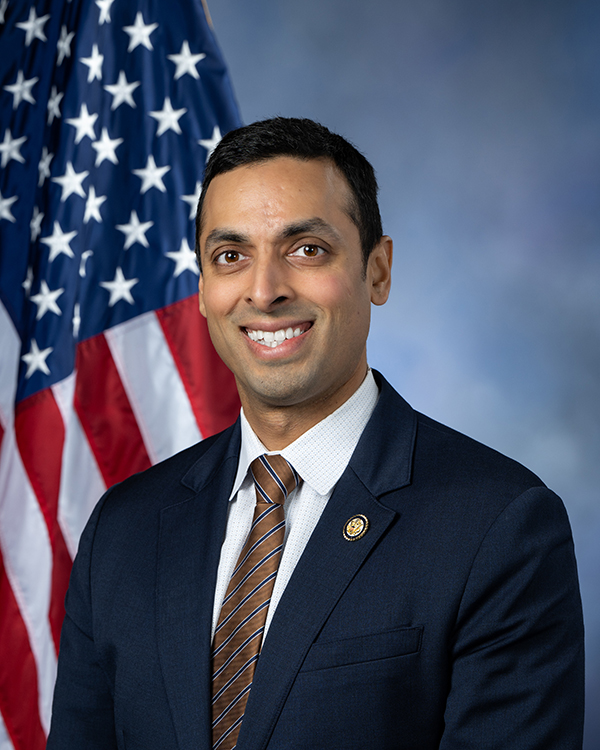
Rep. Suhas Subramanyam
Sponsored bills
Maddy summaryThis bill establishes an Office of Food Loss and Waste within the Department of Agriculture to coordinate national efforts to reduce food loss and waste. It creates a grant program for states, local governments, and tribal entities to collect data on food waste policies and develop model approaches to reduce food loss. The legislation requires federal contractors to report on their food waste reduction efforts and establishes a national education campaign to help consumers understand food waste, food safety, and composting. The bill aims to achieve a 50% reduction in food loss and waste by 2030 compared to 2016 levels through coordinated government action and public education. It authorizes $1.5 million annually for the Office and additional funds for related programs through 2030.
Maddy summaryHRES 187 is a resolution of inquiry requesting the President to provide the House of Representatives with complete, unedited documents within 14 days. It specifically asks for records related to federal employees placed on administrative leave, removed, terminated, or reassigned following actions by Elon Musk, the DOGE agency team, or the Trump administration. The resolution also seeks documents about workforce reductions affecting Diversity, Equity, and Inclusion (DEI) staff and communications regarding the removal of inspectors general. This procedural request aims to obtain transparency on executive branch actions, not to enact new policy.
Maddy summaryHRES 186 is a procedural resolution requesting the President to provide unredacted documents to the House of Representatives within 14 days. It specifically asks for any records related to Elon Musk’s government connections, including his role with the fictional "DOGE Service," potential conflicts of interest, and business ties involving his companies or board positions. The resolution does not create new law but seeks transparency about Musk’s government-related activities as requested by the House. This is a formal inquiry, not a legislative action affecting public policy.
Maddy summaryThe GOSAFE Act prohibits the sale, manufacture, transfer, and possession of gas-operated semi-automatic firearms and large capacity ammunition feeding devices (those holding more than 10 rounds). It defines gas-operated firearms as those that use gas from fired cartridges to cycle the action, requiring the Attorney General to publish a list of prohibited firearms within 180 days. The bill establishes a process for manufacturers to seek approval for new firearm designs before selling to civilians and creates a "Firearm Safety Trust Fund" to cover related costs. Certain firearms are exempt, including single-shot, muzzle-loading, and firearms with permanently fixed magazines holding 10 or fewer rounds. Violations could result in fines up to $5,000 or up to 12 months in prison.
Maddy summaryThe American Family Act (HR 2763) establishes a new refundable child tax credit that provides monthly payments to eligible families with children. It would pay $300 per month for each child under age 6 and $360 per month (120% of $300) for each child age 6 or older, with income limits of $150,000 for joint filers and $112,500 for other filers. The bill creates a "period of presumptive eligibility" to determine eligibility for monthly payments, allowing families to receive advance payments based on information from previous tax returns. This would directly affect millions of families with children who meet the income requirements, providing more consistent financial support throughout the year rather than an annual tax credit.
Maddy summaryHR 2799, the Closing the Bump Stock Loophole Act of 2025, prohibits the sale, possession, and modification of devices that increase the firing rate of semi-automatic firearms to mimic machine guns (commonly called "bump stocks"). It specifically bans manual, power-driven, or electronic devices designed to speed up firing, as well as modified firearms that achieve this effect. Owners of pre-existing modified firearms must register them within 120 days of the law's enactment, with exemptions for government entities and firearms already lawfully modified and registered before the bill passes. The bill does not restrict standard semi-automatic firearms or require registration of unmodified guns.
Maddy summaryThe Raise the Wage Act of 2025 gradually increases the federal minimum wage from $9.50 to $17.00 per hour over six years, with annual adjustments based on median wage growth. It raises the base wage for tipped workers from $6.00 to $17.00 per hour, phasing out their separate minimum wage structure by 2029. The bill also eliminates special minimum wage certificates for disabled workers after 2029, requiring employers to pay the standard minimum wage. These changes apply to most covered workers, including tipped employees and those under 20, with specific transition timelines for each group.
Maddy summaryThis bill establishes federal minimum standards for collective bargaining rights for public employees and supervisors. The Federal Labor Relations Authority would determine if state laws provide these rights, and if not, would establish them for affected employees. The bill guarantees public employees the right to form unions, bargain collectively, and engage in concerted activities, while requiring public employers to recognize unions and put agreements in writing. It also prohibits strikes or lockouts that would disrupt emergency services. This would apply to public employees in states that don't meet the federal standards for collective bargaining rights.
Maddy summaryHR 2672, the Religious Workforce Protection Act, extends temporary nonimmigrant status for religious workers whose applications for permanent residency (green cards) are delayed due to visa backlogs. It directly affects religious workers (such as pastors or missionaries) who are principal or derivative beneficiaries of pending immigrant petitions under specific visa categories, allowing them to maintain their work status beyond the usual 5-year limit while their green card applications are processed. Key provisions include granting extensions until a final decision is made on their adjustment of status application, modifying rules to allow limited job flexibility for these workers, and exempting them from a 1-year foreign residence requirement if they left the U.S. due to the prior 5-year cap. The bill aims to prevent religious workers from losing their legal status during lengthy immigration processing.