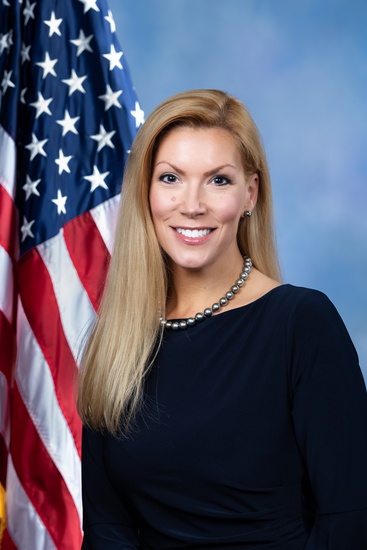
Photo of Beth Van Duyne
R United States House · District 24 · Texas On the 2026 ballot

Rep. Beth Van Duyne

Compare
Total votes
2,837
all sessions
Attendance
99%
19 missed
Higher than 78% of chamber peers
With party
94%
of cast votes
Near the chamber average
Bipartisan score
3%
crosses aisle rarely
Near the chamber average
Sponsored
913
bills & resolutions
Near the chamber average
Committees
8
assignments
913 bills and resolutions

Sponsored bills

Total
913
Primary
111
Co-sponsor
802
This page
913
matching current filters
Co-sponsor HR 992
In committee · Delaware House · Co-sponsor
PATROL Act

Maddy summaryHR 992, the PATROL Act, prohibits the federal Attorney General from suing states that build border barriers (like walls or fences) to prevent illegal entry or protect state territory. It specifically blocks civil lawsuits under existing border laws (33 U.S.C. 401/403) against states for such barrier projects. The bill defines key terms like "barrier" (including walls or fences) and "immigration laws" to clarify its scope. This directly affects states constructing border infrastructure and limits federal legal actions against those efforts. The bill does not create new border policies but changes the legal landscape for state-led border security measures.

In committee Feb 5, 2025 1 co-sponsor
Primary HR 1037
In committee · Delaware House · Lead sponsor
Voter Eligibility Verification Act of 2025

Maddy summaryHR 1037, the Voter Eligibility Verification Act of 2025, amends a 1996 federal law to require state election officials to provide immigration status information for individuals on potential voter lists within 15 days when requested by a state Attorney General or Secretary of State. This bill directly affects state election administrators who must now verify voter eligibility using immigration data upon formal request. The key provision establishes a 15-day deadline for states to share this information, creating a new administrative requirement for voter eligibility checks. The bill focuses on modifying existing federal law to facilitate state-level verification processes without changing voter eligibility criteria.

In committee Feb 5, 2025 0 co-sponsors
Co-sponsor HR 987
In committee · Delaware House · Co-sponsor
Fair Access to Banking Act

Fair Access to Banking Act This bill places restrictions on certain banks, credit unions, and payment card networks if they refuse to do business with a person who complies with the law. Restrictions include prohibiting the use of electronic funds transfer systems and lending programs, termination of an institution's depository insurance, and specified civil penalties. Banks and other specified financial institutions are allowed to deny financial services to a person only if the denial is justified by a documented failure of that person to meet quantitative, impartial, risk-based standards established in advance by the institution. This justification may not be based upon reputational risks to the institution. The bill establishes the right for a person to bring a civil action for a violation of this bill.

In committee Feb 5, 2025 1 co-sponsor
Co-sponsor HR 1024
In committee · Delaware House · Co-sponsor
US-Kazakhstan Trade Modernization Act

Maddy summaryHR 1024, the US-Kazakhstan Trade Modernization Act, terminates the application of Title IV of the Trade Act of 1974 to Kazakhstan. This means the U.S. will no longer apply special trade restrictions tied to Kazakhstan's emigration policies, as Kazakhstan has been found compliant since 1997. The bill allows the President to determine that Title IV no longer applies and extend normal trade relations (NTR) treatment to Kazakhstan's products. As a result, Kazakhstan's exports to the U.S. will be subject to standard U.S. trade rules rather than the specific Title IV provisions.

In committee Feb 5, 2025 1 co-sponsor
Primary HR 974
In committee · Delaware House · Lead sponsor
Small Business Regulatory Reduction Act

Maddy summaryHR 974, the Small Business Regulatory Reduction Act, requires the Small Business Administration (SBA) to ensure that small businesses face zero costs from SBA rulemaking starting in fiscal year 2026. This means the SBA must eliminate all regulatory costs for small businesses related to its own rule changes, including new rules, modifications, or repeals. The bill also mandates the SBA to annually report to Congress on federal rules from other agencies that impact small businesses, broken down by agency. Crucially, the bill specifies no new funding will be provided to implement these requirements.

In committee Feb 4, 2025 0 co-sponsors
Co-sponsor HR 943
In committee · Delaware House · Co-sponsor
No User Fees for Gun Owners Act

Maddy summaryHR 943, the "No User Fees for Gun Owners Act," bans states and local governments from requiring insurance, taxes, or user fees as conditions for owning, buying, or selling firearms. It specifically prohibits these fees for firearm manufacture, importation, acquisition, transfer, or continued ownership, except for general sales taxes applied equally to all goods. The bill amends federal law to prevent states from imposing such conditions on gun ownership or commerce, while allowing standard sales taxes to apply uniformly. This directly affects gun owners, dealers, and manufacturers by removing mandatory fees tied to firearm transactions. The law does not restrict general sales taxes but eliminates state-specific fees as a prerequisite for firearm-related activities.

In committee Feb 4, 2025 1 co-sponsor
Co-sponsor HR 925
In committee · Delaware House · Co-sponsor
Dismantle DEI Act of 2025

Maddy summaryHR 925, the "Dismantle DEI Act of 2025," would eliminate diversity, equity, and inclusion (DEI) programs across federal government operations. The bill requires federal agencies to close DEI offices, rescind related executive orders, and prohibit the use of federal funds for DEI training, offices, or initiatives. It defines "prohibited diversity, equity, or inclusion practice" as any activity that discriminates based on race, ethnicity, religion, biological sex, or national origin, or requires employees to complete training asserting that certain groups are inherently superior or inferior. The legislation also prohibits requiring employees to sign statements about race, ethnicity, or gender, and establishes private lawsuits for violations with potential damages of $1,000 per violation per day. This bill would directly affect federal agencies, contractors, grantees, and advisory committees receiving federal funding.

In committee Feb 4, 2025 1 co-sponsor
Co-sponsor HR 879
In committee · Delaware House · Co-sponsor
Medicare Patient Access and Practice Stabilization Act of 2025

Medicare Patient Access and Practice Stabilization Act of 2025 This bill increases certain payment adjustments under the Medicare physician fee schedule for services furnished between April 1, 2025, and January 1, 2026.

In committee Jan 31, 2025 1 co-sponsor
Co-sponsor HR 885
In committee · Delaware House · Co-sponsor
Drug Cartel Terrorist Designation Act

Drug Cartel Terrorist Designation Act This bill directs the Department of State to designate four specified drug cartels as foreign terrorist organizations. (Among other things, such a designation allows the Department of the Treasury to require U.S. financial institutions to block transactions involving the organization.) The four specified cartels in the bill are the Gulf Cartel, the Cartel Del Noreste, the Cartel de Sinaloa, and the Cartel de Jalisco Nueva Generacion. The bill also requires the State Department to submit a detailed report on those four cartels and any other cartels it may identify. Based on this report, the State Department must designate as a foreign terrorist organization any such identified cartel (or faction thereof) that meets certain criteria for designation as a foreign terrorist organization. The bill specifies that it may not be construed to expand eligibility for asylum.

In committee Jan 31, 2025 1 co-sponsor
Primary HR 824
In committee · Delaware House · Lead sponsor
GORAC Act of 2025

Maddy summaryThe GORAC Act of 2025 requires the government's watchdog office (Comptroller General) to conduct a comprehensive evaluation of federal agencies and programs every 10 years, starting within one year of the bill's enactment. A non-Federal auditor will identify duplicative, wasteful, or outdated programs - recommending consolidation of agencies with identical functions or elimination of those that wasted funds, completed their purpose, or failed to meet goals. Any savings from these changes must be used to reduce the national debt, and affected federal employees must be offered relocation assistance within government positions. The bill applies broadly to most federal agencies and programs (excluding military installations and pure entitlement programs), with Congress required to consider implementation bills based on the auditor's recommendations within 15 days of submission.

In committee Jan 28, 2025 0 co-sponsors
Showing 241 to 250 of 913 bills
Previous 1 … 24 25 26 … 92 Next