Ally's Act This bill requires private health insurance plans to cover certain hearing devices and systems (e.g., bone-anchored auditory implants) and related items and services. The bill also imposes limits on cost sharing.
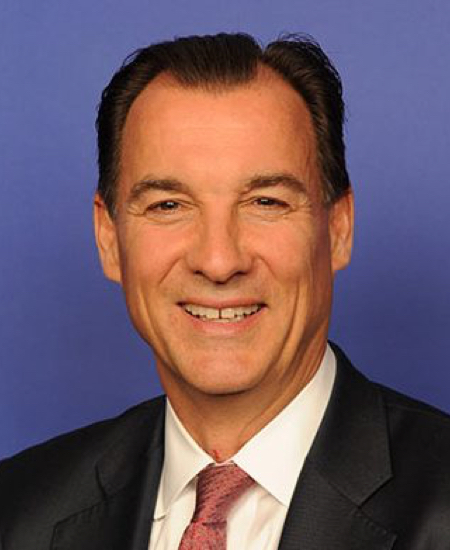
Rep. Thomas R. Suozzi
Sponsored bills
Improving Social Determinants of Health Act of 2021 This bill requires the Centers for Disease Control and Prevention (CDC) to establish a program to improve health outcomes and reduce health inequities by, for example, coordinating activities across the CDC. As part of the program, the CDC must award grants to eligible organizations to build capacity to address social determinants of health. The CDC shall provide for an independent evaluation of certain grants and report findings to Congress.
Protecting Access to Post-COVID-19 Telehealth Act of 2021 This bill makes permanent several telehealth flexibilities that were initially authorized during the public health emergency relating to COVID-19 (i.e., coronavirus disease 2019), particularly with respect to Medicare coverage of telehealth services. For example, the bill permanently allows federally qualified health centers and rural health clinics to serve as the distant site (i.e., the location of the health care practitioner) for telehealth services under Medicare. Payment must be made in the same manner as for non-telehealth services, rather than in accordance with a separate methodology determined by the Centers for Medicare & Medicaid Services (CMS). The bill also permanently allows beneficiaries to receive Medicare telehealth services at any site, regardless of type or location, and grants the CMS general authority to waive any other requirements during any emergency period.
End Diaper Need Act of 2021 This bill establishes and expands programs to increase access to diapers and related supplies primarily for low-income families. The Department of Health and Human Services must award demonstration grants to entities with experience in community distribution of basic necessities or other community services to meet diapering needs of eligible families with infants and toddlers. Additionally, the bill permits states to use Medicaid funds to provide medically necessary diapers and supplies to certain low-income families. These families must have a child who is over age three and diagnosed with a serious condition such as bowel or bladder incontinence. It also allows individuals to buy medically necessary diapers and supplies with funds from health savings accounts and other tax-advantaged accounts for health care expenses.
COVID-19 Cold Storage Expansion Act of 2021 This bill requires the Department of Health and Human Services to reimburse health care providers for costs to obtain and operate certain equipment capable of maintaining cold storage of COVID-19 (i.e., coronavirus disease 2019) vaccines. To receive this reimbursement, health care providers must sign an agreement to participate in the Center for Disease Control and Prevention's COVID-19 Vaccination Program. The agreement sets out prioritization, reporting, and other requirements for the program.
COVID-19 Prevention and Awareness Act of 2021 This bill authorizes the Centers for Disease Control and Prevention to award various grants to federally qualified health centers and other organizations to prevent, treat, and raise awareness of certain diseases or conditions, such as asthma or cancer, that increase the risk of mortality from COVID-19 (i.e., coronavirus disease 2019).
This resolution censures Representative Marjorie Taylor Greene and calls on her to resign from office.
This resolution mourns the death of U.S. Capitol Police Officer Brian D. Sicknick, and it honors his lifelong commitment to service and his selfless acts of heroism on January 6, 2021.
This resolution calls for the federal government to establish a national biodiversity strategy, which must include a goal of conserving at least 30% of U.S. lands and waters to protect biodiversity and address climate change by 2030 and other goals necessary to reduce the threats to biodiversity.
Save Education Jobs Act This bill establishes through FY2030 the Education Jobs Fund, from which the Department of Education (ED) must award grants to state educational agencies and, through them, subgrants to local educational agencies (LEAs) to retain and create education jobs. ED must also provide grants to outlying areas and the Bureau of Indian Education. Specifically, LEAs must use subgrants for compensation and benefits to retain existing employees, rehire former employees, and hire new employees. Further, subgrants may be used for certain activities such as training and professional development, providing salary increases to cover extended days or school years to make up for lost instructional time due to COVID-19 (i.e., coronavirus disease 2019), and developing teacher leadership roles in high-need schools. The bill prohibits the use of subgrants for certain activities, such as funding voucher programs, tax-credit scholarships, or education savings accounts.