Maddy summaryThis bill amends federal law to allow certain prior active duty service as a regular member of an Armed Force to count toward the reduced eligibility age for retirement in the reserve components. The change directly affects members of the Ready Reserve who have served on active duty, enabling them to qualify for retirement benefits at an earlier age than previously permitted under current rules. The legislation applies retroactively to qualifying service performed after January 28, 2008, ensuring that past service is recognized for these retirement calculations.
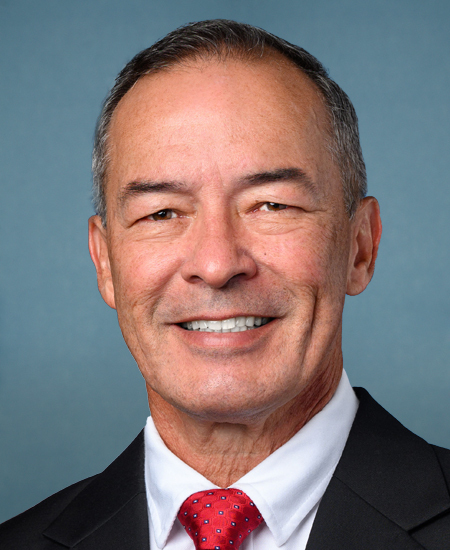
Rep. James C. Moylan
Sponsored bills
Maddy summaryThe No Antisemitism in Education Act of 2026 requires schools and universities receiving federal funds to treat antisemitism with the same seriousness as other forms of discrimination prohibited by Title VI of the Civil Rights Act. Under this law, institutions must use the official definition of antisemitism found in a prior presidential executive order to investigate complaints and enforce their own policies. The bill explicitly states that these requirements do not violate free speech rights or override existing state laws, ensuring that Jewish students and staff are protected from harassment and exclusion on campus.
Maddy summaryThis bill reauthorizes and expands the Radiation Exposure Compensation Act, extending the program's funding through 2043 and allowing new claims to be filed until 2042. It increases compensation amounts for downwinders and Manhattan Project waste claimants from $100,000 or $50,000 to $150,000, respectively, and introduces a provision for reimbursing documented out-of-pocket medical expenses not covered by insurance. The legislation broadens eligibility by adding new geographic areas in states such as Colorado, Montana, Washington, Illinois, and Ohio, as well as the territory of Guam, while also permitting the use of third-party affidavits to verify employment history or physical presence in affected zones. Additionally, it establishes a discretionary process for the President to designate new groups of radiation-exposed individuals for compensation and mandates several health studies regarding the long-term effects of nuclear testing on specific populations.
Maddy summaryThis House resolution formally acknowledges the courage and sacrifice of veterans who served in the Korean War and those who have continued to serve in South Korea as Korean Defense Veterans. It highlights that nearly 1.8 million U.S. service members participated in the conflict, which resulted in over 36,000 American deaths, and notes that approximately 25,000 troops remain stationed in the region today. The text emphasizes that these veterans often returned home without the widespread recognition given to World War II heroes and urges all Americans to honor their service in defending democracy.
Maddy summaryThis resolution expresses the sense of the House of Representatives that Charleston, South Carolina, should proceed with hosting the 2027 annual meeting of the Organization for Security and Cooperation in Europe Parliamentary Assembly. The bill cites Charleston's existing facilities as suitable for the event and notes that hosting the convention in South Carolina honors the legacy of late Senator Lindsey Olin Graham. It also highlights that the United States has not hosted this specific assembly since 2005. The measure does not change any laws or allocate funding but serves as a formal statement of support for the planned event.
Maddy summaryThis bill expands the State Department's Regional Technology Officer program to specifically include experts in biotechnology and emerging life sciences. It mandates that these officers receive specialized training in areas such as gene editing, biosecurity, and international biotechnology regulations to better support U.S. foreign policy goals. The legislation requires the Secretary of State to hire biotechnology-focused officers by fiscal year 2026 and submit a detailed implementation plan to Congress within 180 days. Additionally, the bill creates an exemption from hiring freezes to allow the Department to recruit the necessary personnel and establishes a requirement for annual reports on the program's progress and diplomatic outcomes.
Maddy summaryThis resolution celebrates 55 years of diplomatic relations between the United States and Fiji, highlighting their long-standing cooperation on stability and peace in the Pacific. It formally acknowledges specific partnerships, such as joint military training, maritime law enforcement efforts, and economic ties where the U.S. is Fiji's largest export market. The text also commends Fiji's democratic progress and urges that future elections remain free and fair while affirming ongoing support for rule of law and development. Ultimately, the bill serves as a symbolic statement of the House's commitment to maintaining a strong partnership with Fiji without enacting new laws or funding.
Maddy summaryThe Military Installation Readiness and Resilience Act of 2026 requires the Department of Defense to collect and expand data on how extreme weather and natural disasters impact military bases. Specifically, the Secretary of Defense must ensure that the Under Secretary of Defense for Acquisition and Sustainment gathers information on the costs and effects of these events at all installations. This provision aims to provide a comprehensive record of how climate-related incidents affect military infrastructure, enabling better tracking of damage and expenses. The bill directly affects the Department of Defense by mandating this specific data collection process.
This bill designates the facility of the United States Postal Service located at 86-014 Farrington Highway in Wai'anae, Hawai'i, as the "U.S Representative Colleen Hanabusa Post Office Building".
Maddy summaryThe SCALE Biology Act directs the National Institute of Standards and Technology to create a new biometrology laboratory program focused on engineering biology and biomanufacturing. This initiative aims to improve the accuracy and reliability of biological data while developing technical standards, safety guidelines, and measurement tools to support industry innovation and national security. The bill authorizes funding over several years to establish research facilities, train experts, and collaborate with universities and private companies to advance the field. Additionally, the legislation updates existing definitions related to biotechnology and biosafety to ensure clarity across federal programs.