National Medical Corps Act or the NMC Act This bill establishes a program to create pathways for community college students from economically or educationally disadvantaged backgrounds to pursue careers in primary care medicine or psychiatry by awarding grants or contracts to medical schools, institutions of higher education, or other health or educational institutions (excluding nursing schools) that form consortia comprised of specified educational institutions and health care institutions.
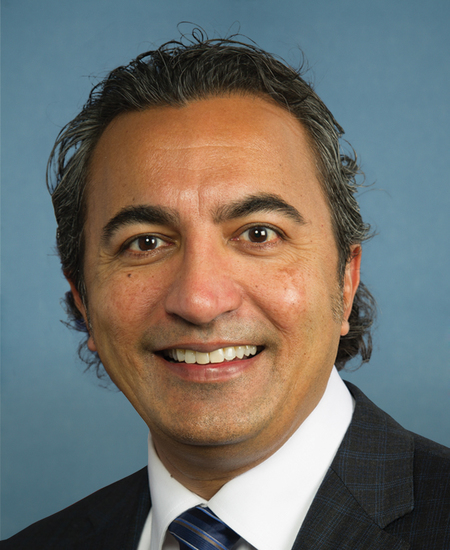
Rep. Ami Bera
Sponsored bills
Gray Zone Defense Assessment Act This bill directs the President and Department of State to report to Congress on U.S. capabilities to respond to gray zone campaigns. Gray zone campaigns are coercive activities a nation uses to achieve its objectives, not including diplomacy or armed conflict.
This resolution recognizes the 15th anniversary of the establishment of Asian American and Native American Pacific Islander-serving institutions and supports the designation of an Asian American and Native American Pacific Islander-serving institutions Week.
Affordable Rabies Treatment for Uninsured Act This bill requires the Department of Health and Human Services to establish a program to reimburse health care providers that furnish postexposure rabies treatments to uninsured individuals.
Maximizing Outcomes through Better Investments in Lifesaving Equipment for (MOBILE) Health Care Act This bill allows a health center that currently receives funding through a Health Resources & Services Administration Health Center Program grant to use a New Access Point grant to set up a mobile unit regardless of whether the health center also establishes a permanent health care delivery site. New Access Point grants help health centers establish new delivery sites to provide comprehensive primary care to medically underserved populations. Under current law, health centers may only use the grants to set up a mobile unit if they also establish a permanent site.
Maddy summaryHCONRES 107 is a symbolic resolution designating the week of September 18-24, 2022, as "National Fall Prevention Awareness Week" to highlight fall risks for older adults (65+). It does not create new laws or funding but encourages awareness of existing fall prevention strategies like balance exercises, home safety modifications, and medication management. The resolution cites CDC data showing falls cause 34,000 annual deaths and $50 billion in yearly medical costs for seniors. It urges collaboration among government agencies, healthcare providers, and communities to reduce falls but does not mandate policy changes.
Social Security Fairness Act of 2021 This bill repeals provisions that reduce Social Security benefits for individuals who receive other benefits, such as a pension from a state or local government. The bill eliminates the government pension offset , which in various instances reduces Social Security benefits for spouses, widows, and widowers who also receive government pensions of their own. The bill also eliminates the windfall elimination provision , which in some instances reduces Social Security benefits for individuals who also receive a pension or disability benefit from an employer that did not withhold Social Security taxes. These changes are effective for benefits payable after December 2021.
Peace Corps Reauthorization Act of 2022 This bill reauthorizes through FY2024 and modifies operations of the Peace Corps. Changes include increasing the readjustment allowance paid to volunteers when their service terminates and providing statutory authority for an executive order that grants returned volunteers noncompetitive eligibility for federal civil-service positions. Additionally, the bill entitles returned volunteers to sixty days of health care benefits. The Peace Corps must also provide volunteers with information about enrolling in U.S. health plans before service termination and mental health care during and after service. The bill also includes provisions to address involuntary termination of Peace Corps service in emergencies, including by expediting re-enrollment of involuntarily terminated volunteers. The Peace Corps must also adequately insure volunteers' safety and must coordinate with the Department of State to periodically update agreements concerning the security of Peace Corps volunteers and staff abroad. The bill also authorizes Peace Corps to recruit domestically based volunteers to serve in the United States at the request of another agency or to provide services in a host country virtually, modifies the Peace Corps National Advisory Council's membership and functions, expands whistleblower protections for volunteers, increases the rate of pay that applies to a volunteer's workers compensation claim, requires Peace Corps to implement a zero tolerance drug use policy regarding volunteer involvement with illegal drugs, and emphasizes the use of the internet in Peace Corps programs. Furthermore, the bill requires reporting, including on the provision of mental health services to volunteers.
The Emergency Relief Program Reauthorization Act of 2022 This bill requires the Department of Agriculture to carry out a program to make payments for losses of crops and livestock during calendar year 2022.
Indo-Pacific Engagement Act This bill requires the Department of State to, in coordination with the U.S. Agency for International Development, report annually to Congress an assessment of the resources and activities needed to achieve certain U.S. objectives in the Indo-Pacific region, such as enhancing diplomatic and economic relations with regional allies and partners and countering any malign influence of China's government.