Maddy summaryThe All Students Count Act of 2026 requires schools to break down student performance data into more specific ethnic categories for Asian Americans and Native Hawaiians and Pacific Islanders. Currently, federal education reporting only uses broad groupings, but this bill mandates that states include detailed subgroups such as Chinese, Vietnamese, Samoan, and Chamorro in their accountability systems. The law aims to provide more accurate information about the educational progress of these diverse communities by updating the Elementary and Secondary Education Act of 1965. These new data reporting requirements will take effect 18 months after the bill is enacted.
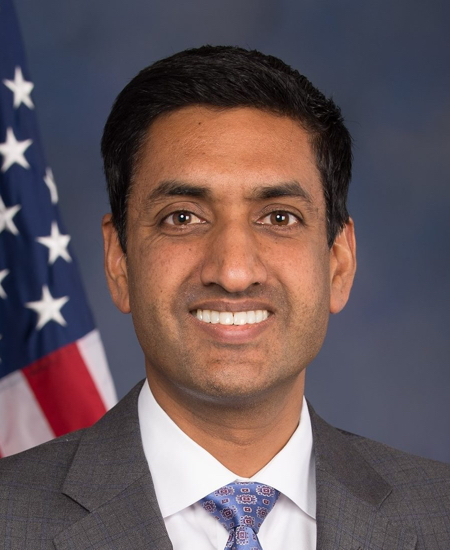
Rep. Ro Khanna
Sponsored bills
Maddy summaryThe PERFECT Act of 2026 establishes a regularly updated list of prohibited dietary supplement ingredients and performance-enhancing substances that members of the armed forces are not allowed to use. To help service members avoid accidental violations, the bill requires the Department of Defense to publish this list in an easy-to-search online format and allows commanders to waive discipline for first-time offenders who unknowingly used a supplement containing a prohibited ingredient. Additionally, the legislation mandates that possession of these specific ingredients does not count as drug abuse and requires the Defense Department to update its training programs and website tools to better educate troops and vendors on supplement safety.
Maddy summaryThis bill authorizes the U.S. Mint to produce commemorative $5 gold and $1 silver coins marking the 25th anniversary of the September 11, 2001, terrorist attacks. The coins must feature designs honoring victims and first responders (including the inscription "Never Forget") and will be sold only during 2027-2028. All surcharges ($35 per gold coin, $10 per silver coin) collected from sales will fund the National September 11 Memorial and Museum at the World Trade Center, with no net cost to the federal government. The coins are legal tender but primarily intended for collectors, not circulation.
Maddy summaryThe Biotechnology Workforce Alignment Act of 2026 directs the National Science Foundation to align its research funding with workforce development efforts in key biotechnology fields such as biomanufacturing, synthetic biology, and bioinformatics. To achieve this, the bill requires the NSF Director to create a workforce framework, support educational pathways with multiple entry points, and foster partnerships between universities, federal labs, and private industry. The legislation also mandates the development of metrics to identify career gaps and barriers to entry, along with a requirement to submit biennial reports to Congress assessing these efforts and the U.S. position in global biotechnology leadership.
Maddy summaryThe Federal Biotechnology Workforce Assessment Act directs the Office of Personnel Management to evaluate the current and future staffing needs for biotechnology roles across various federal agencies. This assessment requires detailed analysis of position requirements, necessary security clearances, and potential funding gaps, while also examining how well existing job classifications track these specialized roles. The report will explore strategies to address workforce challenges, such as training current employees, sharing staff between agencies, and creating pools of prequalified outside experts. Ultimately, the findings will be submitted to congressional oversight committees to inform decisions on how federal agencies can better develop their biotechnology capabilities.
Maddy summaryThe No Taxpayer-Funded Settlement Slush Funds Act of 2026 prohibits the use of federal money to pay specific settlements involving high-ranking government officials and their close associates. It bars payments to the President, Vice President, their immediate families, cabinet members, senior executive staff, political appointees, and individuals connected to these roles, as well as any entity owned by the President or Vice President. Additionally, the bill restricts settlements related to claims about the January 6 Capitol attack, foreign election interference, or previously dismissed lawsuits, while requiring Treasury reports for large settlements and allowing the government to seek repayment if rules are broken.
Maddy summaryThis bill creates federal programs to advance alternative protein production through biomanufacturing and bioprocessing. It authorizes $15 million annually for research centers focused on protein diversification, $50 million for grants to companies building food biomanufacturing facilities, and $25 million for workforce development programs. The bill also requires a national strategy on protein security coordinated across multiple federal agencies. These provisions aim to strengthen food supply chains, create jobs in the growing protein sector, and reduce reliance on foreign commodities. The bill explicitly excludes insect-based food production from its scope.
Dental Care for Veterans Act This bill expands eligibility for veterans for dental care provided by the Department of Veterans Affairs (VA). Specifically, the bill makes all veterans who are enrolled in the VA health care system eligible for VA-provided dental services. Currently, only veterans who have a service-connected dental issue or meet other narrow criteria are eligible for certain dental services. The bill phases in eligibility over four years based upon existing eligibility, degree of service-connected disability or other disability, prisoner of war status, award of a Purple Heart, financial need, or VA health care eligibility.
Maddy summaryThis bill creates a new federal tax on money received by former U.S. presidents, their immediate family members, or their controlled businesses from civil lawsuits against the government. Under the law, any settlement or verdict awarded to these individuals would be subject to a 100 percent tax, and the payments would not be counted as taxable income for other purposes. To enforce this, the bill requires trustees and administrators to file public reports detailing these payments and imposes a $10,000 penalty for failing to do so. These rules would apply to any funds received on or after May 20, 2026.
Maddy summaryH.Res. 1291 is a non-binding resolution that formally recognizes May 3 through May 9, 2026, as Wildfire Preparedness Week. The bill aims to raise public awareness about wildfire risks and promote educational initiatives regarding fire safety and evacuation planning. It highlights the dangers of smoke exposure for both the general public and firefighters while noting that human activity causes the majority of wildland fires. This measure does not change laws or allocate funding, but rather expresses the House of Representatives' support for these preparedness goals.