Issue · Labor & Employment

Labor & Employment

Every labor & employment bill, vote, and legislator stance in Connecticut, automatically classified by Maddy, our AI policy reader.

Total bills
94
2026 Regular Session
Top supporter
Steve Stafstrom
100% support rate
Top opponent
Craig Fishbein
0% support rate
Ranked legislators
10
5 support · 5 oppose
Key legislators

Who's moving labor & employment in Connecticut

Legislators moving labor & employment in Connecticut
Legislator Party Stance Support rate Votes
Steve Stafstrom
Steve Stafstrom House · District 129
D
Strong +
100% 18
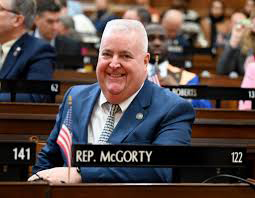
Ben McGorty
Ben McGorty House · District 122
R
Strong +
100% 21
John Kissel
John Kissel Senate · District 7
R
Strong +
89% 43
Roland Lemar
Roland Lemar House · District 96
D
Strong +
88% 20
Christie Carpino
Christie Carpino House · District 32
R
Strong +
88% 21
Craig Fishbein
Craig Fishbein House · District 90
R
Strong −
0% 18
Donna Veach
Donna Veach House · District 30
R
Strong −
12% 21
Karen Reddington-Hughes
Karen Reddington-Hughes House · District 66
R
Strong −
12% 21
John Piscopo
John Piscopo House · District 76
R
Strong −
12% 21
Mark DeCaprio
Mark DeCaprio House · District 48
R
Strong −
12% 21
Showing 61–70 of 94 bills

All labor & employment bills

in committee · Connecticut · House Mar 30, 2026

HB 5387: AN ACT CONCERNING DISCLOSURE OF WAGE RANGES AND BENEFITS ON PUBLIC AND INTERNAL JOB ADVERTISEMENTS.

HB 5387 requires all employers in Connecticut (including public and private entities) to include a wage range and general description of benefits in every public and internal job advertisement. It mandates that employers provide applicants with the wage range for a position upon request or before discussing compensation, and give current employees the wage range for their role when hired, changing positions, or upon request. The bill prohibits employers from banning wage discussions, requiring secrecy waivers, or retaliating against employees who discuss pay. It also bans asking about salary history during hiring, except where permitted by federal or state law. This law takes effect October 1, 2026, aiming to increase pay transparency for job seekers and workers.
Sub-Topics Labor Standards
passed · Connecticut · Senate Feb 25, 2026

SR 3: RESOLUTION PROPOSING APPROVAL OF AN ARBITRATION AWARD BETWEEN THE STATE OF CONNECTICUT JUDICIAL BRANCH AND THE CONNECTICUT STATE EMPLOYEES ASSOCIATION, SEIU LOCAL 2001, THE INTERNATIONAL BROTHERHOOD OF POLICE OFFICERS AND THE UNION OF PROFESSIONAL JUDICIAL EMPLOYEES (AFT/AFT-CT, AFL-CIO).

This resolution approves a pre-existing arbitration award between Connecticut's Judicial Branch and three employee unions (SEIU Local 2001, IBPO Local 731, and AFT/AFT-CT). The agreement, retroactive to July 1, 2025, includes a 2.5% general wage increase, annual increments, and lump-sum payments for judicial employees. It will cost approximately $8.07 million in fiscal year 2026 and $8.60 million in fiscal year 2027, affecting all covered bargaining units. The resolution requires legislative approval per state law but does not create new policy.
in committee · Connecticut · House Apr 7, 2026

HB 5278: AN ACT REQUIRING UNINSURED AND UNDERINSURED MOTORIST COVERAGE FOR DEPARTMENT OF TRANSPORTATION EMPLOYEES.

HB 5278 requires the state to add uninsured and underinsured motorist coverage (minimum $1 million for bodily injury or death) to the State Fleet Insurance Policy for Department of Transportation employees. This coverage specifically protects DOT workers who are outside vehicles during job duties and are injured by drivers without insurance or insufficient coverage. The policy change must be implemented by July 1, 2027, and applies only to these state employees, not the general public. The bill takes effect on October 1, 2026.
in committee · Connecticut · Senate Apr 2, 2026

SB 352: AN ACT CONCERNING THE MINIMUM FAIR WAGE AND PERSONS EMPLOYED AT CANNABIS ESTABLISHMENTS.

SB 352 requires cannabis businesses (including dispensaries and producers) to enter into "labor peace agreements" with approved labor unions as a condition for obtaining or renewing licenses. To qualify as a "bona fide labor organization," unions must apply to the state department, meet specific criteria (like representing cannabis workers or having active organizing efforts), and maintain compliance with reporting standards. The bill establishes a process for the department to maintain a list of eligible unions and mandates binding arbitration for disputes over agreements, with license suspension as a penalty for violations. It directly affects cannabis employers and unions seeking to represent workers in the state’s cannabis industry.
in committee · Connecticut · Senate Feb 4, 2026

SB 47: AN ACT ESTABLISHING A PERSONAL INCOME TAX DEDUCTION FOR TIPS OR GRATUITIES.

SB 47 would create a personal income tax deduction of up to $25,000 for tips or gratuities reported by workers in occupations that customarily receive tips (as defined by the IRS, such as servers or bartenders). This deduction directly affects service industry workers who declare tip income on their tax returns. The bill amends tax law to allow these taxpayers to reduce their taxable income by the amount of declared tips, potentially lowering their overall tax bill. It applies only to tips actually reported to the IRS, not unreported income.
Sub-Topics Income Tax
in committee · Connecticut · House Feb 20, 2026

HB 5060: AN ACT CONCERNING THE APPRENTICESHIP TRAINING TAX CREDIT.

HB 5060 increases the maximum business tax credit for wages paid to apprentices in the construction trades from $4,000 to $7,500 per apprentice. This directly affects construction companies that hire apprentices, providing them with greater financial incentive to train new workers. The key provision raises the per-apprentice credit limit in the existing tax credit program. The change simplifies the policy by increasing the cap without altering eligibility rules or creating new requirements.
in committee · Connecticut · House Apr 7, 2026

HB 5279: AN ACT ADDING WITNESSING A SERIOUS PHYSICAL INJURY AS A QUALIFYING EVENT FOR PURPOSES OF POST-TRAUMATIC STRESS INJURY WORKERS' COMPENSATION COVERAGE.

HB 5279 expands workers' compensation coverage for post-traumatic stress injury (PTSD) by adding "witnessing a serious physical injury" as a qualifying event. It directly affects eligible public safety and healthcare workers - including police officers, firefighters, emergency medical personnel, correctional employees, telecommunicators, and health care providers - who witness such injuries while on duty. The bill amends existing law to include this new qualifying event (effective October 1, 2026), specifying it covers serious physical injuries that do not result in death or permanent disfigurement. This change ensures these workers can access PTSD-related workers' compensation benefits for trauma stemming from witnessing non-fatal but severe injuries.
Sub-Topics Mental Health Workers' Compensation Tags Public Safety
passed · Connecticut · Senate May 1, 2026

SB 271: AN ACT IMPLEMENTING THE RECOMMENDATIONS OF THE LABOR DEPARTMENT.

This bill amends labor laws to limit workweeks to six days for most commercial and industrial employees, protecting them from dismissal for refusing to work seven days. It also revises unemployment rules to require medical documentation for individuals seeking part-time work due to chronic health conditions while claiming benefits. These changes directly affect workers in covered industries and employers who must comply with the new workweek limits and benefit eligibility standards. The provisions take effect October 1, 2026, as specified in Sections 4 and 1 of the bill.
in committee · Connecticut · House Mar 19, 2026

HB 5388: AN ACT CONCERNING PROCESSING FEES FOR MEDICAL RECORDS FOR APPLICATIONS FOR DISABILITY RETIREMENT.

HB 5388 prohibits healthcare providers from charging state employees applying for disability retirement benefits for copies of medical records needed to support their applications. The bill amends Connecticut law to require providers to furnish these specific records without fees, waiving the standard $0.65-per-page charge when the records are necessary for a state employees' retirement disability claim. It directly affects state employees seeking disability retirement who must submit medical documentation. The provision takes effect October 1, 2026, and applies to records requested for this specific purpose only.
in committee · Connecticut · Senate Apr 2, 2026

SB 345: AN ACT CONCERNING BREASTFEEDING IN THE WORKPLACE, PRE AND POST-SHIFT HOURS AND ESTABLISHING A TASK FORCE TO STUDY WORKPLACE HEAT SAFETY STANDARDS.

SB 345 requires employers to provide reasonable break times and private, non-toilet spaces (with refrigeration access) for nursing employees to express breast milk during work hours, including before or after shifts. It also prohibits discrimination against employees using these rights and defines "undue hardship" based on business size and resources. The bill establishes a task force to study workplace heat safety standards and recommend best practices, including examining other states' approaches. This law applies to all employers in the state, including government entities, and takes effect October 1, 2026.
Showing 61 to 70 of 94 bills
Previous 1 6 7 8 10 Next