Issue · Labor & Employment

Labor & Employment

Every labor & employment bill, vote, and legislator stance in Connecticut, automatically classified by Maddy, our AI policy reader.

Total bills
14
2026 Regular Session
Top supporter
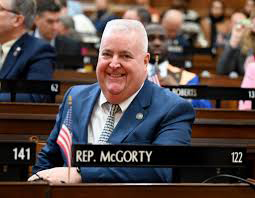
Ben McGorty
100% support rate
Top opponent
Craig Fishbein
0% support rate
Ranked legislators
10
5 support · 5 oppose
Key legislators

Who's moving labor & employment in Connecticut

Legislators moving labor & employment in Connecticut
Legislator Party Stance Support rate Decisive votes
Ben McGorty
Ben McGorty House · District 122
R
Strong +
100% 8
Steve Stafstrom
Steve Stafstrom House · District 129
D
Strong +
100% 5
John Kissel
John Kissel Senate · District 7
R
Strong +
89% 9
Al Paolillo
Al Paolillo House · District 97
D
Strong +
88% 8
Bill Heffernan
Bill Heffernan House · District 115
D
Strong +
88% 8
Craig Fishbein
Craig Fishbein House · District 90
R
Strong −
0% 6
Donna Veach
Donna Veach House · District 30
R
Strong −
12% 8
John Piscopo
John Piscopo House · District 76
R
Strong −
12% 8
Karen Reddington-Hughes
Karen Reddington-Hughes House · District 66
R
Strong −
12% 8
Mark DeCaprio
Mark DeCaprio House · District 48
R
Strong −
12% 8
Showing 11–14 of 14 bills

All labor & employment bills

signed · Connecticut · House May 20, 2026

HB 5143: AN ACT REQUIRING TRAINING FOR HOMEMAKER-COMPANION AGENCY EMPLOYEES.

HB 5143 requires homemaker-companion agencies to provide mandatory training to their employees. New employees must complete 10 hours of initial training within 90 days of hire, covering topics like CPR, safety, abuse reporting, and dementia care. Existing employees must complete 10 hours of annual continuing education from a state-approved training list, and agencies must maintain records of all training for state review. This bill directly affects homemaker-companion agencies and their staff, aiming to improve service quality and client safety through standardized training.
signed · Connecticut · House May 11, 2026

HB 5003: AN ACT CONCERNING WORKFORCE DEVELOPMENT AND WORKING CONDITIONS IN THE STATE.

This bill requires healthcare facilities and schools to cover medical costs and pay full salary for staff injured during work-related assaults or aggressive incidents. It creates a system for reporting patient violence in digital health records (with patient appeal options) and ensures absences due to such incidents don’t count against paid leave. Directly affects healthcare workers, teachers, and school staff who face workplace violence while performing job duties.
passed · Connecticut · House Apr 29, 2026

HR 12: RESOLUTION PROPOSING APPROVAL OF AN AGREEMENT BETWEEN THE STATE OF CONNECTICUT AND THE STATE EMPLOYEES BARGAINING AGENT COALITION (SEBAC).

This bill approves a four-year agreement between the State of Connecticut and the State Employees Bargaining Agent Coalition covering approximately 42,000 state employees. The deal establishes a 2.5% general wage increase and annual increments for most workers from fiscal year 2026 through 2028, along with various other salary adjustments and benefits. The agreement includes a provision allowing for a renegotiation of wages in the final year, subject to specific conditions regarding delayed increments.
passed · Connecticut · House Mar 25, 2026

HR 4: RESOLUTION PROPOSING APPROVAL OF A TENTATIVE AGREEMENT BETWEEN THE STATE OF CONNECTICUT AND THE CONNECTICUT EMPLOYEES UNION INDEPENDENT, NP-2 BARGAINING UNIT (CEUI).

This bill proposes approval of a collective bargaining agreement between the State of Connecticut and the Connecticut Employees Union Independent, NP-2 Bargaining Unit, covering approximately 3,661 state employees who work in service, maintenance, repair, delivery, cleaning, and cooking roles at hospitals, campuses, airports, roads, bridges, and parks. The agreement establishes a four-year contract running from July 1, 2025, to June 30, 2029, that includes general wage increases of 2.5% and annual increments for the first three years, along with lump sum payments for certain employees and provisions for grade changes and differentials. The contract also includes a wage re-opener clause for the final year that allows for additional wage negotiations, with total estimated costs to state funds reaching approximately $45 million over the four-year period.
Showing 11 to 14 of 14 bills