

Better Care Better Jobs Act This bill establishes programs and provides funds for state Medicaid programs to improve home- and community-based services (HCBS), such as home health care, personal care, case management, and rehabilitative services. Specifically, the bill provides funds for the Centers for Medicare & Medicaid Services to award planning grants, develop quality measures, and provide technical assistance to states regarding specified HCBS improvements, particularly with respect to access, utilization, and the associated workforce. The bill also increases the Federal Medical Assistance Percentage (i.e., federal matching rate) for HCBS in states that develop plans and meet specified benchmarks for improvements. The bill also makes permanent (1) the Money Follows the Person Rebalancing Demonstration Program (a grant program to help states increase the use of HCBS for long-term care and decrease the use of institutional care), and (2) certain provisions regarding Medicaid eligibility that protect against spousal impoverishment for recipients of HCBS.
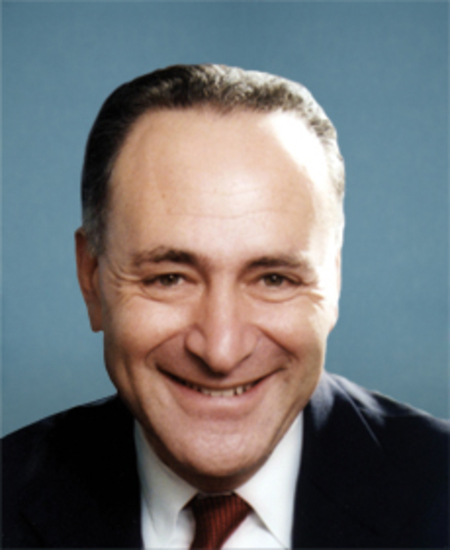
Sen. Charles E. Schumer
Sponsored bills
Washington, D.C. Admission Act This bill provides for admission into the United States of the state of Washington, Douglass Commonwealth, composed of most of the territory of the District of Columbia. The commonwealth shall be admitted to the Union on an equal footing with the other states. The Mayor of the District of Columbia shall issue a proclamation for the first elections to Congress of two Senators and one Representative of the commonwealth. The bill applies current District laws to the commonwealth and continues pending judicial proceedings. The commonwealth (1) shall consist of all District territory, with specified exclusions for federal buildings and monuments, including the principal federal monuments, the White House, the Capitol Building, the U.S. Supreme Court Building, and the federal executive, legislative, and judicial office buildings located adjacent to the Mall and the Capitol Building; and (2) may not impose taxes on federal property except as Congress permits. District territory excluded from the commonwealth shall be known as the Capital and shall be the seat of the federal government. The bill maintains the federal government's authority over military lands and specified other property. The bill provides for expedited consideration of a joint resolution repealing the Twenty-third Amendment to the Constitution, which provides for the appointment of electors of the President and Vice President. The bill continues certain federal authorities and responsibilities, including regarding employee benefits, agencies, courts, and college tuition assistance, until the commonwealth certifies that it is prepared to take over the authorities and responsibilities. The bill establishes the Statehood Transition Commission to advise the President, Congress, and District and commonwealth leaders on the transition.
Facilitating American-Built Semiconductors Act or the FABS Act This bill allows a new tax credit for investment in a semiconductor manufacturing facility and semiconductor manufacturing property.
This resolution condemns the recent rise in anti-Semitic violence and harassment targeting Jewish Americans. The resolution (1) recommits to combating anti-Semitism in all forms; and (2) calls on elected officials, faith leaders, and civil society leaders to denounce and combat all manifestations of anti-Semitism. The resolution urges the President to continue the leadership role of the United States in combating anti-Semitism internationally, advance accurate Holocaust education and counter Holocaust denial and distortion, ensure the physical security of Jewish institutions and organizations, and produce an analysis that accounts for the level and scope of the threat that anti-Semitism poses to the people of the United States. The resolution urges law enforcement agencies to fully participate in the data collection process of the Federal Bureau of Investigation to improve anti-Semitic hate crime data collection.
Refund Equality Act of 2021 This bill permits legally married same sex couples to amend their tax returns to file as married filing jointly for returns outside of the statute of limitations.
This resolution authorizes (1) Nicole Meservey, and any other current or former employee of Senator Mark Warner's office from whom relevant evidence may be necessary, to testify and produce documents in the case of United States v. Taylor (except concerning matters for which a privilege should be asserted); and (2) the Senate Legal Counsel to represent the Senator and any current or former employees of his office in connection with the case.
This resolution authorizes (1) Laura Bowen, and any other employee of the Senate Post Office from whom relevant evidence may be necessary, to testify and produce documents in the case of United States v. Dodd (except concerning matters for which a privilege should be asserted); and (2) the Senate Legal Counsel to represent any employees of such office in connection with the case.
This resolution expresses support for the rights, freedoms, and equal treatment of lesbian, gay, bisexual, transgender, and queer (LGBTQ) individuals. The resolution r ecognizes that LGBTQ rights are human rights and protected by the laws of the United States and international treaties. Additionally, the resolution encourages the celebration of LGBTQ Pride Month in June.
Clean Water For Military Families Act This bill requires the Department of Defense (DOD) to conduct investigations into releases of perfluoroalkyl and polyfluoroalkyl substances (PFAS) at or surrounding DOD installations located in the United States, formerly used defense sites, and state-owned facilities of the National Guard. PFAS are man-made and may have adverse human health effects. DOD must also conduct response actions relating to PFAS contamination at the mentioned locations if any detection of PFAS exceeds specified standards for contamination or DOD finds remediation to be appropriate to protect human health or the environment.
Women's Health Protection Act of 2021 This bill prohibits governmental restrictions on the provision of, and access to, abortion services. Specifically, governments may not limit a provider's ability to prescribe certain drugs, offer abortion services via telemedicine, or immediately provide abortion services when the provider determines a delay risks the patient's health. Furthermore, governments may not require a provider to perform unnecessary medical procedures, provide medically inaccurate information, comply with credentialing or other conditions that do not apply to providers whose services are medically comparable to abortions, or carry out all services connected to an abortion. In addition, governments may not (1) require patients to make medically unnecessary in-person visits before receiving abortion services or disclose their reasons for obtaining such services, or (2) prohibit abortion services before fetal viability or after fetal viability when a provider determines the pregnancy risks the patient's life or health. The bill also prohibits other governmental measures that are similar to the bill's specified restrictions or that otherwise single out and impede access to abortion services, unless a government demonstrates that the measure significantly advances the safety of abortion services or health of patients and cannot be achieved through less restrictive means. The Department of Justice, individuals, or providers may bring a lawsuit to enforce this bill, and states are not immune from suits for violations. The bill applies to restrictions imposed both prior and subsequent to the bill's enactment.